

[Apr 19, 2026] Reliable PK0-005 Exam Tips Test Pdf Exam Material
New 2026 PK0-005 Test Tutorial (Updated 448 Questions)
CompTIA PK0-005 certification exam is an industry-recognized certification that validates the essential knowledge and skills required for project managers. CompTIA Project+ Certification Exam certification exam helps candidates to enhance their career opportunities in the field of project management. CompTIA Project+ Certification Exam certification exam is designed to test the proficiency of candidates in the areas of project initiation, planning, execution, monitoring, and closing.
NEW QUESTION # 112
A project manager is in the process of evaluating the probability and impact of a risk by assigning numbers such as a monetary value. Which of the following is the project manager using?
- A. Monte Carlo simulation
- B. Quantitative risk analysis
- C. Risk response analysis
- D. Root cause analysis
Answer: B
Explanation:
Quantitative risk analysis involves numerically analyzing the effect of identified risks on overall project objectives. It often includes assigning monetary values to risks to understand their impact in financial terms, helping in prioritizing risks based on their potential cost or impact on the project. This contrasts with qualitative risk analysis, which assesses risks based on their probability and impact but does not assign numerical values.
References: CompTIA Project+ Study Guide, specifically the sections covering risk management processes and techniques.
NEW QUESTION # 113
A project manager just found out that the equipment vendor selected for a project is bankrupt. The process of selecting a new vendor and signing a contract will significantly delay the project schedule. Which of the following should the project manager do first?
- A. Perform a PERT analysis.
- B. Update the issue log.
- C. Start a new RFP immediately.
- D. Consult with the legal department.
Answer: B
Explanation:
Updating the issue log is the first step in documenting the problem and determining its impact on the project. This aligns with CompTIA Project+ guidelines, which emphasize the importance of tracking issues as they arise.
NEW QUESTION # 114
A stakeholder works in a remote location and has not been replying to emails. The Internet service in that location is intermittent, and the stakeholder prefers to be contacted by telephone. Which of the following artifacts should the project manager have prepared to avoid this situation?
- A. Risk registry
- B. Acceptable communication channels
- C. Staff directory
- D. Responsibility assignment matrix
Answer: B
Explanation:
Explanation
The project manager should have prepared acceptable communication channels to avoid the situation of a stakeholder not replying to emails due to intermittent Internet service. Acceptable communication channels are methods or modes of communication that are agreed upon by all parties involved in a project. They may include aspects such as email, phone call, text message, video conference, instant message, or face-to-face meeting. Acceptable communication channels can help to ensure that messages are delivered and received effectively and efficiently and that communication preferences and limitations are respected.
NEW QUESTION # 115
After new capabilities were deployed in a system, issues with preexisting capabilities were reported. Which of the following testing cycles should be used to prevent this issue?
- A. Performance testing
- B. Stress testing
- C. Unit testing
- D. User acceptance testing
Answer: C
Explanation:
Unit testing is a testing technique that verifies the functionality and quality of individual units or components of software, such as modules, classes, functions, etc. Unit testing can help prevent issues with preexisting capabilities by detecting and fixing errors at an early stage of development, before they affect the integration and system testing. Unit testing can also ensure that new capabilities do not break or interfere with the existing ones, by checking the compatibility and dependencies of the units. Unit testing can be performed by developers using tools and frameworks that automate the process and generate reports. References = CompTIA Project+ PK0-005 Certification Study Guide, Chapter 10: Project Quality Management; CompTIA Project+ Certification Exam Objectives, Domain 3: Project Execution, Objective 3.2: Execute quality management activities.
NEW QUESTION # 116
Given the following velocity chart: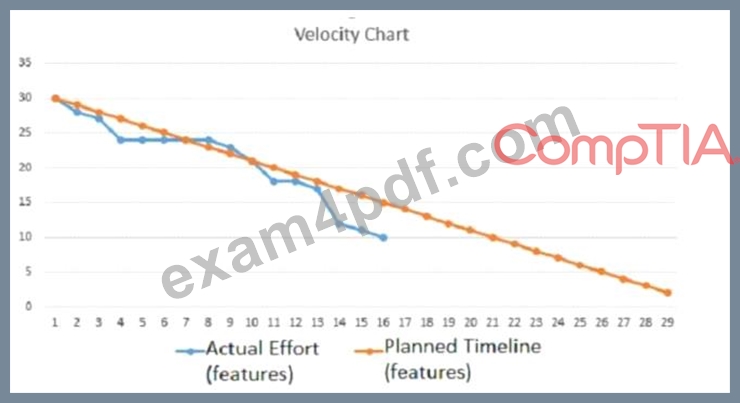
Which of the following updates on the project status should the Scrum master provide to the senior management team?
- A. The project deviated from the critical path.
- B. The project has scope creep.
- C. The project is trending ahead of schedule.
- D. The project utilized all of its available reserve.
Answer: C
Explanation:
A velocity chart is a tool used in agile project management to track the progress and performance of a project team over time. It shows the number of features or user stories completed in each iteration or sprint. The planned timeline line represents the expected or ideal velocity, while the actual effort line shows the actual or achieved velocity. By comparing the two lines, the Scrum master can identify any gaps, trends, or issues in the project delivery.
Based on the image, the most likely update that the Scrum master can provide to the senior management team is D. The project is trending ahead of schedule. This is because the actual effort line is above the planned timeline line for most of the time, indicating that the project team is completing more features than expected in each sprint. This means that the project is ahead of schedule and has a positive velocity variance.
NEW QUESTION # 117
Which of the following BEST identifies the intent and purpose of a project closeout report?
- A. To provide documentation of lessons learned
- B. To release resources and terminate all access rights
- C. To document variances from the initial project baseline
- D. To validate that a project has been successfully completed
Answer: D
Explanation:
To validate that a project has been successfully completed. The intent and purpose of a project closeout report is to validate that a project has been successfully completed and to summarize the goals, objectives, and outcomes of the project, as well as the lessons learned and the feedback from stakeholders. A project closeout report is a document that is submitted at the end of a project to officially conclude it and release the resources and contracts involved. It is useful for evaluating the project's success and improving the performance of future projects12
NEW QUESTION # 118
A new project manager was assigned to a project during the execution phase. The project manager discovers a lot of potential areas that may prevent the project from completing deliverables Which of the following should the project manager do first?
- A. Review the project risk register.
- B. Meet with stakeholders to discuss concerns.
- C. Add the potential blockers to the issues list.
- D. Update the defect tracker.
Answer: A
NEW QUESTION # 119
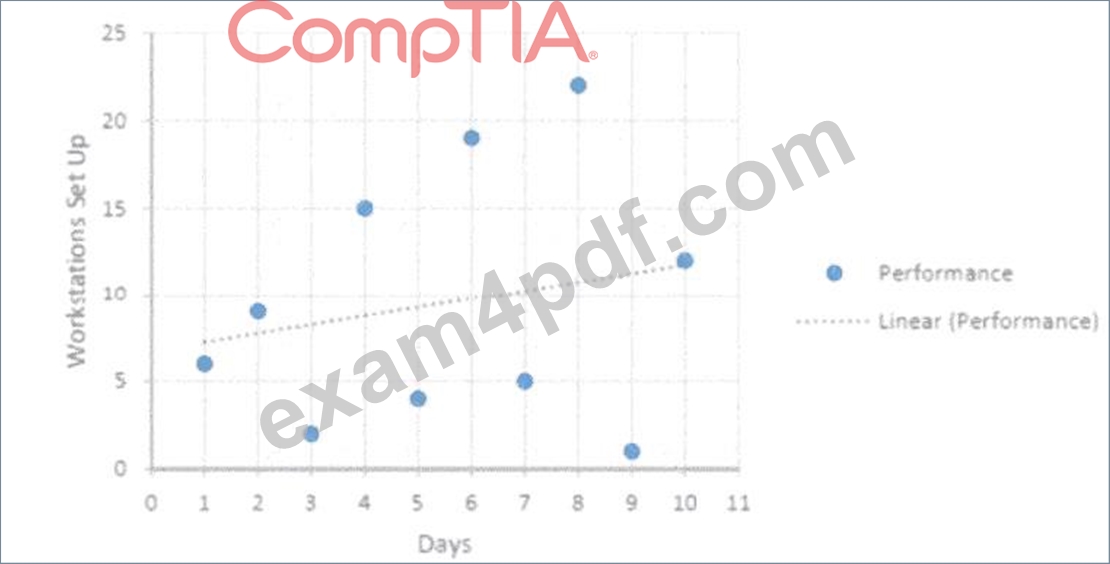
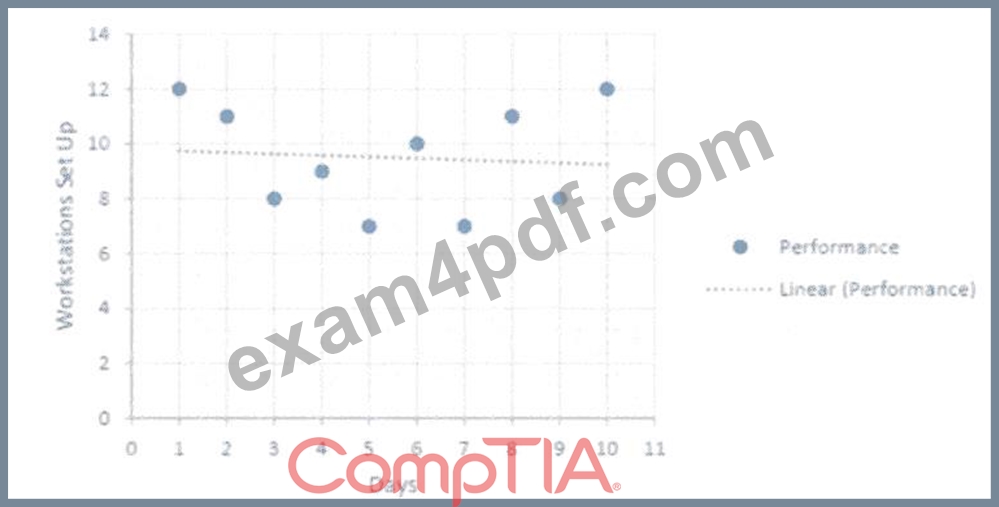
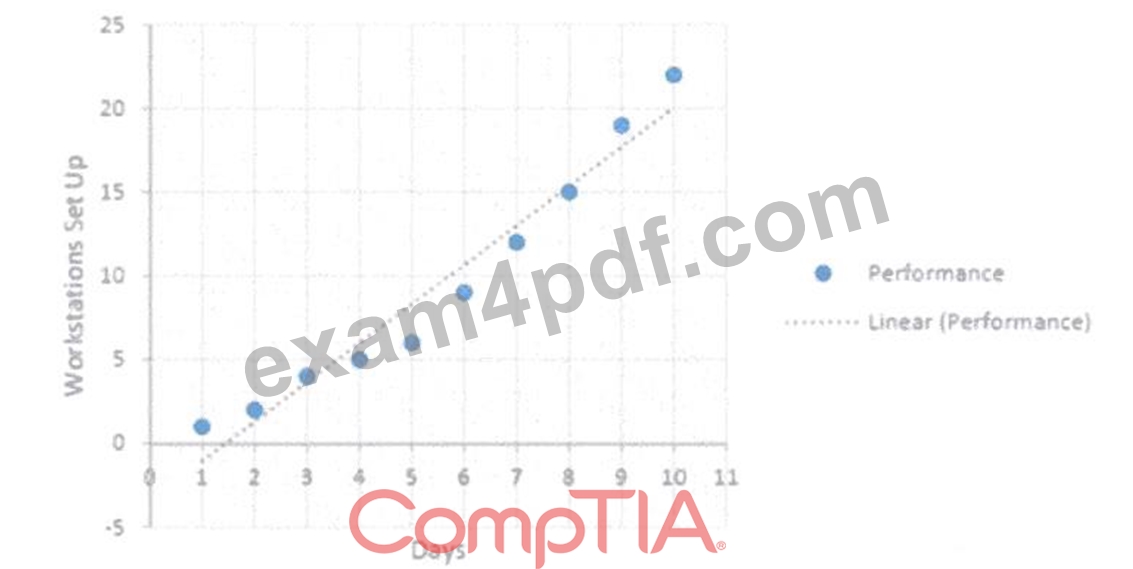
An IT intern was assigned to set up workstations as part of a project. The IT intern was very careful to do the task well and initially referred to notes while performing the task. By the end of the two-week rotation, the IT intern no longer needed the notes and completed more set-ups in less time. Which of the following MOST likely represents the observed relationship in this scenario?
- A.
- B.
- C.
Answer: B
Explanation:
Option C shows a graph that most likely represents the observed relationship in this scenario. The graph shows a learning curve, which is a graphical representation of the relationship between a learner's performance on a task and the number of attempts or time required to complete the task. The learning curve theory proposes that a learner's efficiency in a task improves over time the more the learner performs the task. In this case, the IT intern was able to complete more set-ups in less time as they gained more experience and proficiency over the two-week rotation12
NEW QUESTION # 120
A new project team started work three months ago. The team members are increasing their work productivity and are comfortable asking for help with tasks. Which of the following describes the current stage of the project team?
- A. Adjourning
- B. Performing
- C. Norming
- D. Forming
Answer: C
Explanation:
The current stage of the project team is norming, which is the third stage of the five stages of team development. In this stage, the team members have resolved their conflicts and differences, and have established a sense of cohesion and collaboration. They are more productive, supportive, and cooperative, and they follow the agreed norms and rules of the team. They also communicate effectively and seek feedback and assistance from each other. The norming stage is preceded by the forming stage, where the team members get to know each other and the project goals, and the storming stage, where the team members experience disagreements and challenges. The norming stage is followed by the performing stage, where the team members work efficiently and autonomously towards the project outcomes, and the adjourning stage, where the team members complete the project and celebrate their achievements. References = CompTIA Project+ Study Guide: Exam PK0-005, 3rd Edition, Chapter 11: Team Management1; CompTIA Project+ Certification Study Guide, 3rd Edition, Chapter 11: Team Management2; The 5 Stages of Team Development (Including Examples)3
NEW QUESTION # 121
A software development team completed the development and testing of a new accounting software system for a client. Which of the following should the team do next?
- A. User acceptance testing
- B. Performance testing
- C. Audits and inspections
- D. Unit testing
Answer: A
Explanation:
Comprehensive and Detailed Step-by-Step
User acceptance testing (UAT) is the final phase of the testing process where the client or end users validate that the software meets their needs. Since development and testing have already been completed, UAT is the next logical step before deployment.
Reference:
CompTIA Project+ PK0-005 Official Study Guide, Chapter 9: Testing and Quality Assurance
NEW QUESTION # 122
A project sponsor has asked for a log listing all the bugs identified within a specific project. Which of the following tools should the project manager provide to the sponsor?
- A. Defect log
- B. Risk register
- C. Issue log
- D. Change log
Answer: A
Explanation:
A defect log specifically tracks bugs, errors, or defects discovered in the product. It includes descriptions, severity, and resolution. Issue logs capture broader non-technical challenges, while change logs and risk registers serve different purposes.
Reference: CompTIA Project+ PK0-005 - Logs & Registers
NEW QUESTION # 123
Although a project was successfully released into production a month ago, a project manager continues to receive project-related work. Which of the following is the reason for this issue?
- A. The project manager did not remove access.
- B. The project is in the verification testing phase.
- C. The project manager did not complete the project closure phase.
- D. The project manager did not release the resources.
Answer: C
Explanation:
If a project manager continues to receive project-related work after the project has been released into production, it suggests that the project closure phase was not completed properly. The project closure phase involves several activities, including ensuring that all project deliverables are accepted, documenting the lessons learned, releasing project resources, and formally closing the project. If these activities are not completed, the project can remain 'open' in a sense, leading to continued work and inquiries.
Reference = The answer is based on standard project management practices and the importance of the project closure phase as described in project management literature. For detailed information, please refer to the CompTIA Project+ Study Guide and other official CompTIA resources. Specific references to the closure phase can be found in the CompTIA Project+ PK0-005 Cert Guide1 and the CompTIA Project+ Certification Exam Objectives2.
NEW QUESTION # 124
Given the following information: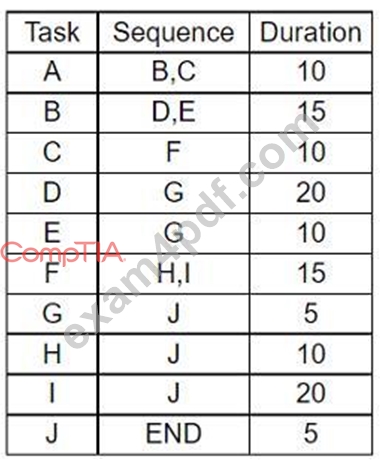
Which of the following represents the critical path of the project?
- A. A-C-F-I-J
- B. A-B-D-G-J
- C. A-B-E-G-J
- D. A-C-F-H-J
Answer: B
Explanation:
The critical path of the project is the longest sequence of tasks that must be completed on time for the project to finish on schedule. It determines the shortest possible duration of the project and shows the tasks that have no slack or float. Any delay in the critical path tasks will affect the project completion date. To find the critical path, we need to calculate the earliest start (ES), earliest finish (EF), latest start (LS), latest finish (LF), and slack (S) for each task. We can use the table and the network diagram given in the question to do this.
The formula for calculating the slack is S = LF - EF or S = LS - ES. A task with zero slack is on the critical path. The calculations are as follows:
Task | Duration | ES | EF | LS | LF | S A | 10 | 0 | 10 | 0 | 10 | 0 B | 15 | 10 | 25 | 10 | 25 | 0 C | 10 | 10 | 20 | 15 |
25 | 5 D | 20 | 25 | 45 | 25 | 45 | 0 E | 10 | 25 | 35 | 35 | 45 | 10 F | 15 | 20 | 35 | 30 | 45 | 10 G | 5 | 45 | 50 | 45 | 50
| 0 H | 10 | 35 | 45 | 40 | 50 | 5 I | 20 | 35 | 55 | 30 | 50 | -5 J | 5 | 50 | 55 | 50 | 55 | 0 Based on the table, we can see that the tasks with zero slack are A, B, D, G, and J. Therefore, the critical path is A-B-D-G-J, which has a total duration of 55 days. The other options are not the correct critical paths, as they either include tasks with positive slack (such as C, E, F, and H) or have a longer duration than 55 days (such as A-C-F-I-J).
NEW QUESTION # 125
A contractor attended a project meeting that was exclusively for company employees. Which of the following
actions should the PM take?
- A. Reinforce the rules of engagement.
- B. Consult the request for proposal.
- C. Escalate to vendor management.
- D. Review the meeting cadence.
Answer: A
Explanation:
The rules of engagement are the guidelines and expectations that define the relationship between the contractor
and the company. They may include topics such as communication, confidentiality, access, security,
performance, and compliance. The project manager should reinforce the rules of engagement with the
contractor to ensure that they understand and respect the boundaries and protocols of the company. This will
help to avoid any potential conflicts, misunderstandings, or breaches of contract. References = CompTIA
Project+ Study Guide: Exam PK0-005, 3rd Edition, Chapter 7: Project Stakeholder Management, p. 239;
Contractor Rules of Engagement - Cox Enterprises, p. 1; Legal Considerations for Engaging Contractors |
LegalVision
NEW QUESTION # 126
During a gate review meeting, the deliverable was rejected by the customer.
INSTRUCTIONS
Review the dashboard.
* Part 1: Drag and drop each task, placing them in the correct order based on the project change control process.
* Part 2: Select the proper document(s) to be updated.
If at any time you would like to bring back the initial state of the simulation, please click the Reset All button.
Part 1: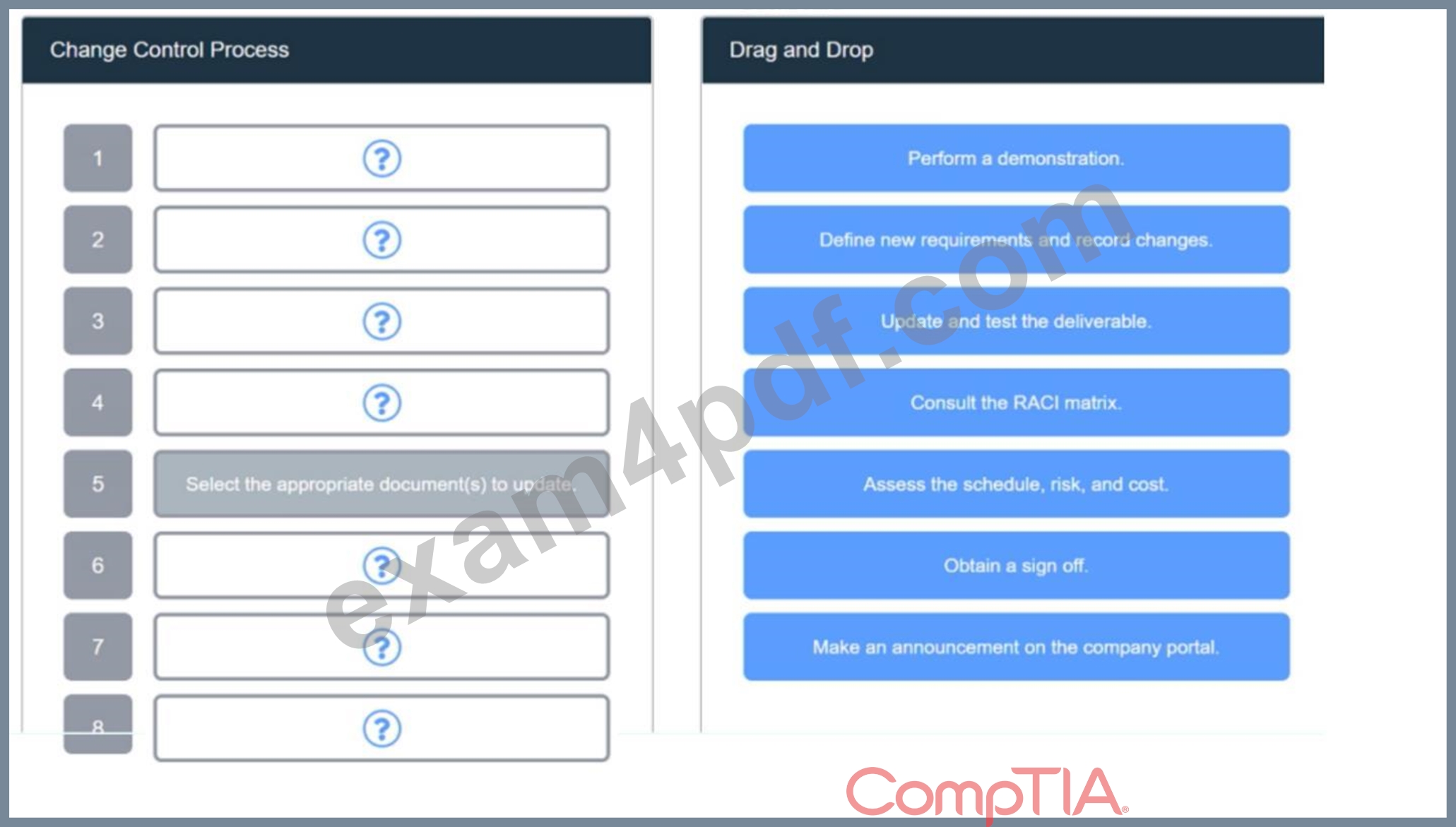
Part 2: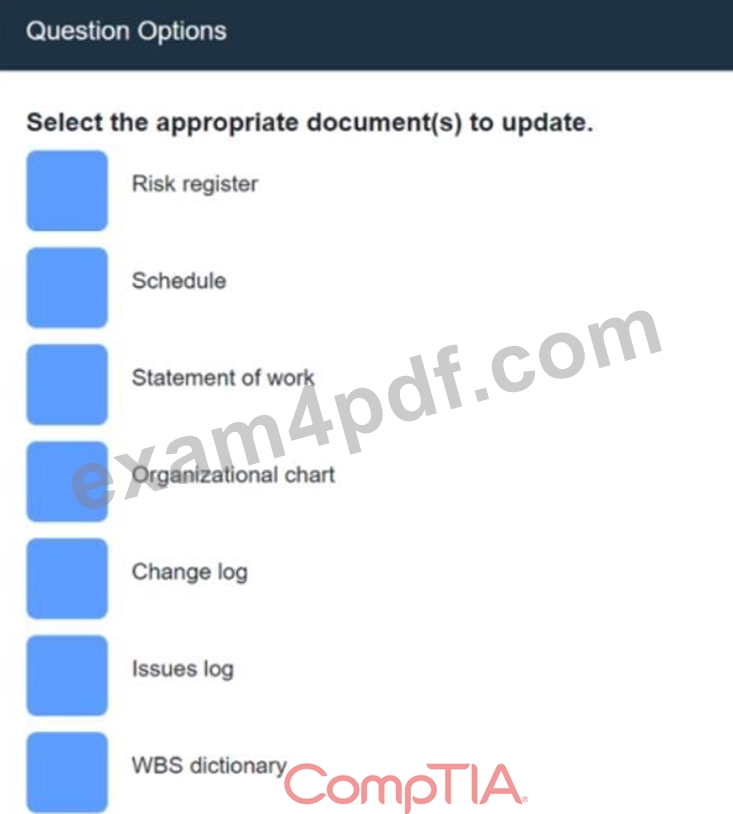
Answer:
Explanation:
See the Explanation for the solution.
Explanation
Part 1:
Change Control Process:
* Consult the RACI matrix.
* Define new requirements and record changes.
* Assess the schedule, risk, and cost.
* Perform a demonstration.
* Obtain a sign off.
* Update and test the deliverable.
* Make an announcement on the company portal.
The change control process is a sequence of steps that helps to manage and document any changes or modifications to a project scope, schedule, cost, quality, or resources. The change control process typically involves the following steps:
* Consult the RACI matrix. A RACI matrix is a tool that defines and clarifies the roles and responsibilities of each team member for each task or activity in a project. RACI stands for responsible, accountable, consulted, and informed. Consulting the RACI matrix can help to identify who needs to be involved or informed about the change request and how to communicate with them.
* Define new requirements and record changes. The new requirements and changes are the details of what needs to be modified or added to the project deliverables or objectives based on the customer feedback or request. Defining and recording the new requirements and changes can help to communicate and justify the need and rationale for the change and its implications on the project scope and quality.
* Assess the schedule, risk, and cost. The schedule, risk, and cost are the aspects of the project that may be affected by the change request. Assessing the schedule, risk, and cost can help to determine the impact and feasibility of the change and identify any possible alternatives or corrective actions to minimize or avoid its negative effects.
* Perform a demonstration. A demonstration is a presentation or show of how the modified or updated deliverable works or meets the customer expectations or requirements. Performing a demonstration can help to validate and verify that the change request has been implemented correctly and effectively and to obtain feedback or approval from the customer or stakeholders.
* Obtain a sign off. A sign off is a formal acceptance and approval of the change request and its deliverables from the customer or stakeholders. Obtaining a sign off can help to confirm that the change request has been completed successfully and satisfactorily and to close the change control process.
* Update and test the deliverable. The deliverable is the product or service that is produced or provided by the project. Updating and testing the deliverable can help to ensure that it meets the quality standards and criteria and that it works as expected after implementing the change request.
* Make an announcement on the company portal. The company portal is a platform or channel that allows internal communication and collaboration among employees within an organization. Making an announcement on the company portal can help to inform and update other team members or departments about the change request and its outcomes and to share any lessons learned or best practices from the change control process.
Part2:
* Risk register: A risk register is a document that identifies, analyzes, and records the potential risks or
* uncertainties that may affect a project. Updating the risk register can help to capture any new or modified risks that may arise from the change request and to plan and implement appropriate risk responses.
* Schedule:A schedule is a document that shows the planned start and end dates, durations, dependencies, and progress of each task or activity in a project. Updating the schedule can help to reflect any changes or adjustments to the project timeline or milestones that may result from the change request and to monitor and control the project performance and delivery.
* Statement of work:A statement of work (SOW) is a document that defines the scope, deliverables, schedule, and terms and conditions of a project or contract. Updating the SOW can help to document any changes or additions to the project scope or deliverables that may be requested or agreed upon by the customer or stakeholders and to ensure alignment and agreement on what needs to be done and how it will be done.
* Change log:A change log is a document that tracks and records any changes or modifications that are made to the project scope, schedule, cost, quality, or resources during a project. Updating the change log can help to document the change request, approval, implementation, and impact of each change and ensure traceability and transparency.
NEW QUESTION # 127
Which of the following best describes a manufacturer's obligation to repair or change, without extra costs, any
part of a product that is not functioning?
- A. Service-level agreement
- B. Audit
- C. Warranty period
- D. Functional testing
Answer: C
Explanation:
A warranty period is the time during which a manufacturer or seller agrees to repair or replace a product that is
defective or does not meet the specified standards. A warranty period can be expressed in terms of duration
(e.g., one year) or usage (e.g., 10,000 miles). A warranty period is a form of consumer protection that obliges
the manufacturer or seller to bear the costs of repairing or changing any part of the product that is not
functioning properly1.
NEW QUESTION # 128
A team currently has a schedule for each sprint that changes after every iteration. The team wants to set up a repeatable schedule that would create a consistent flow of tasks and deliverables after each iteration. Which of the following should be established to best meet this goal?
- A. Task log
- B. Work breakdown structure
- C. Milestones
- D. Cadence
Answer: D
Explanation:
Establishing a cadence means setting a consistent schedule for iterations, enhancing predictability and efficiency in agile environments. This aligns with CompTIA Project+ recommendations for establishing a rhythm in project cycles.
NEW QUESTION # 129
In the initiation phase, a PM is reviewing the objectives, the high-level requirements, the success criteria, and
the budget resources. Which of the following action items will benefit from this analysis?
- A. Establishing communication channels
- B. Developing a RACI
- C. Assigning project resources
- D. Identifying and assessing stakeholders
Answer: D
Explanation:
Identifying and assessing stakeholders is an action item that will benefit from the analysis of the objectives,
the high-level requirements, the success criteria, and the budget resources in the initiation phase. By reviewing
these elements, the PM can determine who are the key individuals or groups that have an interest or influence
in the project, what are their expectations and needs, and how to engage them effectively throughout the
project life cycle12.
NEW QUESTION # 130
......
PK0-005 Cert Guide PDF 100% Cover Real Exam Questions: https://www.exam4pdf.com/PK0-005-dumps-torrent.html
PK0-005 Exam Questions Dumps, Selling CompTIA Products: https://drive.google.com/open?id=1zGJ7T79S6jzyTAZPqDkjRKGTW4-Se_Hj
