

[Aug 01, 2026] Valid MD-102 Test Answers Full-length Practice Certification Exams
Accurate & Verified 2026 New MD-102 Answers As Experienced in the Actual Test!
Microsoft MD-102 Exam Syllabus Topics:
| Topic | Details |
|---|---|
| Topic 1 |
|
| Topic 2 |
|
| Topic 3 |
|
| Topic 4 |
|
NEW QUESTION # 155
You have a Microsoft 365 subscription that contains the devices shown in the following table.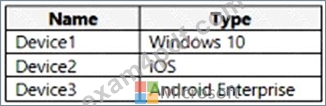
You need to ensure that only devices running trusted firmware or operating system builds can access network resources.
Which compliance policy setting should you configure for each device? To answer, drag the appropriate settings to the correct devices. Each setting may be used once, more than once, or not at all. You may need to drag the split bar between panes or scroll to view content.
NOTE:Each correct selection is worth one point.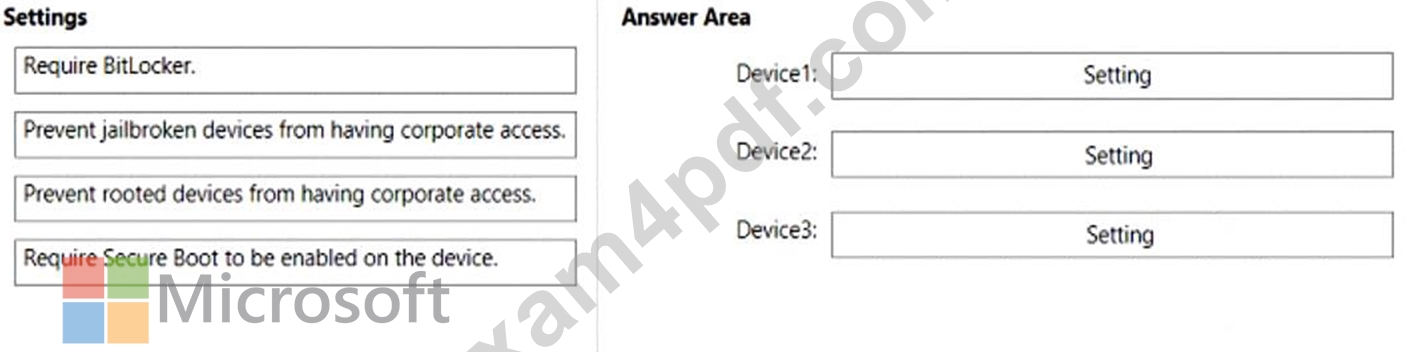
Answer:
Explanation: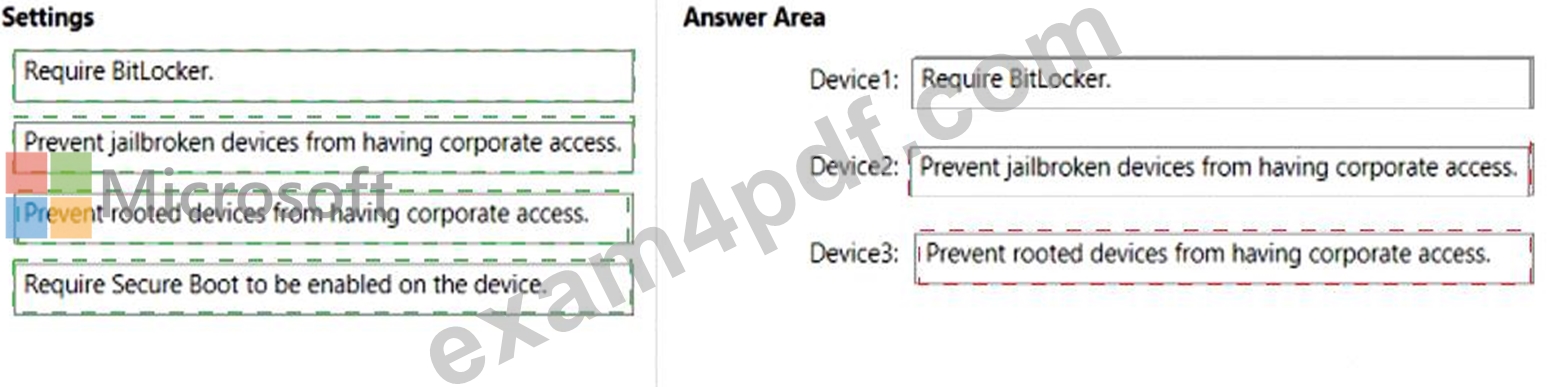
Explanation:
Box 1:
Device Compliance settings for Windows 10/11 in Intune
There are the different compliance settings you can configure on Windows devices in Intune. As part of your mobile device management (MDM) solution, use these settings to require BitLocker, set a minimum and maximum operating system, set a risk level using Microsoft Defender for Endpoint, and more.
Note: Windows Health Attestation Service evaluation rules
Require BitLocker:
Windows BitLocker Drive Encryption encrypts all data stored on the Windows operating system volume.
BitLocker uses the Trusted Platform Module (TPM) to help protect the Windows operating system and user data. It also helps confirm that a computer isn't tampered with, even if its left unattended, lost, or stolen. If the computer is equipped with a compatible TPM, BitLocker uses the TPM to lock the encryption keys that protect the data. As a result, the keys can't be accessed until the TPM verifies the state of the computer.
Not configured (default) - This setting isn't evaluated for compliance or non-compliance.
Require - The device can protect data that's stored on the drive from unauthorized access when the system is off, or hibernates.
Box 2: Prevent jailbroken devices from having corporate access
Device Compliance settings for iOS/iPadOS in Intune
There are different compliance settings you can configure on iOS/iPadOS devices in Intune. As part of your mobile device management (MDM) solution, use these settings to require an email, mark rooted (jailbroken) devices as not compliant, set an allowed threat level, set passwords to expire, and more.
Device Health
Jailbroken devices
Supported for iOS 8.0 and later
Not configured (default) - This setting isn't evaluated for compliance or non-compliance.
Block - Mark rooted (jailbroken) devices as not compliant.
Box 3: Prevent rooted devices from having corporate access.
Device compliance settings for Android Enterprise in Intune
There are different compliance settings you can configure on Android Enterprise devices in Intune. As part of your mobile device management (MDM) solution, use these settings to mark rooted devices as not compliant, set an allowed threat level, enable Google Play Protect, and more.
Device Health - for Personally-Owned Work Profile
Rooted devices
Not configured (default) - This setting isn't evaluated for compliance or non-compliance.
Block - Mark rooted devices as not compliant.
Reference:https://docs.microsoft.com/en-us/mem/intune/protect/compliance-policy-create-windows
https://docs.microsoft.com/en-us/mem/intune/protect/compliance-policy-create-android-for-work
https://docs.microsoft.com/en-us/mem/intune/protect/compliance-policy-create-ios
NEW QUESTION # 156
Your network contains an Active Directory domain.
You deploy a Microsoft Entra tenant.
Another administrator configures the domain to synchronize to the Microsoft Entra tenant.
You discover that 10 user accounts in an organizational unit (OU) are NOT synchronized to the Microsoft Entra tenant. All the other user accounts synchronized successfully.
You review Microsoft Entra Connect Health and discover that all the user account synchronizations completed successfully.
You need to ensure that the 10 user accounts are synchronized to the Microsoft Entra tenant.
Solution: From the Synchronization Rules Editor, you create a new outbound synchronization rule.
Does this meet the goal?
- A. Yes
- B. No
Answer: A
NEW QUESTION # 157
You have a Microsoft 365 subscription that uses Microsoft Intune and contains the users shown in the following table.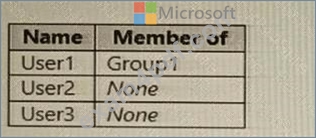
You create a policy set named Set1 as shown in the exhibit. (Click the Exhibit tab.)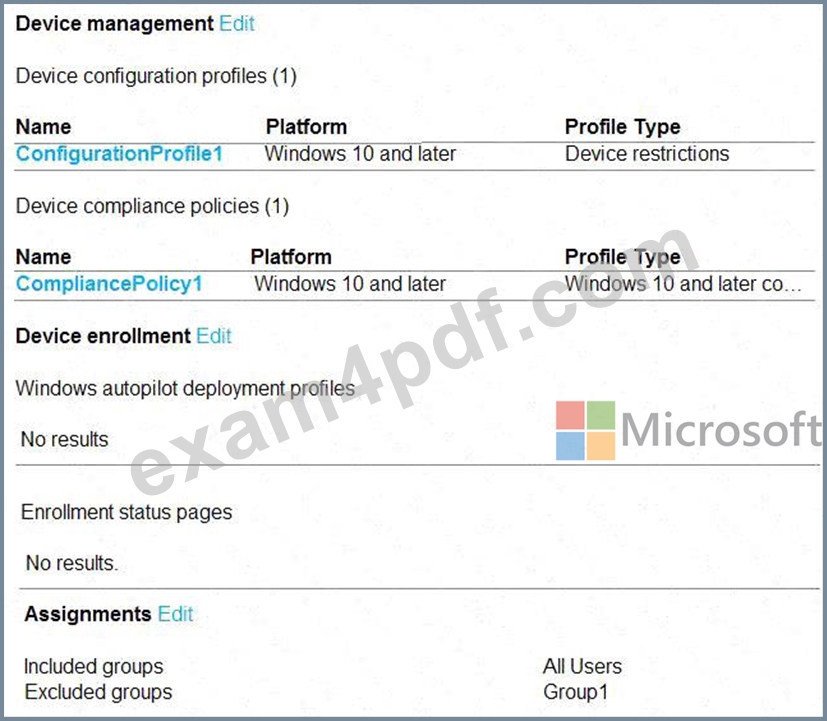
You enroll devices in Intune as shown in the following table.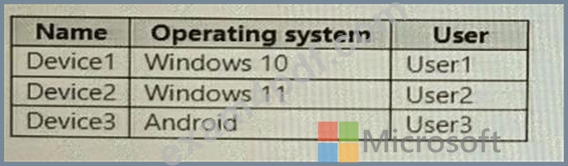
For each of the following statements, select Yes if the statement is true. Otherwise, select No.
NOTE: Each correct selection is worth one point.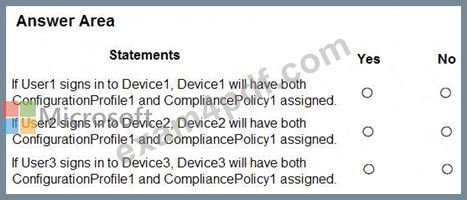
Answer:
Explanation: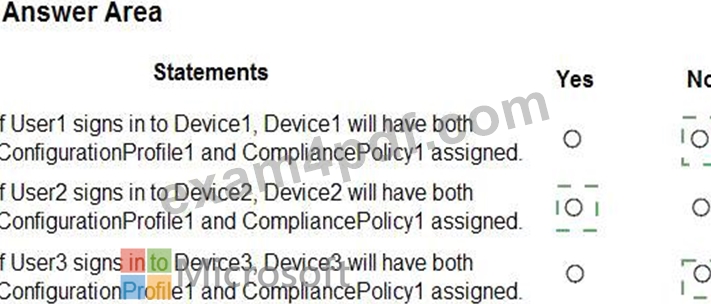
Explanation: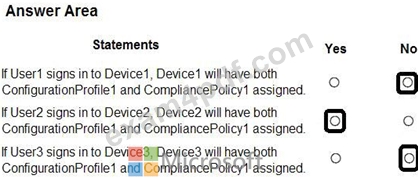
NEW QUESTION # 158
You have a computer named Computed that has Windows 10 installed.
You create a Windows PowerShell script named config.psl.
You need to ensure that config.psl runs after feature updates are installed on Computer5.
Which file should you modify on Computer5?
- A. SetupConfig.ini
- B. Unattend.xml
- C. LiteTouch.wsf
- D. Unattendb*
Answer: A
Explanation:
SetupConfig.ini is a file that can be used to customize the behavior of Windows Setup during feature updates. You can use this file to specify commands or scripts that run before or after the installation process. To run a PowerShell script after a feature update, you can use the PostOOBE parameter in SetupConfig.ini and specify the path to the script file. Reference: [SetupConfig.ini reference]
NEW QUESTION # 159
You have a Microsoft Deployment Toolkit (MDT) deployment share named DS1.
in the Out-of-Box Drivers node, you create folders that contain drivers for different hardware models.
You need to configure the Inject Drivers MDT task to use PnP detection to install the drivers for one of the hardware models.
What should you do first?
- A. Create a selection profile.
- B. Add a Gather task to the task sequence.
- C. Add a Validate task to the task sequence.
- D. Import an OS package.
Answer: A
NEW QUESTION # 160
You have a Microsoft 365 E5 subscription that contains the users shown in the following table.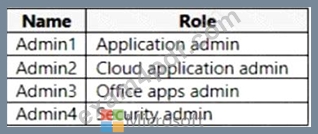
In the Microsoft 365 Apps admin center, you create a Microsoft Office customization.
Which users can download the Office customization file from the admin center?
- A. Admin3 only
- B. Admin1, Admin2, Admin3. and Admin4
- C. Admin1, Admin2, and Admin3 only
- D. Admin3 and Admin4 only
- E. Admin1 and Admin3 only
Answer: C
Explanation:
Explanation
* Admin1
An application admin has full access to enterprise applications, applications registrations, and application proxy settings.
* Admin2
Mark your app as publisher verified.
In Azure AD this user must be a member of one of the following roles: Application Admin, Cloud Application Admin, or Global Admin.
* Admin3
Office Apps admin - Assign the Office Apps admin role to users who need to do the following:
- Use the Office cloud policy service to create and manage cloud-based policies for Office
- Create and manage service requests
- Manage the What's New content that users see in their Office apps
- Monitor service health
Reference:
Office Apps admin - Assign the Office Apps admin role to users who need to do the following
https://docs.microsoft.com/en-us/azure/active-directory/develop/mark-app-as-publisher-verified
NEW QUESTION # 161
You have a Microsoft 365 E5 subscription. The subscription contains 25 computers that run Windows 11 and are enrolled in Microsoft Intune. You need to onboard the devices to Microsoft Defender for Endpoint. What should you create in the Microsoft Intune admin center?
- A. an endpoint detection and response (EDR) policy
- B. a security baseline
- C. an attack surface reduction (ASR) policy
- D. an account protection policy
- E. an antivirus policy
Answer: A
Explanation:
To onboard the devices to Microsoft Defender for Endpoint, you need to create an endpoint detection and response (EDR) policy in the Microsoft Intune admin center. This policy enables EDR capabilities on devices that are enrolled in Intune and allows you to configure various settings for EDR functionality. You can then assign the policy to groups of users or devices. Reference: https://docs.microsoft.com/en-us/mem/intune/protect/edr-windows
NEW QUESTION # 162
You have devices enrolled in Microsoft Intune as shown in the following table.
Intune includes the device compliance policies shown in the following table.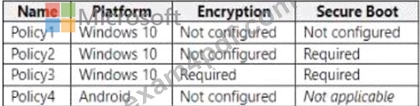
The device compliance policies have the assignments shown in the following table.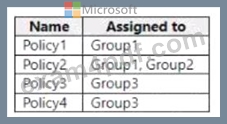
For each of the following statements, select Yes if the statement is true. Otherwise, select No. NOTE: Each correct selection is worth one point.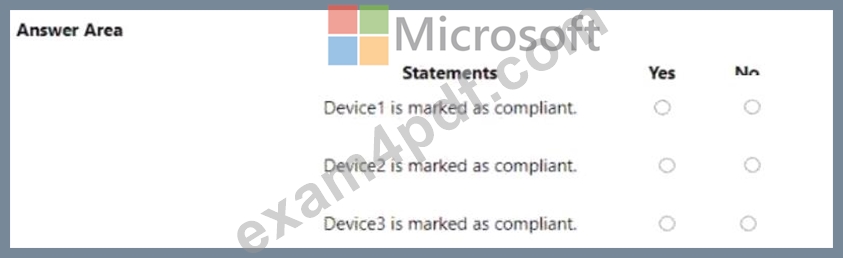
Answer:
Explanation: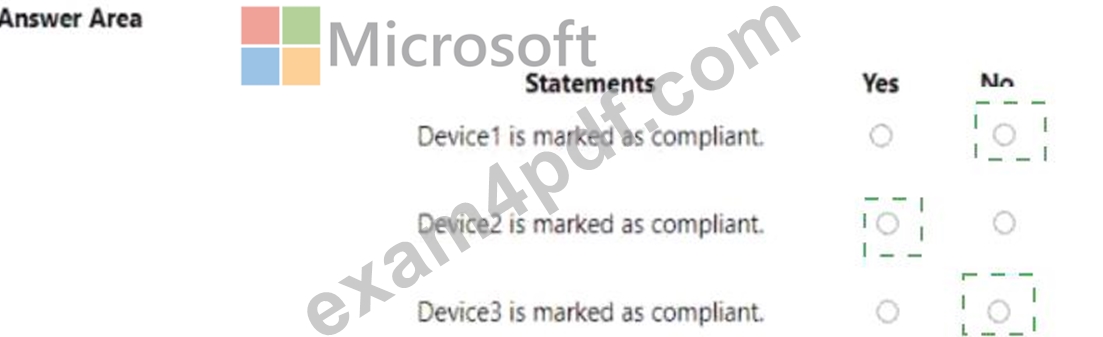
Explanation:
Device1 is marked as compliant = No Device2 is marked as compliant = Yes Device3 is marked as compliant
= No
* Device1 is marked as noncompliant because it does not meet the minimum OS version requirement of Policy1, which is 11.0.0. Device1 has an OS version of 10.0.0, which is lower than the required version1.
* Device2 is marked as compliant because it meets all the requirements of Policy2, which are: minimum OS version of 10.0.0, password required, and encryption enabled. Device2 has an OS version of 11.0.0, a password set, and encryption enabled1.
* Device3 is marked as noncompliant because it does not meet the encryption requirement of Policy3, which is enabled. Device3 has encryption disabled1.
NEW QUESTION # 163
Your network contains an Active Directory domain. The domain contains 10 computers that run Windows 10. Users in the finance department use the computers.
You have a computer named Computer1 that runs Windows 10.
From Computer1, you plan to run a script that executes Windows PowerShell commands on the finance department computers.
You need to ensure that you can run the PowerShell commands on the finance department computers from Computer.
What should you do on the finance department computers?
- A. From the local Group Policy, enable the Turn on Script Execution setting.
- B. From Windows PowerShell, run the Enable-PSRemoting cmdlet.
- C. From Windows PowerShell, run the Enable-MMAgent cmdlet.
- D. From the local Group Policy, enable the Allow Remote Shell Access setting.
Answer: B
Explanation:
Enable-PSRemoting is specifically designed to enable remote PowerShell access. This cmdlet configures the necessary settings on the target computers to allow remote PowerShell connections. The other options are not directly related to enabling remote PowerShell: Enable-MMAgent is used for managing mobile devices. The "Allow Remote Shell Access" group policy setting is primarily for enabling remote access for command prompt (cmd.exe), not PowerShell. The "Turn on Script Execution" group policy setting controls whether scripts can run locally on a computer, but it doesn't enable remote PowerShell access. By running Enable-PSRemoting on the finance department computers, you'll ensure that they are ready to receive and execute PowerShell commands from Computer1.
NEW QUESTION # 164
You have an Azure AD group named Group1. Group! contains two Windows 10 Enterprise devices named Device1 and Device2. You create a device configuration profile named Profile1. You assign Profile! to Group1. You need to ensure that Profile! applies to Device1 only. What should you modify in Profile 1?
- A. Settings
- B. Assignments
- C. Scope (Tags)
- D. Applicability Rules
Answer: D
Explanation:
To ensure that Profile1 applies to Device1 only, you need to modify the Applicability Rules in Profile1. You can use applicability rules to filter which devices receive a profile based on criteria such as device model, manufacturer, or operating system version. You can create an applicability rule that matches Device1's properties and excludes Device2's properties. References:
https://docs.microsoft.com/en-us/mem/intune/configuration/device-profile-assign#applicability-rules
NEW QUESTION # 165
Your network contains an on-premises Active Directory Domain Services (AD DS) domain that syncs with an Azure AD tenant. The tenant contains the users shown in the following table.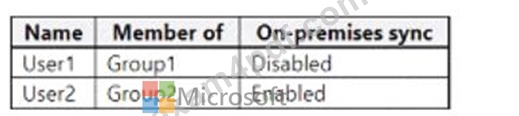
You assign Windows 10/11 Enterprise E5 licenses to Gtoup1 and Uset2.
You deploy the devices shown in the following table.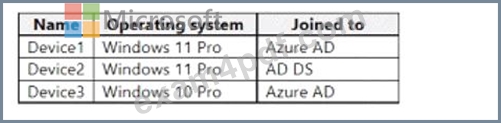
For each of the following statements, select Yes if the statement is true. Otherwise, select No.
NOTE: Each correct selection is worth one point.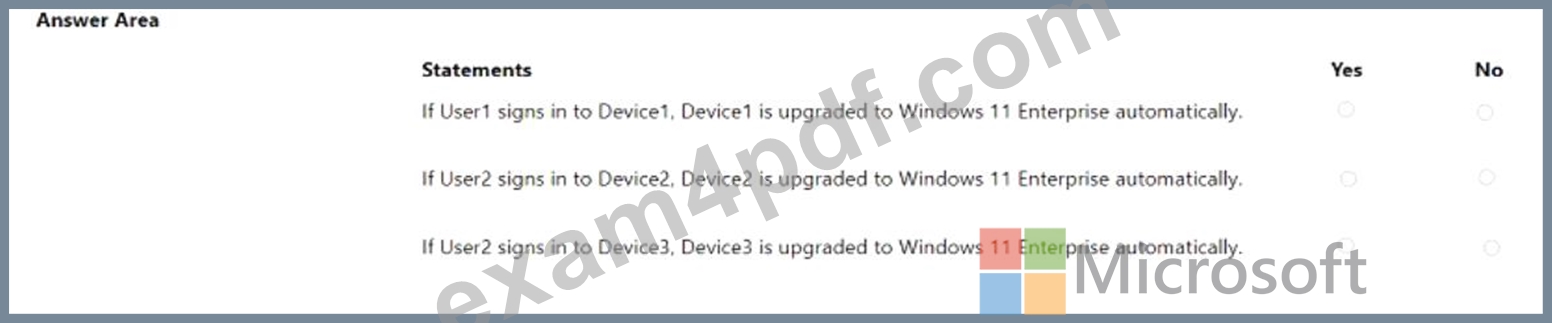
Answer:
Explanation: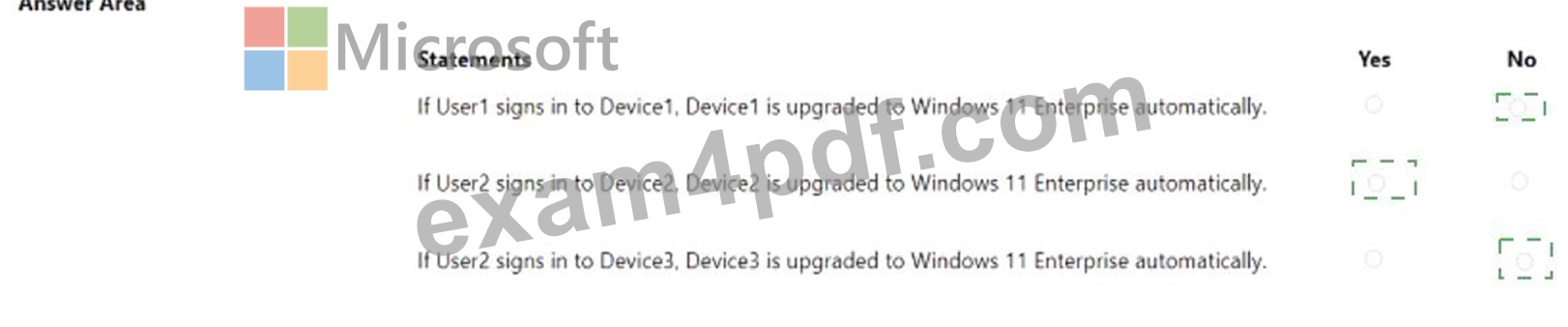
Explanation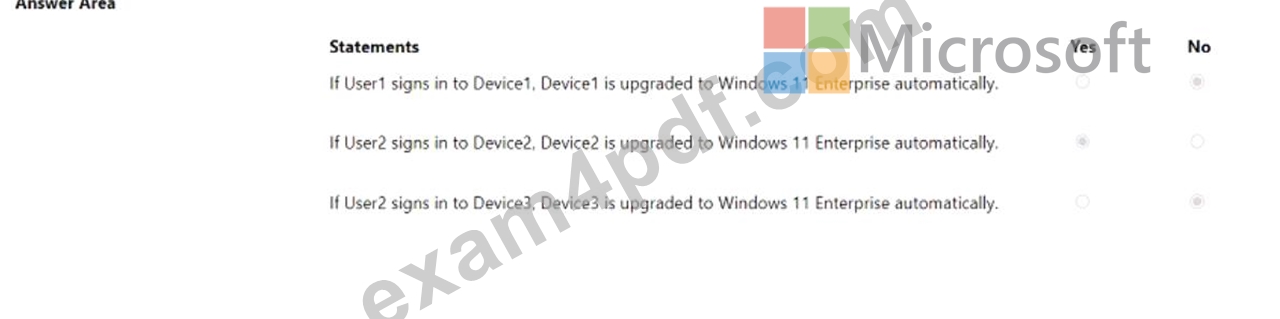
NEW QUESTION # 166
You need to resolve the performance issues in the Los Angeles office.
How should you configure the update settings? To answer, select the appropriate options in the answer area.
NOTE: Each correct selection is worth one point.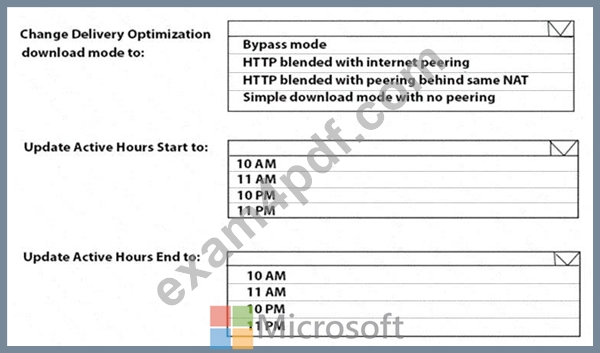
Answer:
Explanation: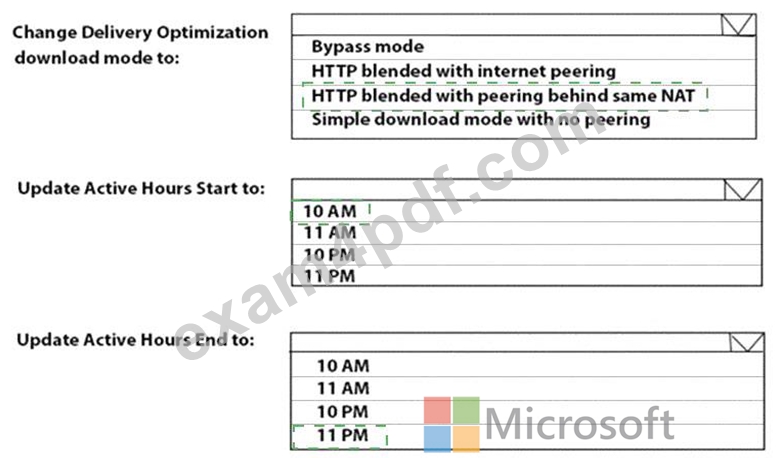
Explanation: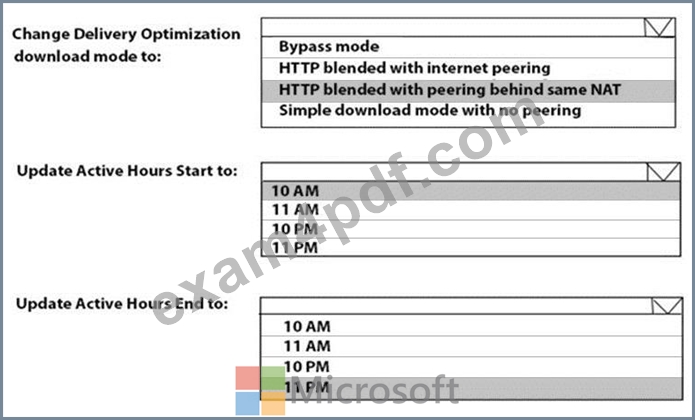
Reference:
https://docs.microsoft.com/en-us/windows/deployment/update/waas-delivery-optimization
https://2pintsoftware.com/delivery-optimization-dl-mode/
NEW QUESTION # 167
You have a public computer named Public1 that runs Windows 10.
Users use Public1 to browse the internet by using Microsoft Edge.
You need to view events associated with website phishing attacks on Public1.
Which Event Viewer log should you view?
- A. Applications and Services Logs > Microsoft\Windows > DeviceGuard > Operational
- B. Applications and Services Logs > Microsoft > Windows > Security-Mitigations > User Mode
- C. Applications and Services Logs > Microsoft > Windows > Windows Defender > Operational
- D. Applications and Services Logs > Microsoft > Windows > SmartScreen > Debug
Answer: D
Explanation:
Viewing Windows event logs for Microsoft Defender SmartScreen.
Microsoft Defender SmartScreen events appear in the Microsoft-Windows-SmartScreen/Debug log, in the Event Viewer.
Reference:
https://docs.microsoft.com/en-us/windows/security/threat-protection/microsoft-defender- smartscreen/microsoft-defender-smartscreen-overview#viewing-windows- event-logs-for- microsoft-defender-smartscreen
NEW QUESTION # 168
Your network contains an Active Directory domain named adatum.com. The domain contains two computers named Computer1 and Computer2 that run Windows 10. Remote Desktop is enabled on Computer2.
The domain contains the user accounts shown in the following table.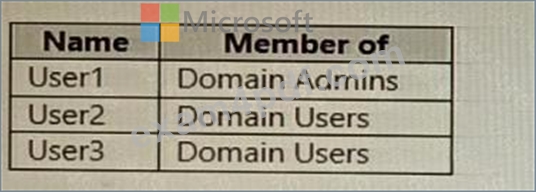
Computer2 contains the local groups shown in the following table.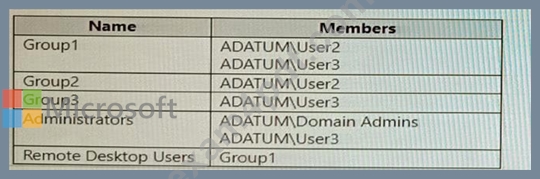
The relevant user rights assignments for Computed are shown in the following table.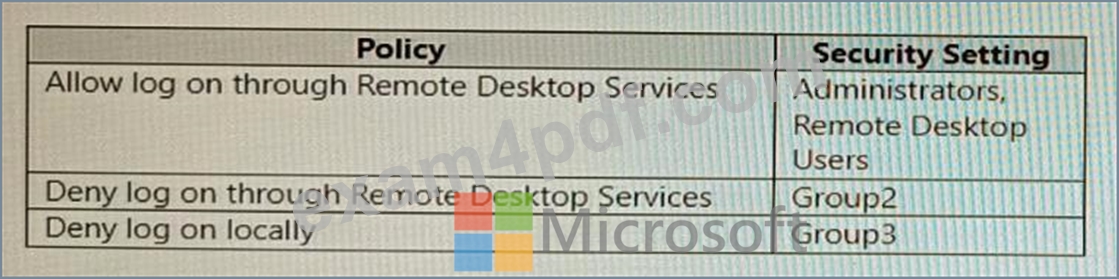
For each of the following statements, select Yes if the statement is true. Otherwise, select No.
NOTE: Each correct selection is worth one point.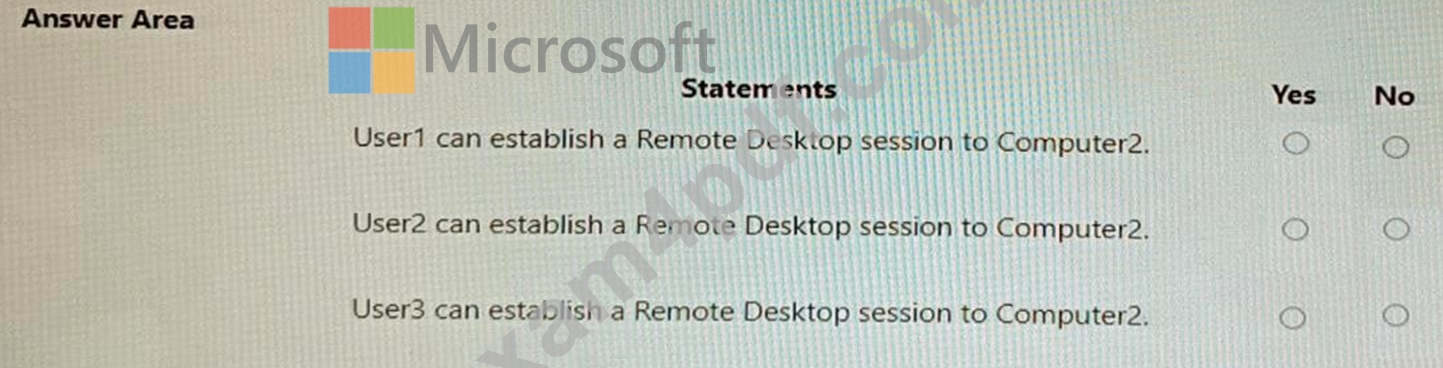
Answer:
Explanation: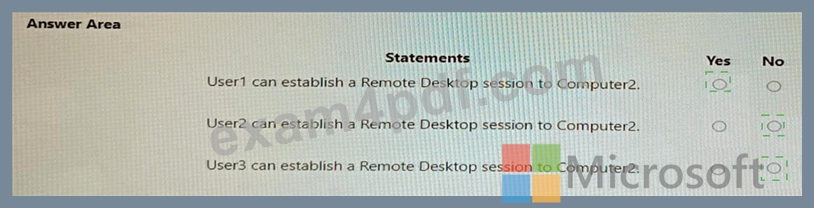
Explanation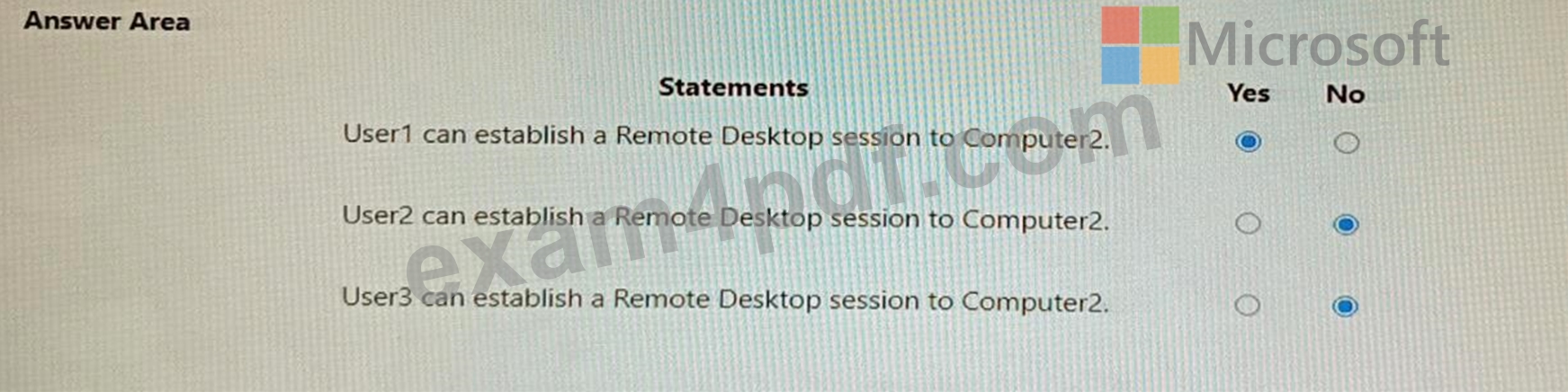
NEW QUESTION # 169
You have a Microsoft 365 subscription that uses Microsoft Intune Suite.
You use Microsoft Intune to manage devices.
You have the devices shown in the following table.
Which devices can be changed to Windows 11 Enterprise by using subscription activation?
- A. Device1, Device2, and Device3
- B. Device2 and Device3 only
- C. Device1 and Device2 only
- D. Device3 only
Answer: B
Explanation:
Subscription activation is available for qualifying devices running Windows 10 or Windows 11.
You can't use subscription activation to upgrade from Windows 10 to Windows 11.
https://learn.microsoft.com/en-us/windows/deployment/windows-10-subscription-activation
NEW QUESTION # 170
Hotspot Question
You have the Microsoft Deployment Toolkit (MDT) installed in three sites as shown in the following table.
You use Distributed File System (DFS) Replication to replicate images in a share named Production.
You configure the following settings in the Bootstrap.ini file.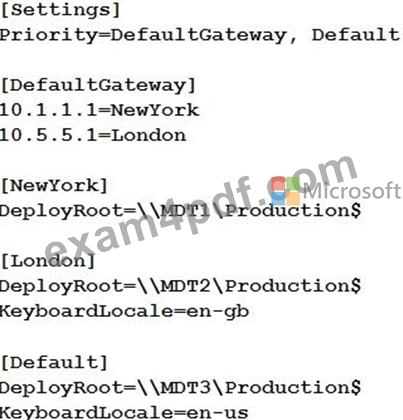
You plan to deploy Windows 10 to the computers shown in the following table.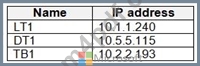
For each of the following statements, select Yes if the statement is true. Otherwise, select No.
NOTE: Each correct selection is worth one point.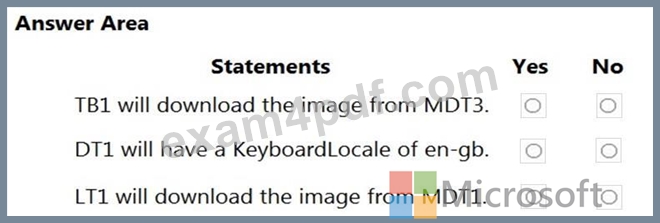
Answer:
Explanation: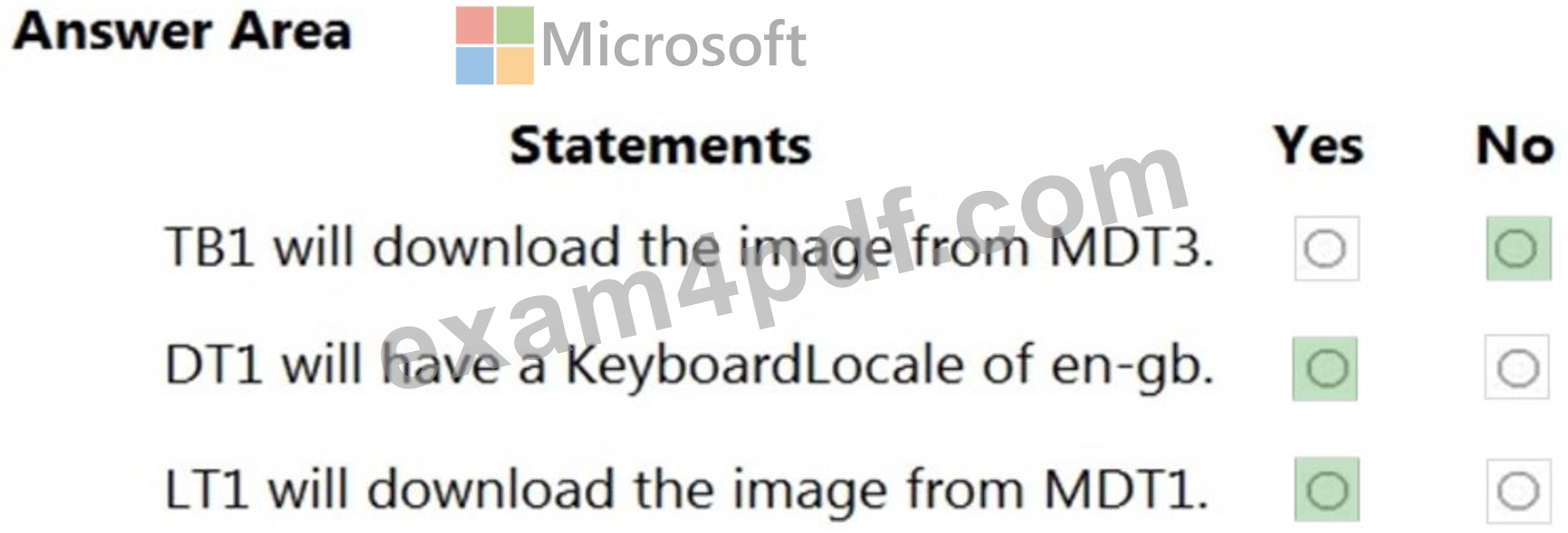
Explanation:
TB1 computer with the ip address of 10.2.2.193 can not connect to MDT3 site which has a subnet of 10.4.4.0/24. 10.2.2.193 is not part of 10.4.4.0/24.
https://docs.microsoft.com/en-us/windows/deployment/deploy-windows-mdt/build-a-distributed- environment-for-windows-10-deployment
NEW QUESTION # 171
You have a Microsoft 365 subscription that contains two security groups named Group1 and Group2.
Microsoft 365 uses Microsoft Intune Suite.
You use Microsoft Intune to manage devices.
You need to assign roles in Intune to meet the following requirements:
* The members of Group1 must manage Intune roles and assignments.
* The members of Group2 must assign existing apps and policies to users and devices.
The solution must follow the principle of least privilege.
Which role should you assign to each group? To answer, select the appropriate options in the answer area.
NOTE: Each correct selection is worth one point.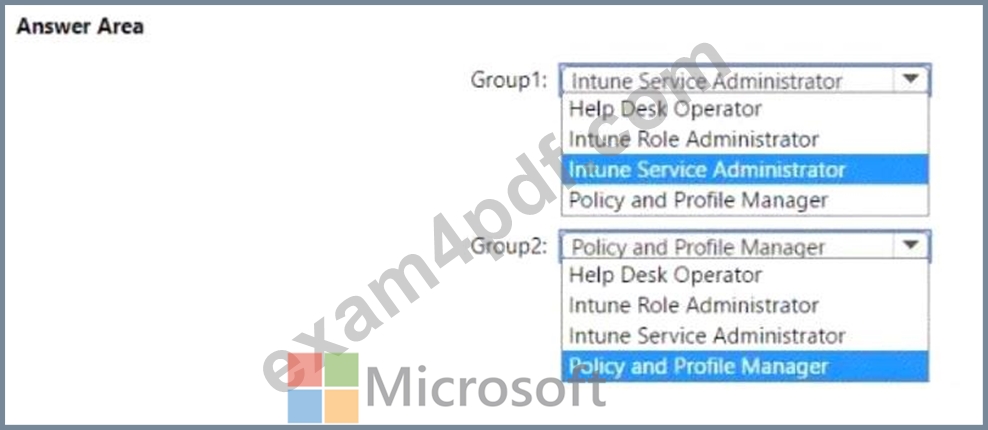
Answer:
Explanation: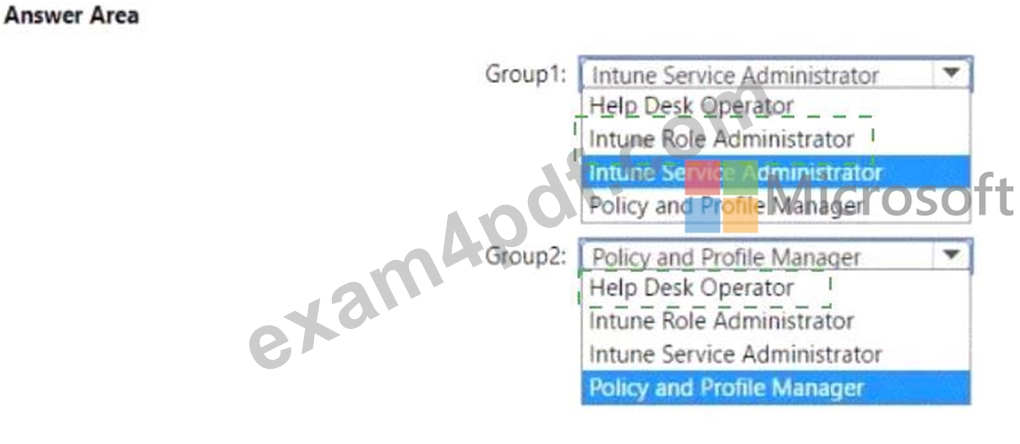
Explanation:
To assign roles in Intune to meet the requirements, you should assign the following roles to each group:
Group1: Intune Role Administrator Group2: Help Desk Operator
The Intune Role Administrator role is the only Intune role that can manage custom Intune roles and add assignments for built-in Intune roles1. This role meets the requirement for Group1 to manage Intune roles and assignments.
The Help Desk Operator role can perform remote tasks on users and devices, and can assign applications or policies to users or devices1. This role meets the requirement for Group2 to assign existing apps and policies to users and devices.
NEW QUESTION # 172
You have 100 computers that run Windows 10. You have no servers. All the computers are joined to Microsoft Azure Active Directory (Azure AD).
The computers have different update settings, and some computers are configured for manual updates.
You need to configure Windows Update. The solution must meet the following requirements:
The configuration must be managed from a central location.
Internet traffic must be minimized.
Costs must be minimized.
How should you configure Windows Update? To answer, select the appropriate options in the answer area.
NOTE: Each correct selection is worth one point.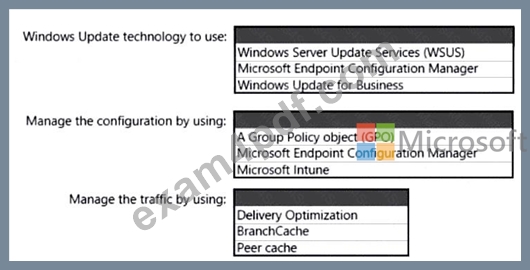
Answer:
Explanation: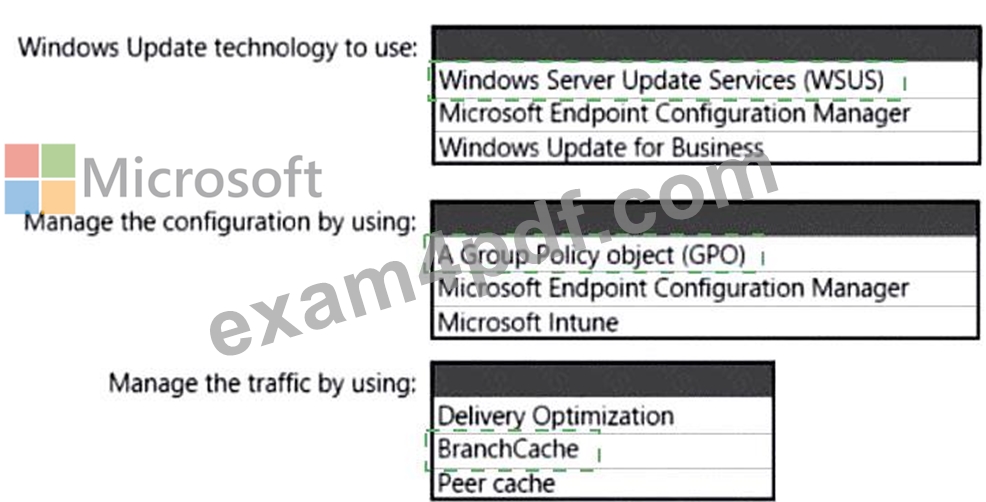
Explanation:
Box 1: Windows Server Update Services (WSUS)
Windows Server Update Services (WSUS) enables information technology administrators to deploy the latest Microsoft product updates. You can use WSUS to fully manage the distribution of updates that are released through Microsoft Update to computers on your network.
Windows Server Update Services is a built-in server role that includes the following enhancements:
Can be added and removed by using the Server Manager
Includes Windows PowerShell cmdlets to manage the most important administrative tasks in WSUS Etc.
Box 2: A Group Policy object
In an Active Directory environment, you can use Group Policy to define how computers and users can interact with Windows Update to obtain automatic updates from Windows Server Update Services (WSUS).
Box 3: BranchCache
BranchCache is a bandwidth-optimization feature that has been available since the Windows Server 2008 R2 and Windows 7 operating systems. Each client has a cache and acts as an alternate source for content that devices on its own network request. Windows Server Update Services (WSUS) and Microsoft Endpoint Manager can use BranchCache to optimize network bandwidth during update deployment, and it ' s easy to configure for either of them. BranchCache has two operating modes: Distributed Cache mode and Hosted Cache mode.
Reference: https://docs.microsoft.com/en-us/windows/deployment/update/waas-branchcache
https://docs.microsoft.com/en-us/windows-server/administration/windows-server-update-services/deploy/4-configure-group-policy-settings-for-automatic-updates
NEW QUESTION # 173
Hotspot Question
You have the device configuration profile shown in the following exhibit.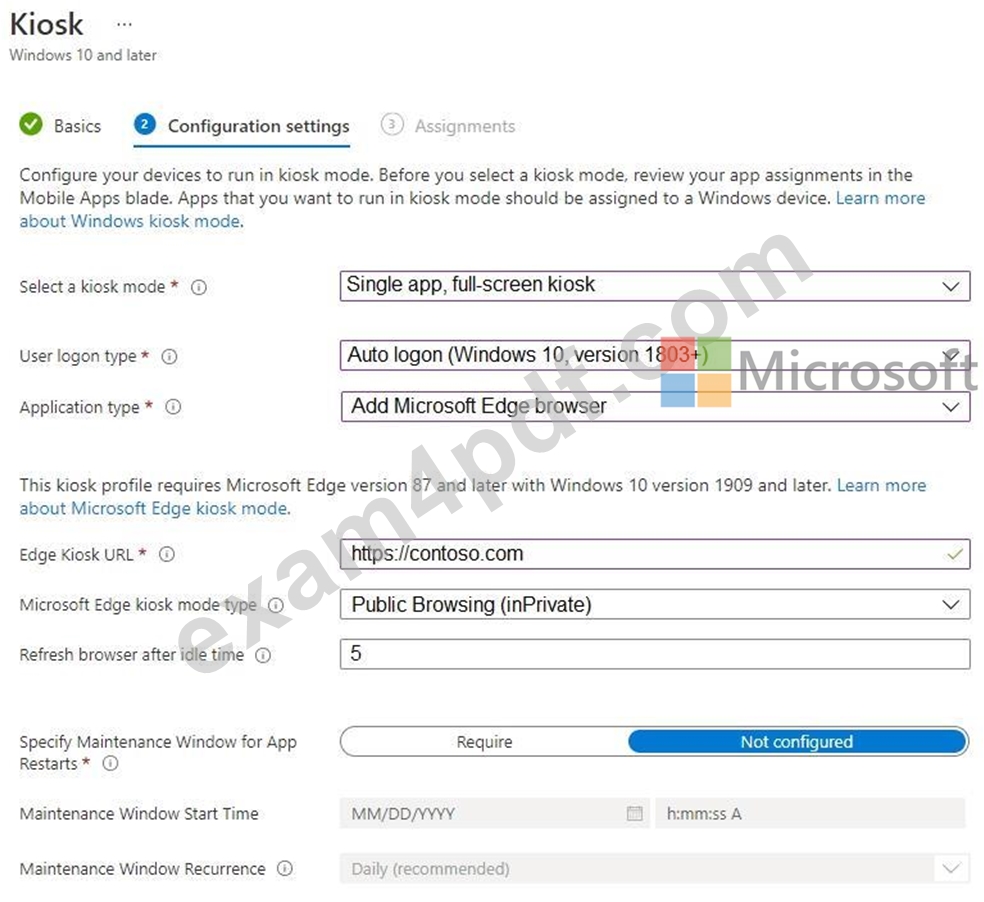
Use the drop-down menus to select the answer choice that completes each statement based on the information presented in the graphic.
NOTE: Each correct selection is worth one point.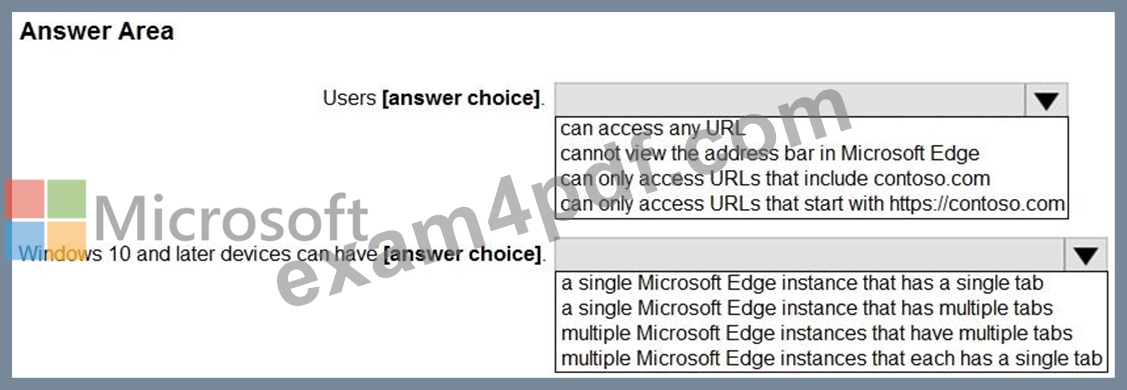
Answer:
Explanation: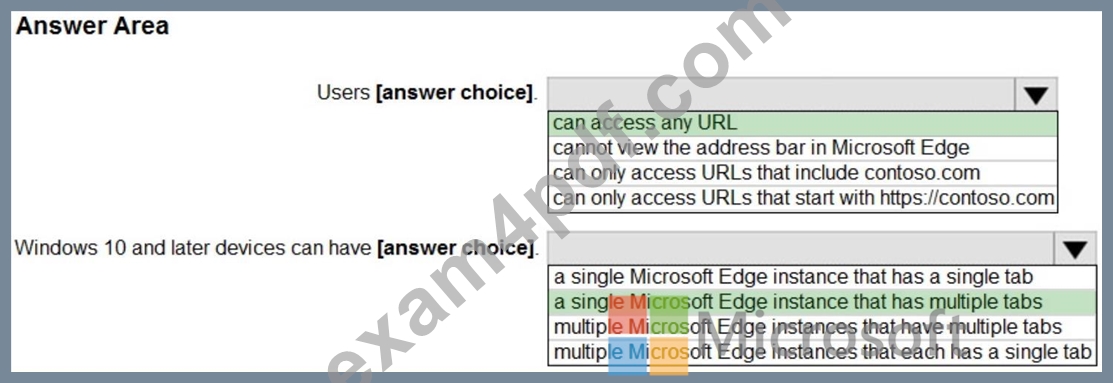
Explanation:
Box 1: can access any URL.
Public Browsing (InPrivate): Runs a limited multi-tab version of Microsoft Edge. Users can browse publicly, or end their browsing session.
Box 2: a single Microsoft Edge instance that has multiple tabs
Single app, full-screen kiosk runs only one app on the device, such as a web browser or Store app.
Reference:
https://docs.microsoft.com/en-us/mem/intune/configuration/kiosk-settings-windows
NEW QUESTION # 174
You have a Microsoft 365 subscription that includes Microsoft Intune.
You have computers that run Windows 11 as shown in the following table.
You have the groups shown in the following table.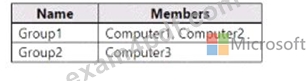
You create and assign the compliance policies shown in the following table.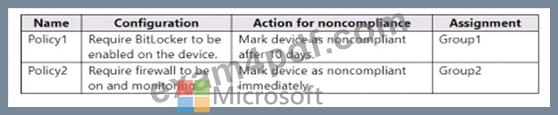
The next day, you review the compliance status of the computers.
For each of the following statements, select Yes if the statement is true. Otherwise, select No.
NOTE: Each correct selection is worth one point.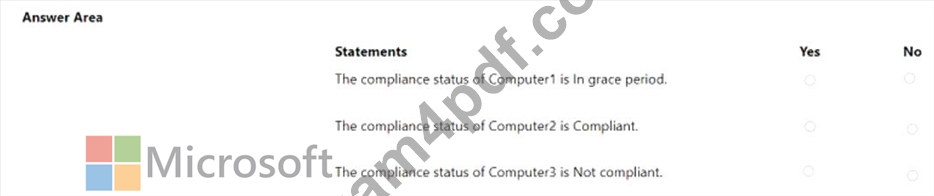
Answer:
Explanation: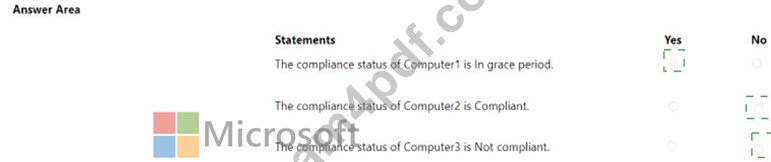
Explanation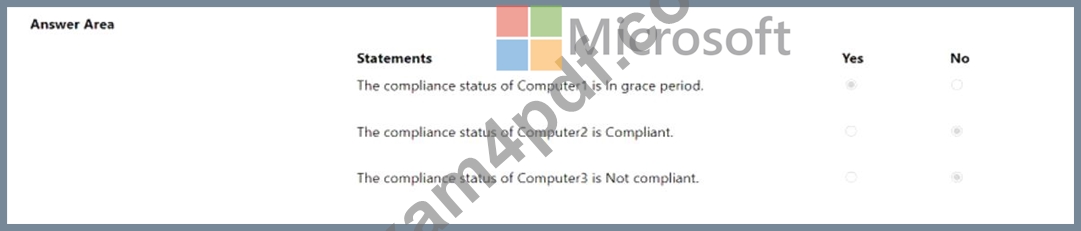
NEW QUESTION # 175
You have a Microsoft 365 E5 subscription that contains a group named Group1.
You create a Conditional Access policy named CAPolicy1 and assign CAPolicy1 to Group1.
You need to configure CAPolicy1 to require the members of Group1 to reauthenticate every eight hours when they connect to Microsoft Exchange Online.
What should you configure?
- A. an assignment that uses a Sign-in risk condition
- B. an assignment that uses a User risk condition
- C. Session access controls
- D. Grant access controls
Answer: C
Explanation:
User sign-in frequency
Sign-in frequency defines the time period before a user is asked to sign in again when attempting to access a resource.
The Azure Active Directory (Azure AD) default configuration for user sign-in frequency is a rolling window of 90 days.
Sign-in frequency control
Sign in to the Azure portal as a global administrator, security administrator, or Conditional Access administrator.
Browse to Azure Active Directory > Security > Conditional Access.
Select New policy.
Give your policy a name. We recommend that organizations create a meaningful standard for the names of their policies.
Choose all required conditions for customer's environment, including the target cloud apps.
Under Access controls > Session.
Select Sign-in frequency.
Choose Periodic reauthentication and enter a value of hours or days or select Every time.
Save your policy.
Reference:
https://docs.microsoft.com/en-us/azure/active-directory/conditional-access/howto-conditional-access-session-life
NEW QUESTION # 176
In Microsoft Intune, you have the device compliance policies shown in the following table.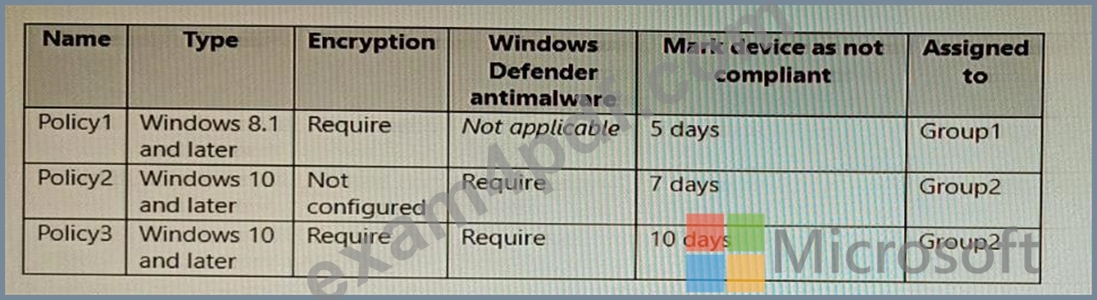
The Intune compliance policy settings are configured as shown in the following exhibit.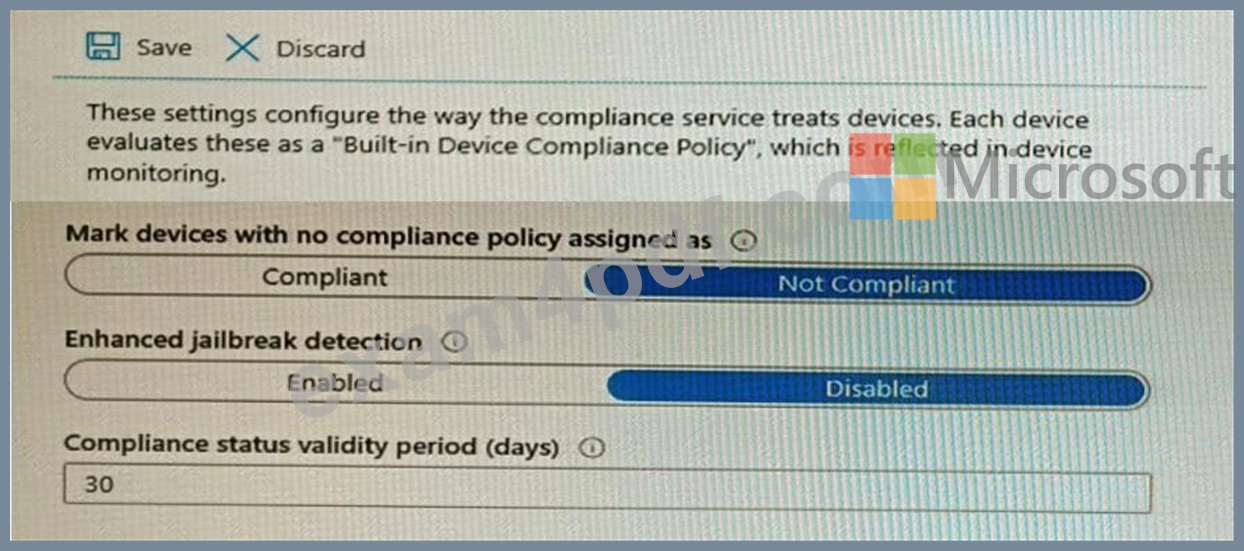
On June 1, you enroll Windows 10 devices in Intune as shown in the following table.
For each of the following statements, select Yes if the statement is true. Otherwise, select No.
NOTE: Each correct selection is worth one point.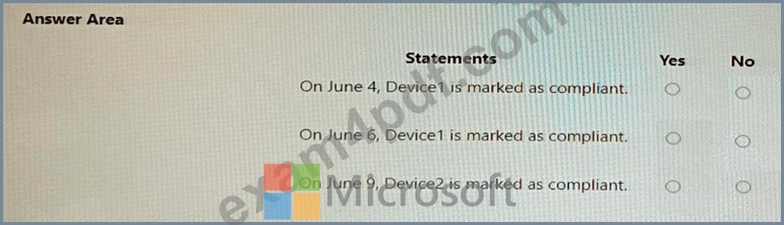
Answer:
Explanation: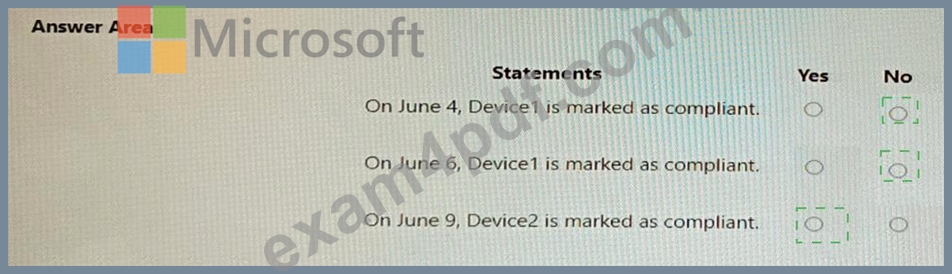
Explanation: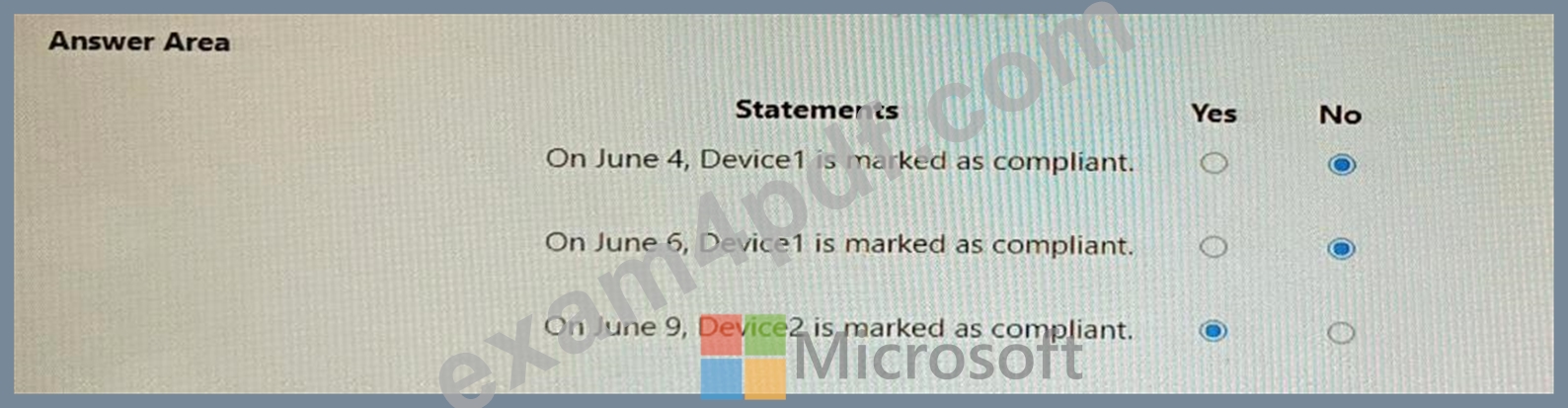
Device 1 is Windows 10 - and policy 1 is for Windows 8. Default compliance for devices without a policy is not compliant so first 2 questions are NO.
Then the third device has 2 policies, the first one is compliant and the second policy is not compliant but the device is not marked as non-compliant due to the fact that mark device as non-compliant is set to 10 days. This means that the machine will be compliant until june 10th.
Source:
Mark device non-compliant: By default, this action is set for each compliance policy and has a schedule of zero (0) days, marking devices as noncompliant immediately.
When you change the default schedule, you provide a grace period in which a user can remediate issues or become compliant without being marked as non-compliant.
This action is supported on all platforms supported by Intune.
https://docs.microsoft.com/en-us/mem/intune/protect/actions-for-noncompliance
NEW QUESTION # 177
You have the devices shown in the following table.
You need to migrate app data from Device1 to Device2. The data must be encrypted and stored on Seryer1 during the migration.
Which command should you run on each device? To answer, select the appropriate options in the answer area.
NOTE: Each correct selection is worth one point.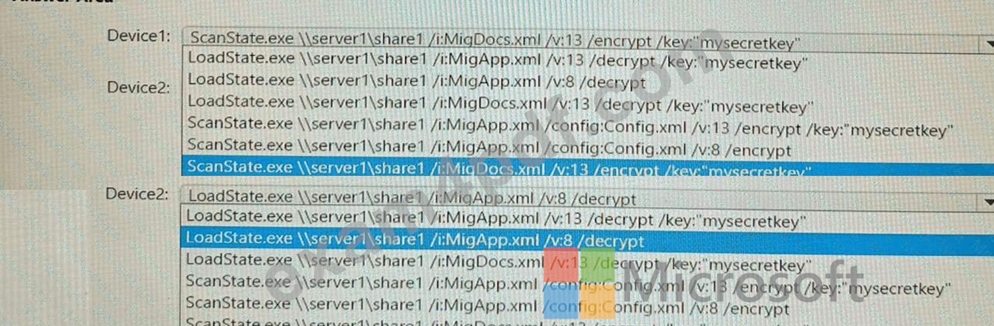
Answer:
Explanation: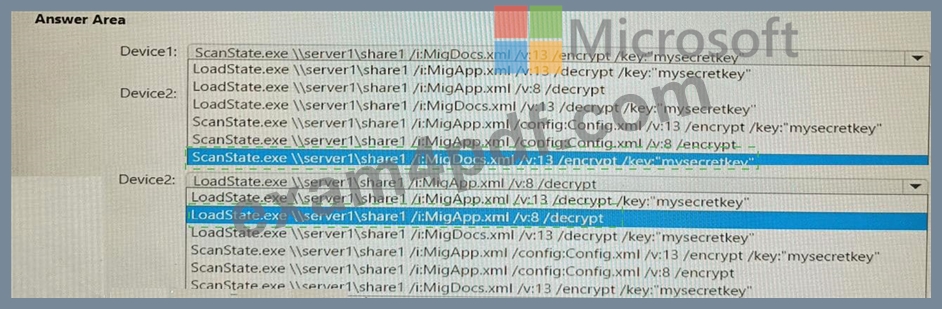
Explanation: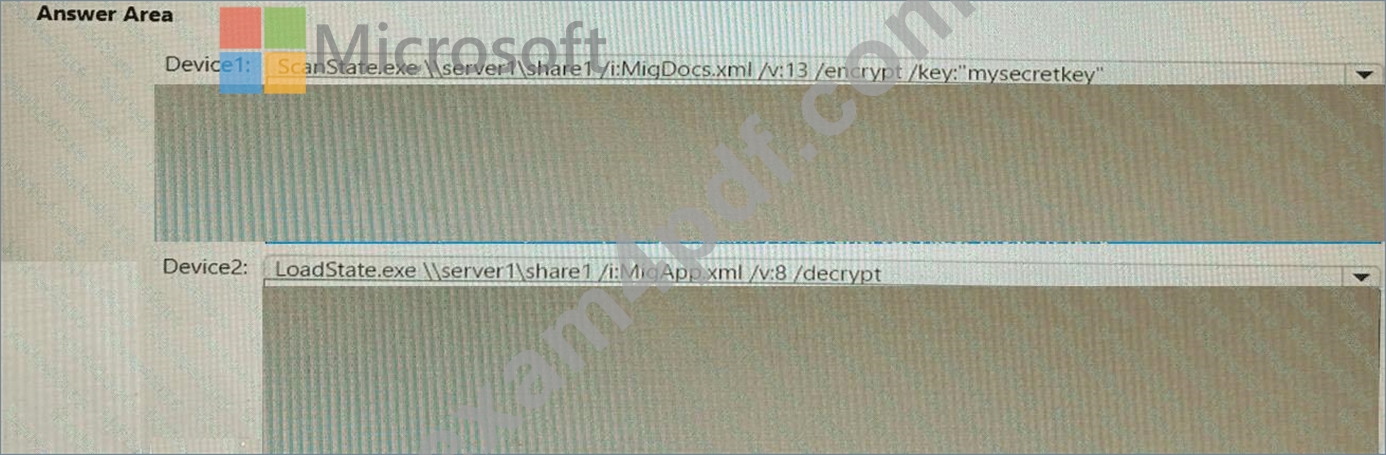
NEW QUESTION # 178
You have a Microsoft 365 E5 subscription that uses Microsoft Intune. The subscription contains the users shown in the following table.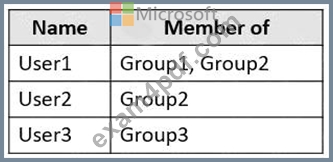
Group2 and Group3 are members of Group1.
All the users use Microsoft Excel.
From the Microsoft Endpoint Manager admin center, you create the policies shown in the following table.
For each of the following statements, select Yes if the statement is true. Otherwise, select No.
NOTE: Each correct selection is worth one point.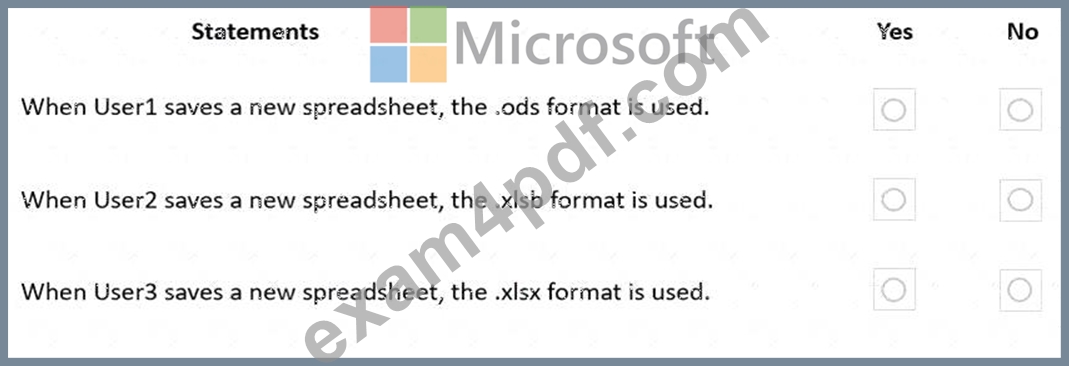
Answer:
Explanation: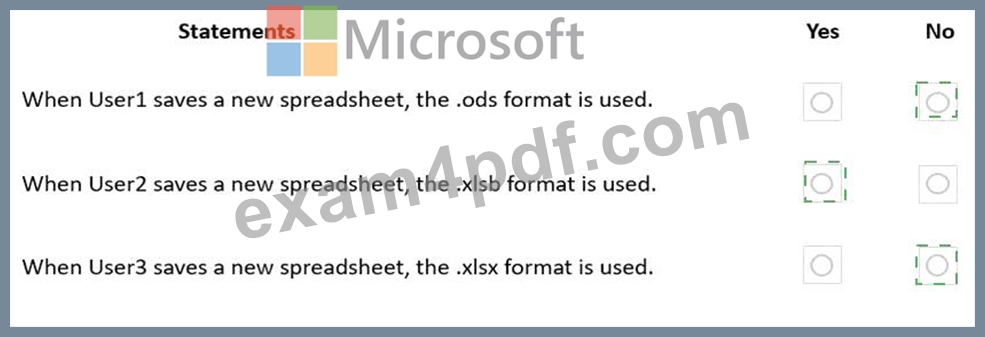
Explanation
Box 1: No
User1 is member of Group1 and Group2.
Policy1 with priority 0 is assigned to Group1: default file format for Excel is.ods.
Policy2 with priority 1 is assigned to Group2: default file format for Excel is.xlsb.
Note: Key points to remember about policy order
Policies are assigned an order of priority.
Devices receive the first applied policy only.
You can change the order of priority for policies.
Default policies are given the lowest order of priority.
Box 2: Yes
User2 is member of Group2.
Group2 and Group3 are members of Group1.
Box 3: No
User3 is member of Group3.
Group2 and Group3 are members of Group1.
Reference: https://learn.microsoft.com/en-us/microsoft-365/security/defender-business/mdb-policy-order
NEW QUESTION # 179
......
Certification Topics of MD-102 Exam PDF Recently Updated Questions: https://www.exam4pdf.com/MD-102-dumps-torrent.html
MD-102 Certification Sample Questions certification Exam: https://drive.google.com/open?id=15dwABcvjeFBnn3Rh-JIainvKeKU8Sbl_
