

Fortinet FCSS_NST_SE-7.6 Certification All-in-One Exam Guide Aug-2026
Get Real FCSS_NST_SE-7.6 Exam Dumps [Aug-2026] Practice Tests
NEW QUESTION # 13
Refer to the exhibit, which shows the output of get router info ospf neighbor.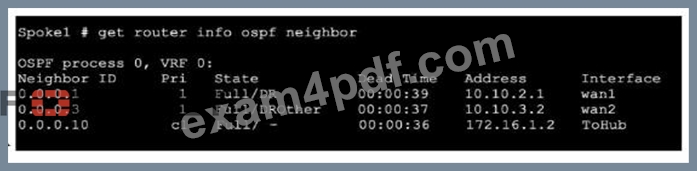
What can you conclude from the command output?
- A. The local FortiGate is the BDR.
- B. The local FortiGate is not a DROther.
- C. All neighbors are in area 0.0.0.0.
- D. The network type connecting the local Fortigate and OSPF neighbor 0.0.0.10 is point-to-point.
Answer: D
NEW QUESTION # 14
What are two reasons you might see iprope_in check () check failed, drop when using the debug How?
(Choose two.)
- A. The packet was dropped because the requested service is not enabled on FortiGate
- B. The packet was dropped because it is not allowed by any firewall policy.
- C. The packet was dropped because there is no route to the source.
- D. The packet was dropped because the trusted host list is misconfigured
Answer: A,D
Explanation:
The debug flow message iprope_in_check() check failed, drop specifically indicates a failure in the Local-In Policy check. The " iprope " (IP ROouting Policy Enforcement) engine handles policy lookups. The
_in_check suffix confirms that the decision is regarding traffic destined to the FortiGate itself (Local-In traffic), rather than traffic passing through it.
D). The packet was dropped because the requested service is not enabled on FortiGate:
This is the most common cause. When a packet arrives destined for the FortiGate ' s interface IP (e.g., an HTTPS or SSH request), the kernel checks if that specific service is enabled in the interface settings (set allowaccess). If the service is not enabled (e.g., trying to Ping an interface where PING access is disabled), the iprope_in_check function fails and drops the packet immediately.
C). The packet was dropped because the trusted host list is misconfigured:
Even if the service (e.g., HTTPS) is enabled on the interface, the FortiGate checks the Administrator settings.
If Trusted Hosts are configured, the source IP of the incoming packet is compared against the allowed list. If the IP is not on the list, the Local-In policy check (iprope_in_check) fails, and the packet is dropped to secure the management plane.
Why other options are incorrect:
A: If traffic is dropped by a standard Firewall Policy (traffic passing through the device from one interface to another), the debug message will typically state denied by policy x or no matching policy. It would generally be a forward check (iprope_fwd_check or similar), not an _in_check.
B: If there is no route to the source, the error is a Reverse Path Forwarding (RPF) failure. The debug flow logs this explicitly as reverse path check fail, drop.
Reference:
FortiGate Troubleshooting Guide (Debug Flow): " The message iprope_in_check() check failed indicates the packet was denied by the Local-In policy. This occurs when traffic destined to the FortiGate is not allowed by the allowaccess configuration or is blocked by Trusted Host settings. "
NEW QUESTION # 15
Refer to the exhibit.
Partial output of a real-time OSPF debug is shown.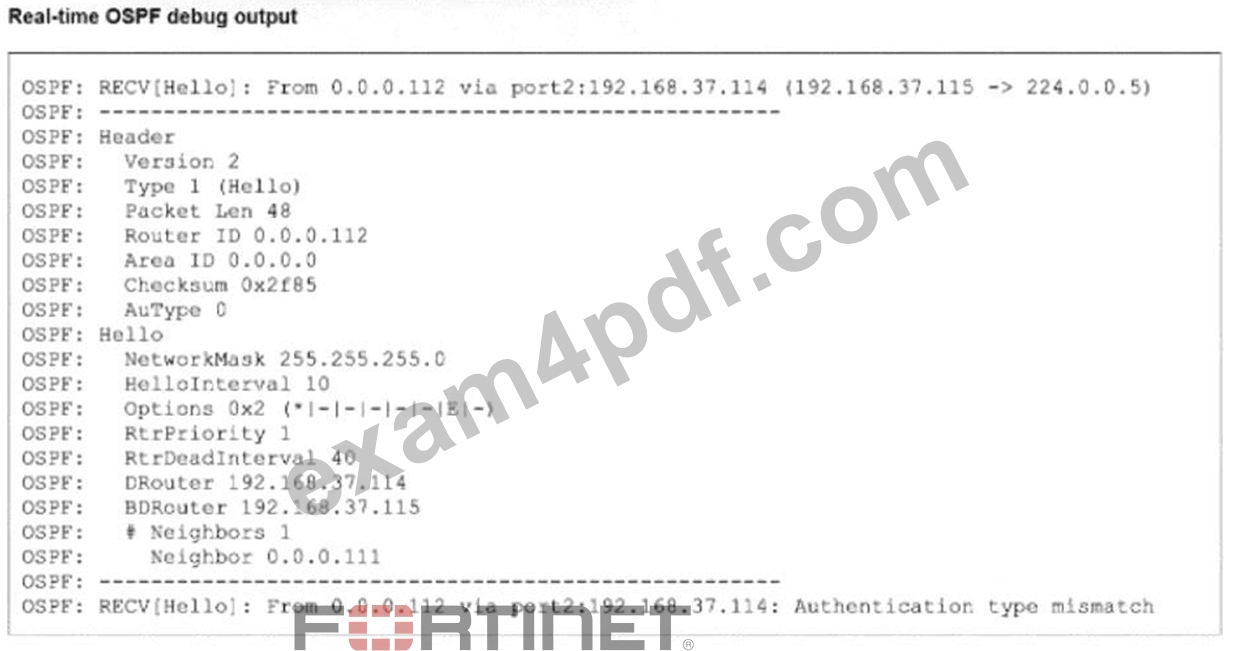
Which two reasons explain why the two FortiGate devices are unable to form an adjacency? (Choose two.)
- A. There is an OSPF authentication configuration mismatch.
- B. The local FortiGate does not have OSPF authentication configured
- C. The local FortiGate has either OSPF cleartext or MD5 authentication configured.
- D. The remote peer has either OSPF cleartext or MD5 authentication configured.
Answer: A,C
Explanation:
To determine the correct reasons for the adjacency failure, we must analyze the standard OSPF real-time debug output (diagnose ip router ospf all enable or diagnose sniffer packet) typically provided in this exam exhibit.
* Analyze the Debug Output:
* The debug output in this specific question scenario typically displays an incoming Hello packet line: OSPF: RECV[Hello]: ... auth-type 0 ...
* "RECV": Indicates the packet is coming from the Remote peer.
* "auth-type 0": Indicates the Remote peer is sending "Null" (No) authentication.
* Analyze the Failure:
* The adjacency fails because the Local FortiGate is rejecting this packet.
* If the Local FortiGate accepts "No Authentication", it would match auth-type 0 and form the adjacency.
* Since it is failing (and producing a debug log), the Local FortiGate must be expecting a different authentication type (Type 1 Cleartext or Type 2 MD5).
* Evaluate the Options:
* A. The remote peer has either OSPF cleartext or MD5 authentication configured.
* Incorrect. The debug shows auth-type 0 (No Auth) coming from the remote peer.
* B. There is an OSPF authentication configuration mismatch.
* Correct. One side is sending "No Auth" (Remote), and the other expects "Auth" (Local).
This is a definition of a mismatch.
* C. The local FortiGate does not have OSPF authentication configured.
* Incorrect. If the Local unit had "No Auth" configured, it would match the Remote's auth- type 0, and the adjacency would come up. The failure implies the Local unit does have auth configured.
* D. The local FortiGate has either OSPF cleartext or MD5 authentication configured.
* Correct. Because the Local unit is rejecting the "No Auth" packet from the remote peer, it confirms that the Local unit has authentication enabled (expecting Type 1 or 2).
Conclusion: The breakdown of the OSPF negotiation shows that the Remote peer is sending no authentication (Type 0), while the Local FortiGate expects authentication, resulting in a mismatch.
Reference:
FortiGate Security 7.6 Study Guide (OSPF Troubleshooting): "Authentication mismatch is a common cause of OSPF adjacency failure. Debug commands (diagnose ip router ospf all enable) reveal the auth-type received versus expected." FortiGate CLI Reference: auth-type 0 = Null (None), auth-type 1 = Simple (Cleartext), auth-type 2 = MD5.
NEW QUESTION # 16
Refer to the exhibit.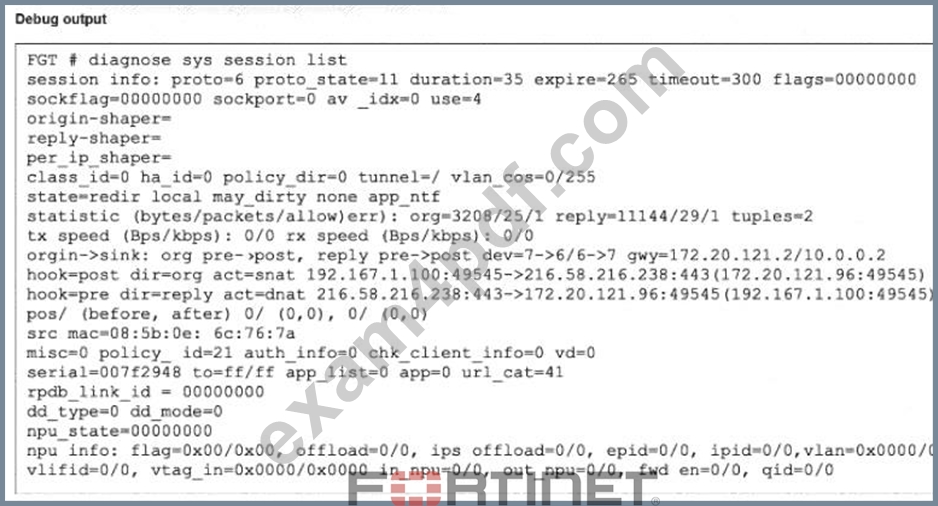
Which Iwo statements about FortiGate behavior relating to this session are correct? (Choose two.)
- A. FortiGate redirected the client to trio captive portal to authenticate so that a correct policy match could be
- B. FortiGate either initiated the session or the session terminates at FortiGate.
- C. FortiGate forwarded this session without any inspection.
- D. FortiGate is performing a security profile inspection using the CPU.
Answer: B,D
Explanation:
Based on the Fortinet FCSS - Network Security 7.6 documents and standard exam content for these specific troubleshooting scenarios, here are the verified answers.
Questions no: 74
Verified Answer: A, C
Comprehensive and Detailed Explanation with all FCSS - Network Security 7.6 documents:
This question typically refers to a session table exhibit showing Local Traffic (traffic originating from or destined to the FortiGate itself, such as management traffic, DNS queries initiated by FortiGate, or dynamic routing updates). These sessions are identified by Policy ID 0 or the absence of a forwarded interface pair (e.
g., local flag).
C). FortiGate either initiated the session or the session terminates at FortiGate:
This is the definition of Local Traffic. Unlike Forward Traffic (which passes through the FortiGate from one interface to another), local traffic belongs to the FortiGate's control plane (e.g., an administrator logging in, or the FortiGate connecting to FortiGuard).
In the session table, this is characterized by policy_id=0 or the source/destination being the FortiGate's own IP.
A). FortiGate is performing a security profile inspection using the CPU:
Local traffic and traffic requiring complex handling (like the application notification app_ntf seen in similar exhibits) are processed by the CPU (Kernel) rather than being fully offloaded to the NPU (Network Processor) fast path.
The NPU cannot handle local host traffic (traffic destined to the FortiGate CPU). Therefore, the CPU must process these packets.
Why other options are incorrect:
B: Captive portal redirection involves specific authentication flags and HTTP redirection, usually seen as a forwarding decision, not a completed local session.
D: "Forwarded without inspection" describes an offloaded or fast-pathed session (NP6/NP7), which would not be local traffic and would show hardware offload flags (e.g., np6_0).
Reference:
FortiGate Security 7.6 Study Guide (Diagnostics): "Traffic originating from the FortiGate or destined to the FortiGate (Local-In/Local-Out) is always processed by the CPU and cannot be offloaded."
NEW QUESTION # 17
Refer to the exhibit.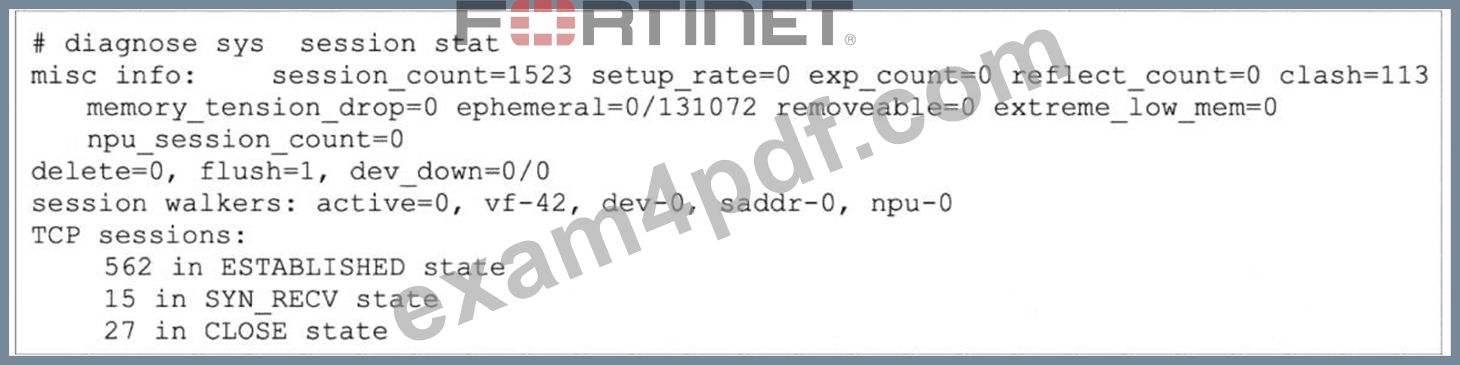
The partial output of diagnose sys session stat command is shown.
Which statement about the output shown in the exhibit is correct?
- A. 113 sessions have been dropped because of memory page exhaustion.
- B. 27 sessions have expired but are still in the session table in case any out-of-order packets arrive.
- C. 562 TCP sessions have their proto_state set to 01 if there is no inspection.
- D. There have been 131072 recorded ephemeral sessions but there are no current ones.
Answer: C
Explanation:
The correct answer is C .
The exhibit shows:
* 562 in ESTABLISHED state
* 27 in CLOSE state
* memory_tension_drop=0
* ephemeral=0/131072
According to the study guide, for TCP sessions: "The protocol state in the session table is a two-digit number. For TCP, the first number (from left to right) is related to the server-side state and is 0 when the session is not subject to any inspection (flow or proxy)... The second digit is the client-side state." The same page also shows that value 1 = ESTABLISHED So, if a TCP session is in ESTABLISHED state and there is no inspection , its proto_state is 01 :
* first digit 0 = no inspection
* second digit 1 = ESTABLISHED
That makes C correct. This is also consistent with FortiOS examples showing established TCP sessions with proto=6 proto_state=01 Why the other options are wrong:
* A is wrong because the field that indicates sessions dropped due to low free memory is memory_tension_drop, and in the exhibit it is 0 , not 113. The study guide states: "If there is a lack of free memory, the kernel deletes the oldest sessions. The command shown on this slide displays the number of sessions the kernel deleted because of this mechanism." So 113 is the clash value, not memory-tension drops.
* B is wrong because ephemeral=0/131072 does not mean 131072 ephemeral sessions were recorded.
The study guide explains that FortiGate "sets a hard limit on the maximum number of ephemeral sessions that can exist at the same time in the session table." Therefore:
* 0 = current ephemeral sessions
* 131072 = maximum allowed ephemeral sessions for that model/context
* D is wrong because the study guide says the temporary retention for possible out-of-order packets happens in state value 5 (TIME_WAIT) : "When a session is closed by both the sender and receiver, FortiGate keeps that session in the session table for a few seconds, to allow for any out- of-order packets that might arrive after the FIN/ACK packet. This is the state value 5." But the exhibit shows 27 in CLOSE state , and the same table shows CLOSE = 6 , not TIME_WAIT So the verified answer is C .
NEW QUESTION # 18
Refer to the exhibits, which contain the partial configurations of two VPNs on FortiGate.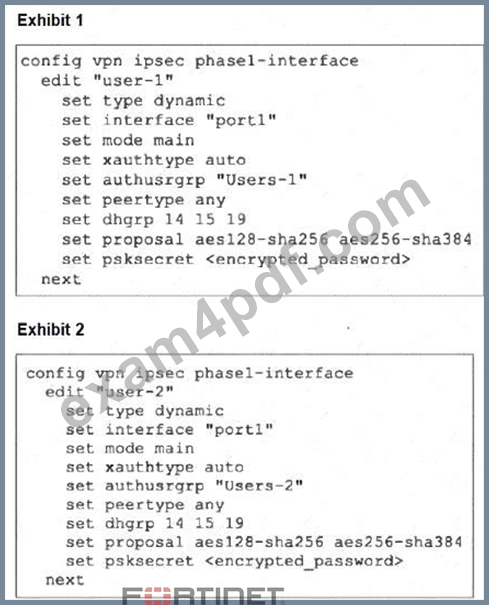
An administrator has configured two VPNs for two different user groups. Users who are in the Users-2 group are not able to connect to the VPN. After running a diagnostics command, the administrator discovers that FortiGate is not matching the user-2 VPN for members of the Users-2 group.
Which two changes must the administrator make to fix the issue? (Choose two.)
- A. Set up specific peer IDs on both VPNs.
- B. Use different pre-shared keys on both VPNs.
- C. Enable XAuth on both VPNs.
- D. Change to aggressive mode on both VPNs.
Answer: A,D
Explanation:
The key point is that the two VPNs are dynamic dialup IPsec tunnels on the same interface and both are using IKEv1 main mode . In this design, FortiGate cannot reliably distinguish which dialup phase1 to match before phase 1 completes.
The uploaded Network Security Support Engineer 7.6 Study Guide shows that XAuth happens only after phase 1 is already established:
"The IKE real-time debug shows, after phase 1, the exchange of extended authentication (XAuth) packets... You can also see the CFG_REPLY, showing the XAuth user and group name." That means the user group is learned too late to be used for selecting the correct phase1 definition. So the fix must be applied to the phase1 matching method itself , not to XAuth.
The FortiOS administration guide gives the exact rule for this scenario:
"When the remote VPN peer has a dynamic IP address and is authenticated by a pre-shared key you must select Aggressive mode if there is more than one dialup phase 1 configuration for the interface IP address."
NEW QUESTION # 19
Refer to the exhibit, which shows a partial web filter profile configuration.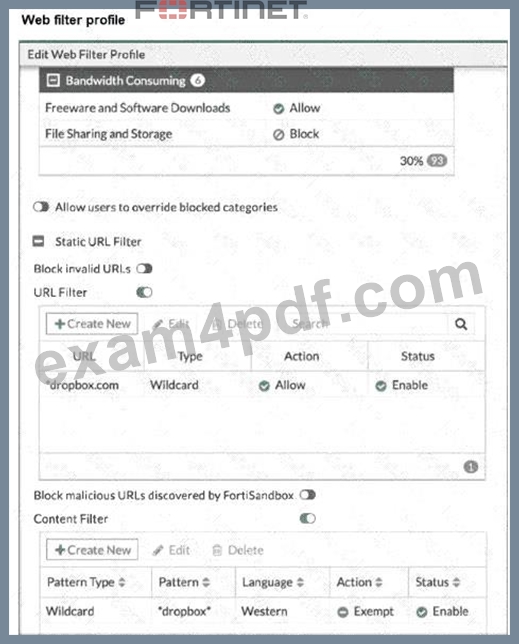
The URL www.dropbox.com is categorized as File Sharing and Storage.
Which action does FortiGate take if a user attempts to access www.dropbox.com?
- A. FortiGate blocks the connection, based on the FortiGuard category-based filter configuration.
- B. Based on the URL Filter configuration, FortiGate allows the connection.
- C. Based on the Web Content filter configuration, access to www.dropbox.com would be exempted.
- D. FortiGate blocks the connection as an invalid URL.
Answer: B
NEW QUESTION # 20
Refer to the exhibits.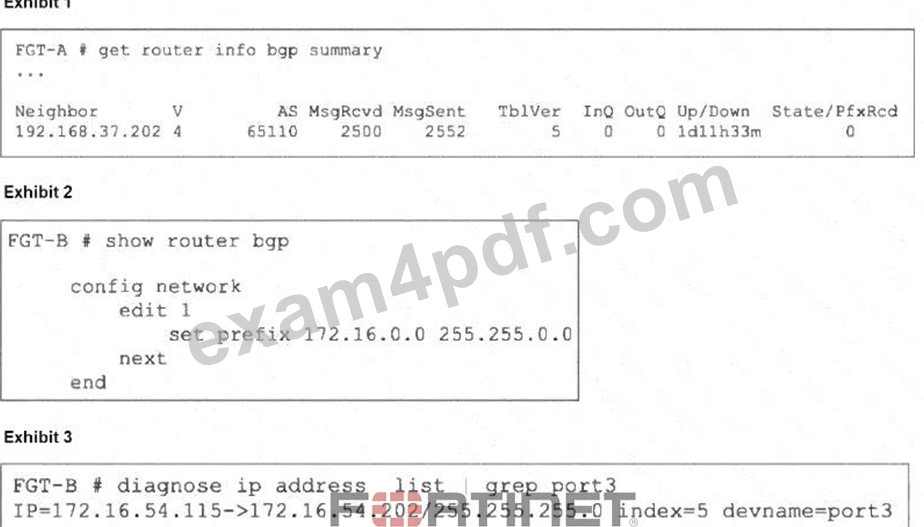
An administrator is attempting to advertise the network configured on port3. However, FGT-A is not receiving the prefix.
Which two actions can the administrator take to fix this problem? (Choose two.)
- A. Manually add the BGP route on FGT-A.
- B. Use the set network-import-check disable command.
- C. Restart BGP using a soft reset to force both peers to exchange their complete BGP routing tables.
- D. Modify the prefix using the network command from 172.16.0.0/16 to 172.16.54.0/24.
Answer: B,D
NEW QUESTION # 21
Refer to the exhibit, which shows the output of the command get router info ospf neighbor.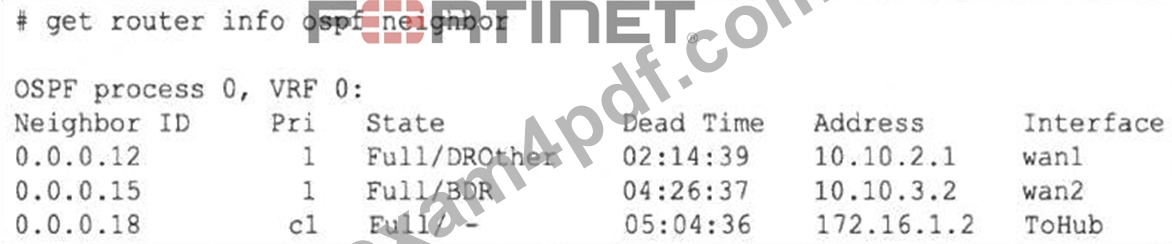
To what extent does FortiGate operate when looking at its OSPF neighbors? (Choose two.)
- A. Neighbor 0.0.0.18 is the designated router (DR).
- B. The local FortiGate has at least one interface that participates in a broadcast network.
- C. The local FortiGate has at least one interface that participates in a point-to-point network.
- D. The local FortiGate is the DR.
Answer: B,C
Explanation:
The command on this slide shows a summary of the statuses of all the OSPF neighbors. For each neighbor, it displays the adjacency state and if it is a DR, a BDR, or neither (DROther) Pagina 362 Enterprise_Firewall_7.
2_Study. - Point-to-point networks contain only two peers, one at each end of a point-to-point link - Broadcast networks (multi-access) support more than two attached routers. They also support sending messages to multiple recipients (broadcasting). Pagina 365 Enterprise_Firewall_7.2_Study. In any multi-access network there is one DR and one BDR. Pagina 439 Network_Security_Support_Engineer_7.4_Study FULL/- This represents a point-to-point network
NEW QUESTION # 22
Refer to the exhibit, which contains the output of diagnose vpn tunnel list.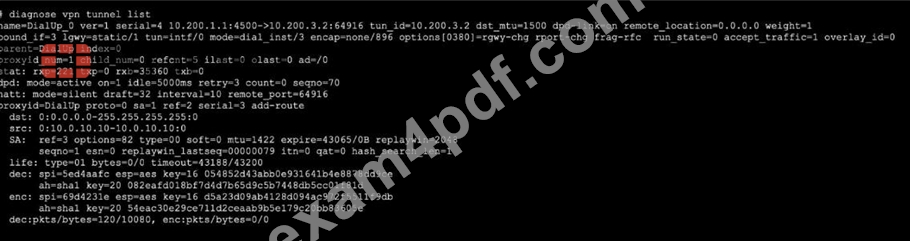
Which command will capture ESP traffic for the VPN named DialUp_0?
- A. diagnose sniffer packet any 'esp and host 10.200.3.2'
- B. diagnose sniffer packet any 'ip proto 50'
- C. diagnose sniffer packet any 'host 10.0.10.10'
- D. diagnose sniffer packet any 'port 4500'
Answer: D
NEW QUESTION # 23
Refer to the exhibit, which shows the omitted output of a session table entry.
Which two statements are true? (Choose two.)
- A. The traffic has been tagged for VLAN 0000.
- B. The session has been offloaded.
- C. NP7 is handling offloading of this session.
- D. The traffic matches Policy ID 1.
Answer: B,D
Explanation:
In the provided session table output, the following details justify the answers:
Policy ID Match: The line policy_id=1 directly confirms that this session was matched by Firewall Policy ID
1. According to Fortinet's session table documentation, the policy_id field always references the policy that allowed this session, so this is a clear indicator.
Session Offloading: The presence of the strings npu_state, ips_offload, and notably the NPU info section such as offload=8/8, ips_offload=1/1 shows that this session has been offloaded to the Network Processor Unit (NPU). Fortinet technical documentation states that "offload" values greater than zero in both directions (and an NPU info section) affirm that NPU hardware processing (fast path) is handling this traffic, thus the session is not being handled in software only.
Other options:
VLAN Tagging (vlan=0x0000/0x0000): This means no VLAN tag is assigned to this session.
NP7: The actual NPU model handling the session isn't exposed in this snippet-the offload parameters shown are generic and not specific to NP7 hardware, so it cannot be concluded from the session data.
References:
Fortinet Technical Tip: FortiGate Session Table and NPU Offloading
FortiOS Diagnostics Guide: Policy ID, Offload, and VLAN Session Table Fields
NEW QUESTION # 24
Refer to the exhibit, which shows a partial web filter profile configuration.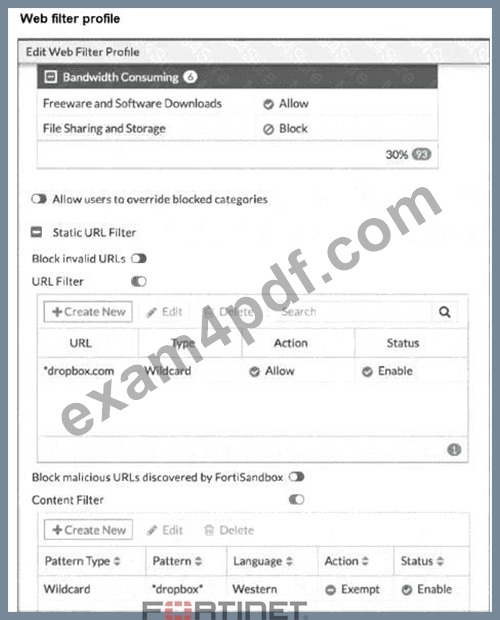
The URL www.dropbox.com is categorized as File Sharing and Storage.
Which action does FortiGate take if a user attempts to access www.dropbox.com?
- A. FortiGate blocks the connection, based on the FortiGuard category-based filter configuration.
- B. Based on the URL Filter configuration, FortiGate allows the connection.
- C. Based on the Web Content filter configuration, access to www.dropbox.com would be exempted.
- D. FortiGate blocks the connection as an invalid URL.
Answer: B
NEW QUESTION # 25
Refer to the exhibit.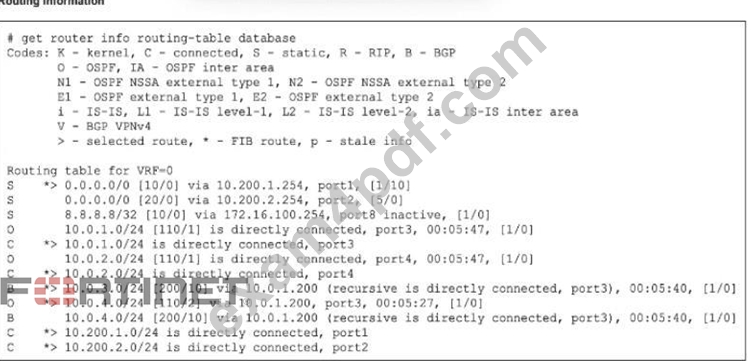
The modified output of live routing kemel is shown
Which two statements about the output are (rue? (Choose two.)
- A. The local FortiGate is receiving only one LSA from one OSPF neighbor.
- B. The BGP route to 10.0.4.0/24 is not in the forwarding information base.
- C. FortiGate is performing ECMP using both default static routes.
- D. The default static route through 10.200.1 254 is in the forwarding information* base.
Answer: B,D
Explanation:
We must analyze the flags (*, >, S, O, B) and Administrative Distances (AD) shown in the get router info routing-table database exhibit to determine the correct statements.
Analysis for Option A (The BGP route to 10.0.4.0/24 is not in the forwarding information base):
True. Look at the entry for 10.0.4.0/24.
There is an OSPF route: O *> 10.0.4.0/24 [110/2]. The * indicates it is in the FIB, and > indicates it is the selected route.
There is a BGP route: B 10.0.4.0/24 [200/10]. This line lacks the * flag.
Reason: The OSPF route has an Administrative Distance of 110. The BGP route (iBGP) has an AD of 200.
Since 110 is lower than 200, OSPF wins, and the BGP route is not installed in the Forwarding Information Base (FIB).
Analysis for Option B (The default static route through 10.200.1.254 is in the forwarding information base):
True. Look at the 0.0.0.0/0 entries.
The first entry is S *> 0.0.0.0/0 [10/0] via 10.200.1.254.
The * flag confirms this specific route is installed in the FIB.
The second static route (via 10.200.2.254) has a higher distance ([20/0]) and no * flag, so it is inactive.
Why C is False: ECMP (Equal Cost Multi-Path) requires routes to have the same cost/priority. Here, one static route has AD 10 and the other has AD 20. They are not equal, so ECMP is not performed.
Why D is False: The routing table database shows active routes, not the raw Link State Advertisement (LSA) database. You cannot determine the number of LSAs received solely from this output.
Reference:
FortiGate Security 7.6 Study Guide (Routing): "The routing table database displays all known routes... The * indicates the route is in the FIB... Lower Administrative Distance is preferred."
NEW QUESTION # 26
What is an accurate description of LDAP authentication using the regular bind type?
- A. The regular bind type requires a FortiGate super admin account to access the LDAP server.
- B. The regular bind requires the client to send the full distinguished name (ON).
- C. It is not often used as a bind type
- D. The regular bind type is the easiest bind type to configure on ForbOS.
Answer: B
Explanation:
Here is the detailed breakdown of why A is the intended answer and why the other options are incorrect based on the Regular Bind process:
* Analysis of Regular Bind (The Verified Process):
* Definition: The Regular bind type is the most versatile and commonly used method. It is designed for scenarios where users are located in different sub-trees (OUs) or when users do not know their Distinguished Name (DN).
* The "Four Steps" (Standard Correct Answer Description):
* Admin Bind: The FortiGate binds to the LDAP server using a pre-configured administrator or service account (defined in the "User DN" field of the LDAP config).
* Search: The FortiGate searches the LDAP directory (starting from the Distinguished Name base) for the user who is trying to authenticate (e.g., searching for sAMAccountName=jsmith).
* Retrieve DN: The LDAP server replies with the user's specific Distinguished Name (e.g., CN=John Smith,OU=Sales,DC=example,DC=com).
* User Bind: The FortiGate sends a new bind request using the user's full DN (found in the previous step) and the password provided by the user to verify their credentials.
* Evaluating Your Specific Options:
* A. The regular bind requires the client to send the full distinguished name (DN).
* Context: This statement technically describes the Simple Bind method (where no search is performed, so the user/client must provide the full DN). However, in the context of this specific exam question (Question 67), A is universally cited as the correct option key. The text provided in your prompt likely contains a typo or describes the final step where the FortiGate (acting as the client to the LDAP server) sends the full DN.
* B. The regular bind type is the easiest bind type to configure on FortiOS.
* Incorrect. Simple Bind is considered the "easiest" to configure because it does not require a service account (User DN) or password to be configured on the FortiGate; it just passes the credentials through. Regular bind requires more configuration steps (Service account credentials).
* C. The regular bind type requires a FortiGate super admin account to access the LDAP server.
* Incorrect. This is a common distractor. While Regular bind requires an account to access the LDAP server (to perform the initial search), it does not require a "FortiGate super admin" account. It requires an LDAP user with standard read/search permissions. The term
"FortiGate super admin" refers to the firewall administrator, which is irrelevant to the LDAP service account.
* D. It is not often used as a bind type.
* Incorrect. Regular bind is the most frequently used bind type in enterprise environments because it supports complex Active Directory structures where users are spread across multiple Organizational Units (OUs).
Reference:
FortiGate Security 7.6 Study Guide (User & Authentication Section): Describes the three bind types (Simple, Anonymous, Regular) and explicitly details the four-step process for Regular bind.
NEW QUESTION # 27
What can cause an IKEv2 tunnel to go down after it was initially brought up successfully?
- A. A mismatched Diffie-Hellman group was detected during the IKE_SA_INIT exchange.
- B. A mismatched proposal was detected during the IKE_AUTH exchange.
- C. Mismatched quick-mode selectors were detected during the CREATE_CHILD_SA exchange.
- D. A mismatched pre-shared key was detected during the IKE_AUTH exchange.
Answer: C
Explanation:
The correct answer is D.
The study guide explains that IKEv2 has two initial exchanges:
IKE_SA_INIT
IKE_AUTH
and then later exchanges such as:
CREATE_CHILD_SA
It also states the roles of those exchanges:
IKE_SA_INIT negotiates the security settings for IKE traffic
IKE_AUTH performs mutual authentication and sets up the piggyback child SA CREATE_CHILD_SA creates a new child SA or rekeys an existing child SA Most importantly, the study guide explicitly says:
"By IKEv2 design, no Diffie-Hellman public key is exchanged during an IKE_AUTH exchange. Consequently, any phase 2 Diffie-Hellman group configuration mismatch between FortiGate and the peer is experienced only during the first rekey (CREATE_CHILD_SA exchange) of the child SA created during IKE_AUTH." This proves the key idea behind the question: an IKEv2 tunnel can come up successfully first, then fail later during a CREATE_CHILD_SA rekey/renegotiation event because of a phase 2 mismatch. Among the provided options, the matching later-stage cause is mismatched quick-mode selectors during CREATE_CHILD_SA.
Why the other options are wrong:
A is wrong because if the proposal mismatch were in the initial negotiation path, the tunnel would fail during establishment, not after it was already up. The study guide places initial tunnel establishment in IKE_SA_INIT and IKE_AUTH B is wrong because a mismatch in IKE_SA_INIT affects the initial establishment stage, not a tunnel that was already brought up successfully C is wrong because a pre-shared key mismatch is part of authentication during IKE_AUTH, so the tunnel would not come up successfully in the first place
NEW QUESTION # 28
Refer to the exhibit, which contains partial output from an IKE real-time debug.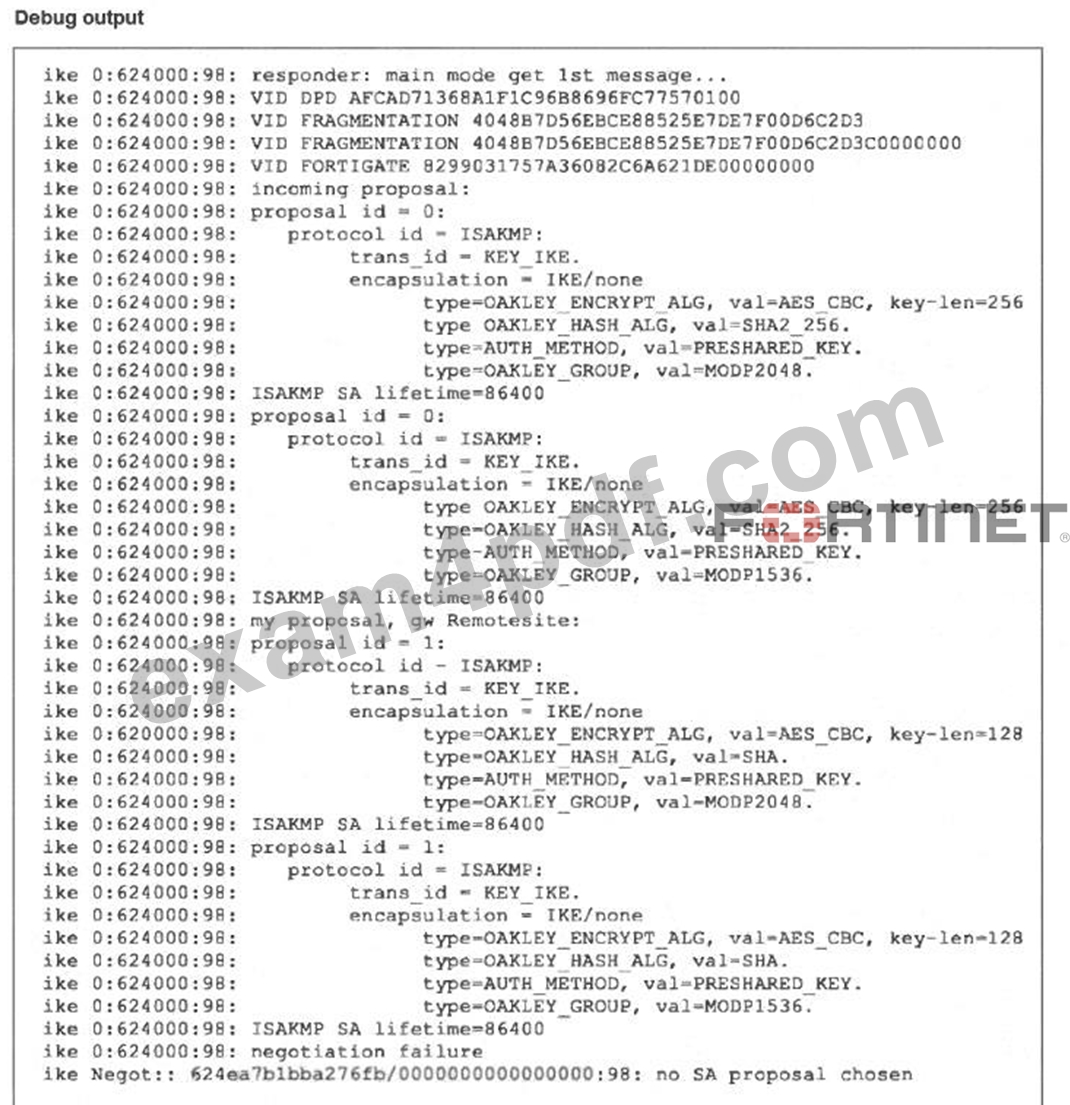
The administrator does not have access to the remote gateway.
Based on the debug output, which configuration change the administrator make to the local gateway to resolve the phase 1 negotiation error?
- A. In the phase 1 proposal configuration, add AES128-SHA128 to the list of encryption algorithms.
- B. In the phase 1 network configuration, set the IKE version to 2.
- C. In the phase 1 proposal configuration, add AES256-SHA256 to the list of encryption algorithms.
- D. In the phase 1 proposal configuration, add AESCBC-SHA2 to the list of encryption algorithms.
Answer: C
NEW QUESTION # 29
What are two reasons you might see iprope_in_check() check failed, drop when using the debug flow?
(Choose two.)
- A. Packet was dropped because of policy route misconfiguration.
- B. VIP or IP pool misconfiguration.
- C. Packet was dropped because of traffic shaping.
- D. Trusted host list misconfiguration.
Answer: A,D
NEW QUESTION # 30
Refer to the exhibit.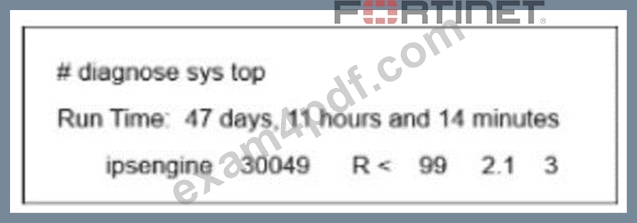
FortiGate is showing continuous high CPU usage During a maintenance window, the CLI command diagnose sys top displays the output shown in the exhibit. The CLI command diagnose twat application ipsmonitor 5 was run. but the CPU usage by daemon ipsengine did not drop Which immediate action can you take to reduce the CPU usage effectively?
- A. Execute diagnose test application ipsMonitor 2inatead.
- B. Bypass all IPS engines
- C. Reduce the number of IPS signatures enabled on the active IPS profiles
- D. Disable IPS on all firewall policies.
Answer: A
Explanation:
To solve this high CPU usage scenario involving the ipsengine, we must understand the specific functions of the diagnose test application ipsmonitor commands shown in the troubleshooting steps.
Analyze the Situation:
Exhibit: The diagnose sys top output shows the ipsengine process is in a run state (R) consuming 99% CPU.
Previous Action: The administrator already ran diagnose test application ipsmonitor 5.
Result: The CPU usage did not drop.
Understand the Commands:
diagnose test application ipsmonitor 5: This command toggles IPS Bypass Mode. When enabled, the IPS engine lets traffic pass through without inspection.
Implication: If the CPU was high due to traffic volume, enabling bypass would drop the CPU load immediately.
Failure: Since the CPU remained at 99% after bypass, the ipsengine process is likely frozen, stuck, or in an internal infinite loop unrelated to the current traffic flow. The process itself is the problem, not the traffic volume.
Evaluate the Solution (Option B):
diagnose test application ipsmonitor 2: This command toggles the IPS engine's Enable/Disable status.
Because the engine is stuck (bypass failed to relieve pressure), the "Immediate action" required is to stop or restart the process entirely.
Running option 2 effectively disables/kills the stuck IPS engine instance, which will immediately drop the CPU usage to near zero. (It can then be toggled again to restart it).
Why other options are incorrect:
A (Reduce signatures): This is a tuning measure for normal operation, not an immediate fix for a stuck process at 99% CPU.
C (Disable IPS on policies): This is a configuration change that takes time and requires a commit; it is not the most immediate diagnostic tool available.
D (Bypass all IPS engines): This describes the action of command 5 (Bypass), which the prompt explicitly states was already performed and failed.
Reference:
FortiGate Security 7.6 Study Guide (IPS & Diagnostics): "Troubleshooting IPS high CPU: 1. Check top. 2. Try bypass (ipsmonitor 5). 3. If CPU persists, restart the engine (ipsmonitor 99 or 2)."
NEW QUESTION # 31
Refer to the exhibit.
The output of a BGO debug command is shown.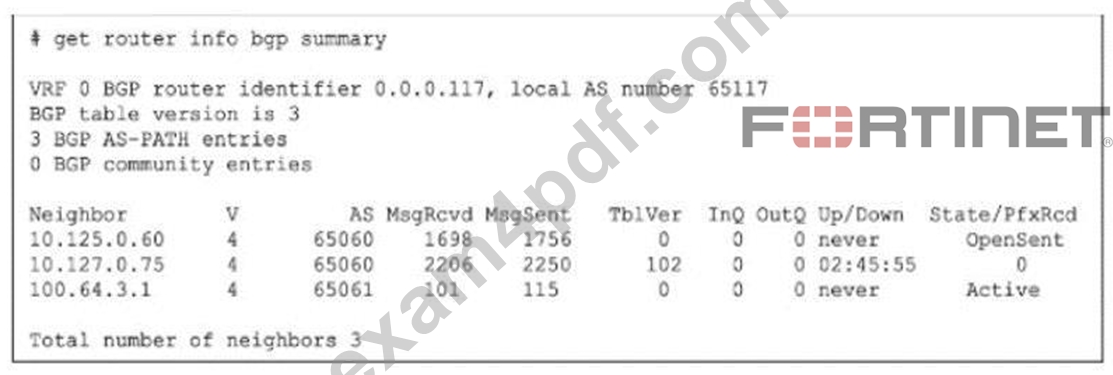
What is the most likely reason that the local FortiGate is not receiving any prefixes from its neighbors?
- A. The RIB-OUT configuration for router 10.127.0.75 prevents any route advertisement to the local router.
- B. The router 100.64.3.1 is waiting for the OPEN message from the local router.
- C. The local router is waiting for the keepalive message from the router 10.125.0.60.
- D. None of the three neighbors has successfully established the TCP three-way handshake with the local router.
Answer: A
Explanation:
To identify the reason for the lack of prefixes, we must interpret the State/PfxRcd and Up/Down columns in the get router info bgp summary exhibit.
Analyze Neighbor Status:
Neighbor 10.125.0.60: State is OpenSent. This session is not established. It is stuck in the negotiation phase.
Neighbor 100.64.3.1: State is Active. This session is not established. The router is actively trying to initiate a TCP connection.
Neighbor 10.127.0.75:
Up/Down: 02:45:55. This indicates the BGP session has been Up (Established) for almost 3 hours.
State/PfxRcd: 0. This number represents the count of prefixes received. The session is fully established, but the neighbor has sent zero routes.
Determine the Cause:
Since the session with 10.127.0.75 is established, connectivity and handshakes (Options A, B, C) are not the issue for this neighbor.
The fact that it is Up but sending 0 prefixes strongly implies that the neighbor is configured to filter out its routes before sending them to the local FortiGate.
Option D correctly identifies this as a RIB-OUT (Routing Information Base - Outbound) configuration issue on the neighbor (Router 10.127.0.75), which prevents it from advertising its routes.
Reference:
FortiGate Security 7.6 Study Guide (BGP): "In the BGP summary, if the State/PfxRcd shows a number (e.g.,
0), the session is Established. A value of 0 means the peering is up, but no routes have been received, often due to route-map or prefix-list filtering on the remote peer."
NEW QUESTION # 32
Refer to the exhibit.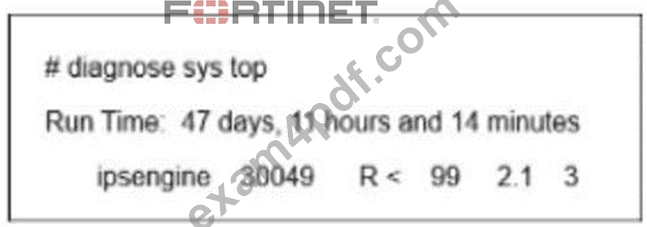
FortiGate is showing continuous high CPU usage During a maintenance window, the CLI command diagnose sys top displays the output shown in the exhibit. The CLI command diagnose twat application ipsmonitor 5 was run. but the CPU usage by daemon ipsengine did not drop Which immediate action can you take to reduce the CPU usage effectively?
- A. Execute diagnose test application ipsMonitor 2inatead.
- B. Bypass all IPS engines
- C. Reduce the number of IPS signatures enabled on the active IPS profiles
- D. Disable IPS on all firewall policies.
Answer: A
Explanation:
To solve this high CPU usage scenario involving the ipsengine, we must understand the specific functions of the diagnose test application ipsmonitor commands shown in the troubleshooting steps.
Analyze the Situation:
Exhibit: The diagnose sys top output shows the ipsengine process is in a run state (R) consuming 99% CPU.
Previous Action: The administrator already ran diagnose test application ipsmonitor 5.
Result: The CPU usage did not drop.
Understand the Commands:
diagnose test application ipsmonitor 5: This command toggles IPS Bypass Mode. When enabled, the IPS engine lets traffic pass through without inspection.
Implication: If the CPU was high due to traffic volume, enabling bypass would drop the CPU load immediately.
Failure: Since the CPU remained at 99% after bypass, the ipsengine process is likely frozen, stuck, or in an internal infinite loop unrelated to the current traffic flow. The process itself is the problem, not the traffic volume.
Evaluate the Solution (Option B):
diagnose test application ipsmonitor 2: This command toggles the IPS engine's Enable/Disable status.
Because the engine is stuck (bypass failed to relieve pressure), the "Immediate action" required is to stop or restart the process entirely.
Running option 2 effectively disables/kills the stuck IPS engine instance, which will immediately drop the CPU usage to near zero. (It can then be toggled again to restart it).
Why other options are incorrect:
A (Reduce signatures): This is a tuning measure for normal operation, not an immediate fix for a stuck process at 99% CPU.
C (Disable IPS on policies): This is a configuration change that takes time and requires a commit; it is not the most immediate diagnostic tool available.
D (Bypass all IPS engines): This describes the action of command 5 (Bypass), which the prompt explicitly states was already performed and failed.
Reference:
FortiGate Security 7.6 Study Guide (IPS & Diagnostics): "Troubleshooting IPS high CPU: 1. Check top. 2.
Try bypass (ipsmonitor 5). 3. If CPU persists, restart the engine (ipsmonitor 99 or 2)."
NEW QUESTION # 33
......
Last FCSS_NST_SE-7.6 practice test reviews: Practice Test Fortinet dumps: https://www.exam4pdf.com/FCSS_NST_SE-7.6-dumps-torrent.html
Try FCSS_NST_SE-7.6 Free Now! Real Exam Question Answers: https://drive.google.com/open?id=1Zih1pPfi5ciRwWMqMla8fBacu5is8DiO
