

[Jun-2026] Pass Juniper JN0-452 Exam in First Attempt Guaranteed!
Full JN0-452 Practice Test and 120 unique questions with explanations waiting just for you, get it now!
NEW QUESTION # 45
You receive a Marvis Actions alert informing you that there is a non-compliant AP at one of your sites.
What should you do to correct the problem?
- A. Disconnect the Rogue AP from your Ethernet switch.
- B. Request an RM
- C. Install the correct version of firmware on the AP.
- D. Replace the AP with the correct hardware model.
Answer: C
Explanation:
Reference: https://www.mist.com/documentation/what-is-marvis-actions/
NEW QUESTION # 46
A client device is associated to a Mist AP and is functioning correctly. A network administrator wants to move this AP to a different site in the same organization. What is the correct procedure to move the AP in the Mist UI?
- A. Delete the AP from the current site and then re-claim it into the new site.
- B. In the AP's configuration page, change the "Site Assignment" property to the new site.
- C. In the Organization > Inventory page, select the AP and use the "Assign to Site" option in the More menu.
- D. Create a device profile for the new site and add the AP's MAC address to it.
Answer: C
NEW QUESTION # 47
Click the Exhibit button.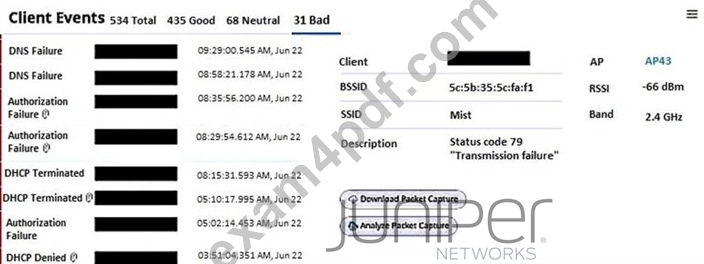
Referring to the exhibit, which statement is correct?
- A. The packet capture will contain full frames.
- B. The packet capture was taken manually.
- C. The packet capture will contain only management frames.
- D. The packet capture was taken automatically.
Answer: A
NEW QUESTION # 48
An administrator is reviewing the AP Health SLE for a site and observes failures attributed to the
"Ethernet Errors" classifier.
What is the underlying cause of this specific failure?
- A. The AP has lost its IP address.
- B. The AP has rebooted unexpectedly.
- C. The AP has lost connectivity to the Mist cloud.
- D. The AP's Ethernet port is detecting a high rate of physical errors, such as CRC errors, on its wired connection to the switch.
Answer: D
NEW QUESTION # 49
The "Capacity" SLE is showing a poor health score.
Which of these is a likely cause?
- A. The RADIUS server is slow to respond.
- B. A client is too far away from the AP.
- C. The AP has a faulty cable connection to the switch.
- D. A large number of clients are connected to a single AP, and the RF channel is overutilized.
Answer: D
NEW QUESTION # 50
During the client connection process to a WPA2-Personal network, what is the primary purpose of the 4-Way Handshake that occurs after a successful association?
- A. To assign the client an IP address via DHCP.
- B. For the client to request a list of neighboring APs to facilitate future roaming.
- C. For the client and AP to mutually verify that they both possess the correct pre-shared key (PSK) and to derive the unique session keys used for encrypting data traffic.
- D. For the AP to check the client's MAC address against a RADIUS server.
Answer: C
NEW QUESTION # 51
Which 802.11 amendment, also known as Wi-Fi 6, introduced Orthogonal Frequency-Division Multiple Access (OFDMA) to improve efficiency in high-density environments?
- A. 802.11n
- B. 802.11ax
- C. 802.11be
- D. 802.11ac
Answer: B
NEW QUESTION # 52
What information is required to initially claim an AP and assign it to a Mist organization?
- A. The AP's MAC address and the Claim Code from the packaging.
- B. The AP's serial number and its IP address.
- C. The AP's model number and the site name.
- D. The AP's MAC address and a password set on the AP.
Answer: A
NEW QUESTION # 53
Which statement best describes the function of Proximity Tracing within the Juniper Mist LBS portfolio?
- A. It provides a real-time "blue dot" indoor navigation experience for mobile app users.
- B. It uses the mobile SDK to log close-contact interactions between users for health and safety purposes.
- C. It tracks the location of BLE-tagged physical assets on a floorplan.
- D. It creates a historical heatmap of user density in different zones.
Answer: B
NEW QUESTION # 54
What does Mist qualify as a rogue AP?
- A. A neighbor AP
- B. An AP close to your network as measured by RSSI
- C. A honeypot AP
- D. An unauthorized AP on your wired network
Answer: D
Explanation:
InJuniper Networks Mist AI Wireless, arogue access point (AP)is precisely defined to avoid confusion with external or non-threatening wireless devices. Mist qualifies a rogue AP asan unauthorized access point that is physically connected to your wired network infrastructure.
This distinction is critical from a security perspective. A rogue AP represents a direct threat because it bypasses established security controls by providing wireless access into the enterprise wired network without authorization. Such APs are often installed by users without IT approval or, in more serious cases, by malicious actors attempting to gain internal network access.
Mist APs continuously scan the RF environment and correlate wireless observations with wired-side intelligence. If an AP is detected advertising SSIDs and Mist can confirm-through MAC address correlation and wired discovery-that the device is connected to the enterprise's wired network but isnot claimed or authorized in the Mist cloud, it is classified as a rogue AP. This allows administrators to take immediate remediation actions, such as physical removal or switch-port shutdown.
The other options are incorrect for the following reasons:
* Neighbor APsare access points belonging to nearby organizations or environments and are not security threats by default. Mist classifies these separately for RF awareness.
* APs close to your network as measured by RSSImay simply be physically nearby but not connected to your infrastructure; proximity alone does not make an AP rogue.
* Honeypot APsare intentionally deployed decoy access points used in security research or attack detection and are not Mist's definition of a rogue AP.
Therefore, Mist correctly defines a rogue AP asan unauthorized AP connected to your wired network, making optionAthe correct answer.
NEW QUESTION # 55
Which modulation method will result in the highest theoretical data rates?
- A. QPSK
- B. 64 QAM
- C. 16 QAM
- D. BPSK
Answer: B
NEW QUESTION # 56
What information would be streamed through webhooks? (Choose two.)
- A. SLE metrics of clients
- B. location coordinates of RFID tags
- C. audit logs
- D. alerts
Answer: A,D
Explanation:
According to the Webhooks - Mist document, two types of information that would be streamed through webhooks are:
* Alerts, which are notifications that are triggered by certain events or conditions on the network.
* SLE metrics of clients, which are service level expectations that measure the quality of experience for clients on various aspects such as connection, coverage, capacity, throughput, and roaming.
References: https://www.mist.com/documentation/webhooks/
NEW QUESTION # 57
You are asked to clone your Juniper Mist primary site configuration to use for a new site being added. In this scenario, which two configuration objects will be copied? (Choose two.)
- A. the RF templates
- B. the Auto Firmware Upgrade settings
- C. the WLANs
- D. the site location
Answer: A,B
Explanation:
The Clone Site feature in the Juniper Mist dashboard is a powerful tool designed to streamline the deployment of new physical locations by duplicating the environmental and operational logic of an existing
"gold standard" site. However, to avoid configuration conflicts (such as duplicate addresses) and to maintain the integrity of the hierarchy, Mist is selective about which objects are carried over during the cloning process.
According to Juniper Mist documentation, only the settings visible on the Site Configuration page are copied to the new site. This specifically includes:
* Auto Firmware Upgrade settings (A): The specific versioning (Production vs. RC) and the weekly or daily maintenance windows defined for the site are preserved. This ensures that the new site follows the same lifecycle management policy as the primary site.
* RF Templates (B): The radio resource management (RRM) profile assigned to the site is copied. This includes channel planning, bandwidth settings (20/40/80 MHz), and power level constraints tailored for that environment.
* Other Site-Level Settings: This also includes Webhooks, Rogue/Honeypot AP detection rules, and Location Services settings.
Conversely, certain objects are explicitly not copied. The Site Location (C) and Site Name are excluded because each site must be geographically unique for accurate mapping and time zone calculation. WLANs (D) are also not copied through the Clone Site function; SSIDs are typically managed at the Organization level via WLAN Templates, which are then mapped to sites or site groups rather than being "hardcoded" into an individual site's local configuration. By cloning the site-specific parameters like RF templates and upgrade schedules, Mist allows administrators to rapidly scale their infrastructure while ensuring the core network access (WLANs) is maintained through the overarching organizational policy.
NEW QUESTION # 58
An organization has two sites: New York and London. They want to apply a consistent set of WLANs, security policies, and RF settings to all APs in the New York site. What is the most efficient way to achieve this in the Mist UI?
- A. Use Marvis to copy settings between APs.
- B. Use a Template and apply it to the New York site.
- C. Create a Device Profile for each AP model.
- D. Configure each AP in New York individually.
Answer: B
NEW QUESTION # 59
What is the method of claiming multiple Juniper Access Points simultaneously to an organization?
- A. Use a digital certificate.
- B. Use the Juniper Mist Mobile Application.
- C. Use a QR code.
- D. Use an activation code.
Answer: D
Explanation:
InJuniper Networks Mist AI Wireless, access points must beclaimedto an organization in the Mist cloud before they can be configured, monitored, and managed. When deploying APs at scale, Juniper provides an efficient mechanism to onboardmultiple access points simultaneouslyusing anactivation code.
An activation code is abulk-claim methodgenerated within the Mist cloud portal. This code is typically associated with a purchase order or shipment and can represent dozens, hundreds, or even thousands of access points. When the activation code is applied to an organization, all APs tied to that code are automatically claimed at once. This approach is especially valuable for enterprise and campus deployments, where manual per-device onboarding would be impractical.
Once claimed using an activation code, APs can be assigned to sites, receive configurations, and leverage Zero-Touch Provisioning (ZTP). As soon as the APs obtain network connectivity and reach the Mist cloud, they automatically download their configuration and become operational without further manual intervention.
The other options are incorrect for the following reasons:
* QR codesare used for claimingindividual APs, typically during small deployments or troubleshooting scenarios.
* Digital certificatesare used for secure authentication and communication but are not a method for claiming APs to an organization.
* The Juniper Mist Mobile Applicationcan assist with onboarding and visibility but does not provide a bulk-claim mechanism for large numbers of APs.
Therefore, the correct and documented method for claimingmultiple Juniper Access Points simultaneously is touse an activation code, making optionAthe correct answer.
NEW QUESTION # 60
A university is preparing for final exams week and expects a very high density of users in the library. The IT team wants to proactively optimize the wireless network to handle the increased load. The APs are all dual-band capable.
Which two RRM configurations would be most effective in this scenario? (Select all that apply.)
- A. In the RF Template, setting the "2.4 GHz Settings" to "Disabled" for the entire site.
- B. In the RF Template, setting channel widths to 80 MHz in the 5 GHz band.
- C. In the RF Template, setting the "Dual Band Radio Settings" to "Auto" to allow auto-conversion of
2.4 GHz radios to 5 GHz. - D. In the RF Template, allowing RRM to automatically manage channel and power settings.
- E. Manually setting all APs to use channel 1 in the 2.4 GHz band.
Answer: C,D
NEW QUESTION # 61
What is the AP's role in the IEEE 802.1X authentication process?
- A. It acts as a supplicant.
- B. It acts as an authenticator.
- C. It acts as an authentication server.
- D. It acts as a RADIUS proxy server.
Answer: B
Explanation:
In the IEEE 802.1X authentication process, the AP acts as an authenticator.
According to the Lecture 5 - Security - Part 1 document, the AP's role in the IEEE 802.1X authentication process is to act as an authenticator. This means that the AP acts as a gatekeeper between the client device (supplicant) and the RADIUS server (authentication server). The AP forwards authentication messages between the supplicant and the server and grants or denies network access based on the server's response.
References:
http://faculty.georgebrown.ca/~jolenewa/courses/comp3049-intermediate-wirel/lecture-5-security.pdf
NEW QUESTION # 62
An administrator at a university campus is troubleshooting intermittent connectivity issues for users on a tunneled WLAN. The APs are connected to a Mist Edge cluster. The administrator suspects one of the Mist Edge appliances in the cluster may be failing.
They review the Mist Edge events log.
Mist Edge Events
Timestamp | Mist Edge | Event Type
--|--|
2025-07-16 09:30:15 | ME-Campus-01 | Tunnel Service Restarted 2025-07-16 09:35:20 | ME- Campus-02 | Upstream Resource Unreachable 2025-07-16 09:35:22 | ME-Campus-02 | Tunnel Service Inactive Based on these events, what is the most likely cause of the user connectivity issues?
- A. ME-Campus-02 has detected a failure with a critical upstream resource, causing its tunnel service to stop.
- B. The entire Mist Edge cluster has been misconfigured in the WLAN template.
- C. All APs have lost power due to a switch failure.
- D. The administrator has manually rebooted ME-Campus-01.
Answer: A
NEW QUESTION # 63
Your Juniper Access Point has changed channels due to RADAR being observed on a DFS channel.
This change is an example of which Juniper Mist RRM system?
- A. Reinforcement learning
- B. FCC compliance
- C. Global optimization
- D. Event-driven
Answer: D
Explanation:
InJuniper Networks Mist AI Wireless, Radio Resource Management (RRM) uses multiple decision-making systems to adapt the RF environment intelligently. A channel change triggered by the detection ofRADAR on a DFS (Dynamic Frequency Selection) channelis a clear example of anevent-driven RRM action.
DFS channels are regulated frequencies that must be shared with weather, military, and aviation radar systems. Regulatory bodies require wireless devices toimmediately vacate a DFS channelwhen radar activity is detected. When a Juniper Mist AP operating on a DFS channel detects radar signatures, it generates areal-time RF event. This event forces the AP to immediately stop transmitting on that channel and move to a new, non-DFS or alternate DFS channel.
Mist classifies this behavior asevent-driven RRMbecause:
* The channel change isreactive, not predictive
* It is triggered by aspecific external RF event(radar detection)
* It requiresimmediate actionto maintain regulatory compliance and avoid interference The other options are incorrect for the following reasons:
* FCC compliancedefineswhythe change is required, but it is not an RRM system or decision model.
* Global optimizationrefers to long-term RF tuning across the network based on historical performance data, not immediate forced changes.
* Reinforcement learningis used by Mist to optimize RF parameters over time through continuous learning, not for mandatory, instantaneous responses to radar events.
Mist RRM combinesevent-driven actions,AI-based global optimization, andreinforcement learningto deliver both compliance and performance. In the case of radar detection on a DFS channel, the AP's channel change is driven by areal-time RF event, makingevent-driven RRMthe correct answer.
NEW QUESTION # 64
Regarding roaming, which device determines when it is time to connect to another AP?
- A. the client device
- B. the current AP
- C. the primary AP
- D. the gateway router
Answer: A
Explanation:
According to the Cisco Catalyst 9800 Series Wireless Controller Software Configuration Guide1, roaming is the process of moving a wireless client device from one AP to another while maintaining network connectivity. The client device determines when it is time to connect to another AP based on its own roaming algorithm and criteria.
References: https://www.cisco.com/c/en/us/td/docs/wireless/controller/9800/17-2/config-guide/b_wl_17_2_cg
/roaming.html
NEW QUESTION # 65
An administrator is configuring the Service Level Expectations for a new site. They want to ensure that users can connect to the network quickly.
Which SLE allows the administrator to define a specific time-based goal, in seconds, for the entire connection process (Association, Authorization, DHCP)?
- A. Capacity
- B. Roaming
- C. Time to Connect
- D. Successful Connects
Answer: C
NEW QUESTION # 66
What do 802.11 stations perform to help avoid collisions on the WLAN medium?
- A. Stations only transmit when polled by the access point.
- B. 802.11 stations detect collisions and set a back-off timer.
- C. Transmit on a fixed schedule.
- D. Listen to verify that the medium is free before transmitting.
Answer: D
Explanation:
Reference: https://blogs.arubanetworks.com/industries/understanding-802-11-medium-contention/ According to the IEEE 802.11 - Wikipedia document, one thing that 802.11 stations perform to help avoid collisions on the WLAN medium is to listen to verify that the medium is free before transmitting. This is part of the carrier-sense multiple access with collision avoidance (CSMA/CA) mechanism that 802.11 stations use to coordinate access to the shared medium.
References: https://en.wikipedia.org/wiki/IEEE_802.11
NEW QUESTION # 67
Refer to Exhibit: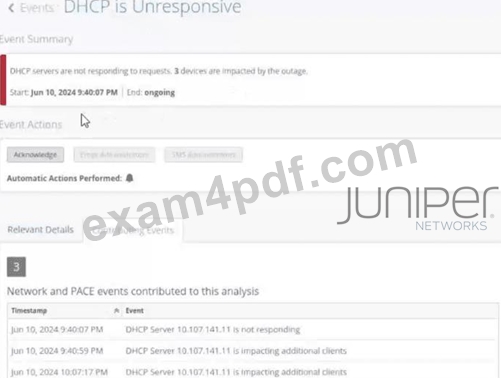
You notice that your site events show an unresponsive DHCP server in your network. You want to analyze the event by using the dynamic packet capture.
Referring to the exhibit, how would you access the packet capture for further analysis in Wireshark?
- A. Verify the impacted site and use the corresponding organization event to fetch the automatically generated packet capture.
- B. Verify the impacted client and use the corresponding client event to fetch the automatically generated packet capture.
- C. Verify the impacted site and use the corresponding site event to fetch the automatically generated packet capture.
- D. Verify the impacted client and use the corresponding site event to fetch the automatically generated packet capture.
Answer: C
Explanation:
InJuniper Networks Mist AI Wireless,dynamic packet capture (dPCAP)is tightly integrated with events to enable rapid, context-aware troubleshooting. When Mist detects a systemic issue-such as aDHCP server becoming unresponsive-it automatically generates asite-level eventbecause the problem impacts multiple devices within a site rather than a single client.
As shown in the exhibit, the event "DHCP is Unresponsive" lists multiple impacted devices and includes a timeline of contributing network events. This classification is critical: DHCP infrastructure failures are treated assite events, not client-specific or organization-wide events. When such a site event is triggered, Mist can automatically perform adynamic packet captureon the relevant access points to capture DHCP Discover, Offer, Request, and Acknowledgment (DORA) traffic in real time.
To access this packet capture, an administrator must:
* Navigate to theimpacted siteidentified in the event.
* Open thecorresponding site event(in this case, the DHCP unresponsive event).
* Download theautomatically generated packet capture file, which can then be opened inWireshark for detailed protocol-level analysis.
The incorrect options are explained as follows:
* Organization eventsprovide high-level visibility and auditing but do not host packet captures.
* Client eventsare used when a single client experiences issues; they are not appropriate when multiple devices are impacted by a shared service failure.
* Verifying an impacted client does not expose the dynamic packet capture tied to a site-wide DHCP issue.
Therefore, the correct method is toverify the impacted site and use the corresponding site event to fetch the automatically generated packet capture, makingOption Bthe correct answer.
NEW QUESTION # 68
......
Prepare for your Juniper certification with the updated Exam4PDF JN0-452 exam questions: https://drive.google.com/open?id=106ROAJobHThepxxGtohknMpV2sks2oxM
Get Latest JN0-452 Dumps Exam Questions in here: https://www.exam4pdf.com/JN0-452-dumps-torrent.html
