

Microsoft AZ-800 Test Engine Practice Test Questions, Exam Dumps
100% Free AZ-800 Daily Practice Exam With 262 Questions
NEW QUESTION # 25
Your company has a main office and a branch office. The two offices are connected by using a WAN link. Each office contains a firewall that filters WAN traffic.
The network in the branch office contains 10 servers that run Windows Server. All servers are administered from the main office only.
You plan to manage the servers in the branch office by using a Windows Admin Center gateway.
On a server in the branch office, you install the Windows Admin Center gateway by using the defaults settings.
You need to configure the firewall in the branch office to allow the required inbound connection to the Windows Admin Center gateway.
Which inbound TCP port should you allow?
- A. 0
- B. 1
- C. 2
- D. 3
Answer: C
NEW QUESTION # 26
Your network contains an Active Directory Domain Services (AD DS) domain.
You have a Group Policy Object (GPO) named GPO1 that contains Group Policy preferences.
You plan to link GPO1 to the domain.
You need to ensure that the preference in GPO1 apply only to domain member servers and NOT to domain controllers or client computers. All the other Group Policy settings in GPO1 must apply to all the computers. The solution must minimize administrative effort.
Which type of item level targeting should you use?
- A. Domain
- B. Environment Variable
- C. Security Group
- D. Operating System
Answer: D
Explanation:
https://docs.microsoft.com/en-us/previous-versions/windows/it-pro/windows-server-2012-r2-and-
2012/dn789189(v=ws.11)#operating-system-targeting
NEW QUESTION # 27
You have a Windows Server 2022 container host named Host1 that has the Subsystem for Linux installed and the container images shown in the following table.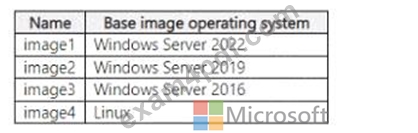
You need to deploy the images to Host1. The solution must maximize the isolation of the containers.
Which images can you run by using process isolation, and which images can you run by using Hyper-V isolation? To answer, select the appropriate options in the answer area.
NOTE: Each correct selection is worth one point.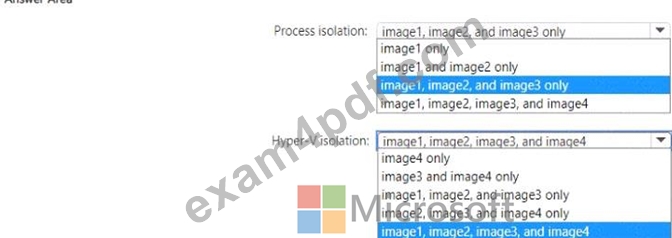
Answer:
Explanation: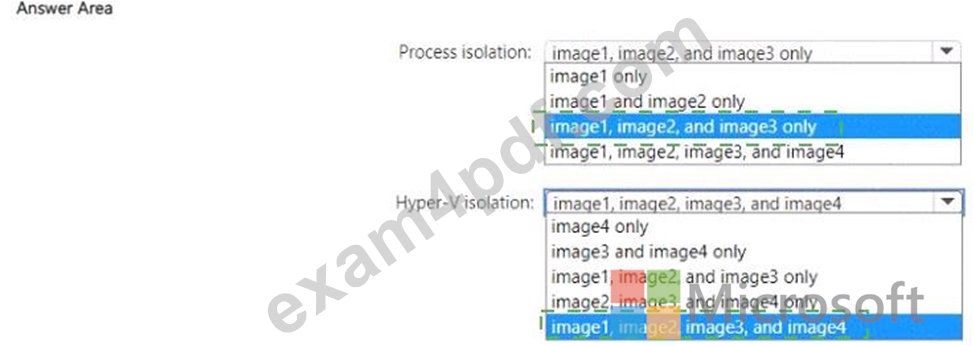
Explanation:
NEW QUESTION # 28
Hotspot Question
Your network contains two VLANs for client computers and one VLAN for a datacenter. Each VLAN is assigned an IPv4 subnet. Currently, all the client computers use static IP addresses.
You plan to deploy a DHCP server to the VLAN in the datacenter.
You need to use the DHCP server to provide IP configurations to all the client computers.
What is the minimum number of scopes and DHCP relays you should create? To answer, select the appropriate option the answer area.
NOTE: Each correct selection is worth one point.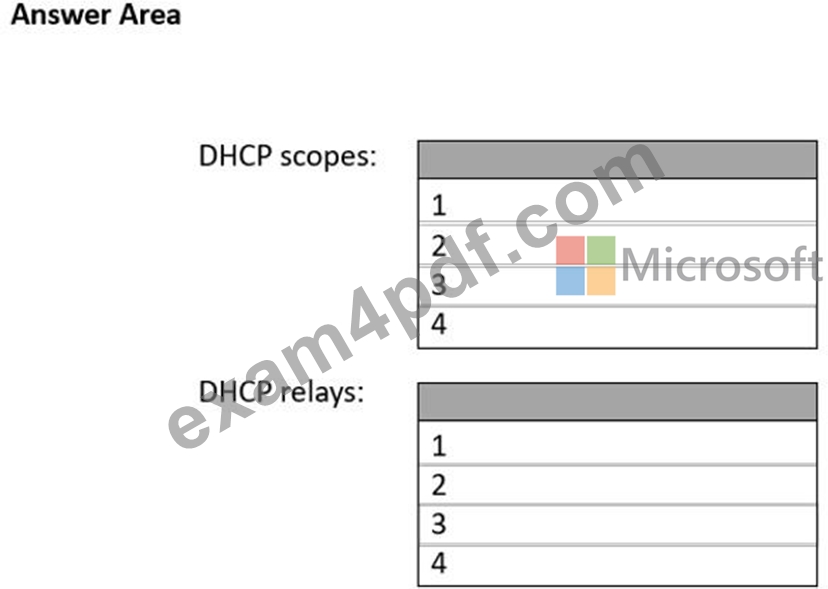
Answer:
Explanation: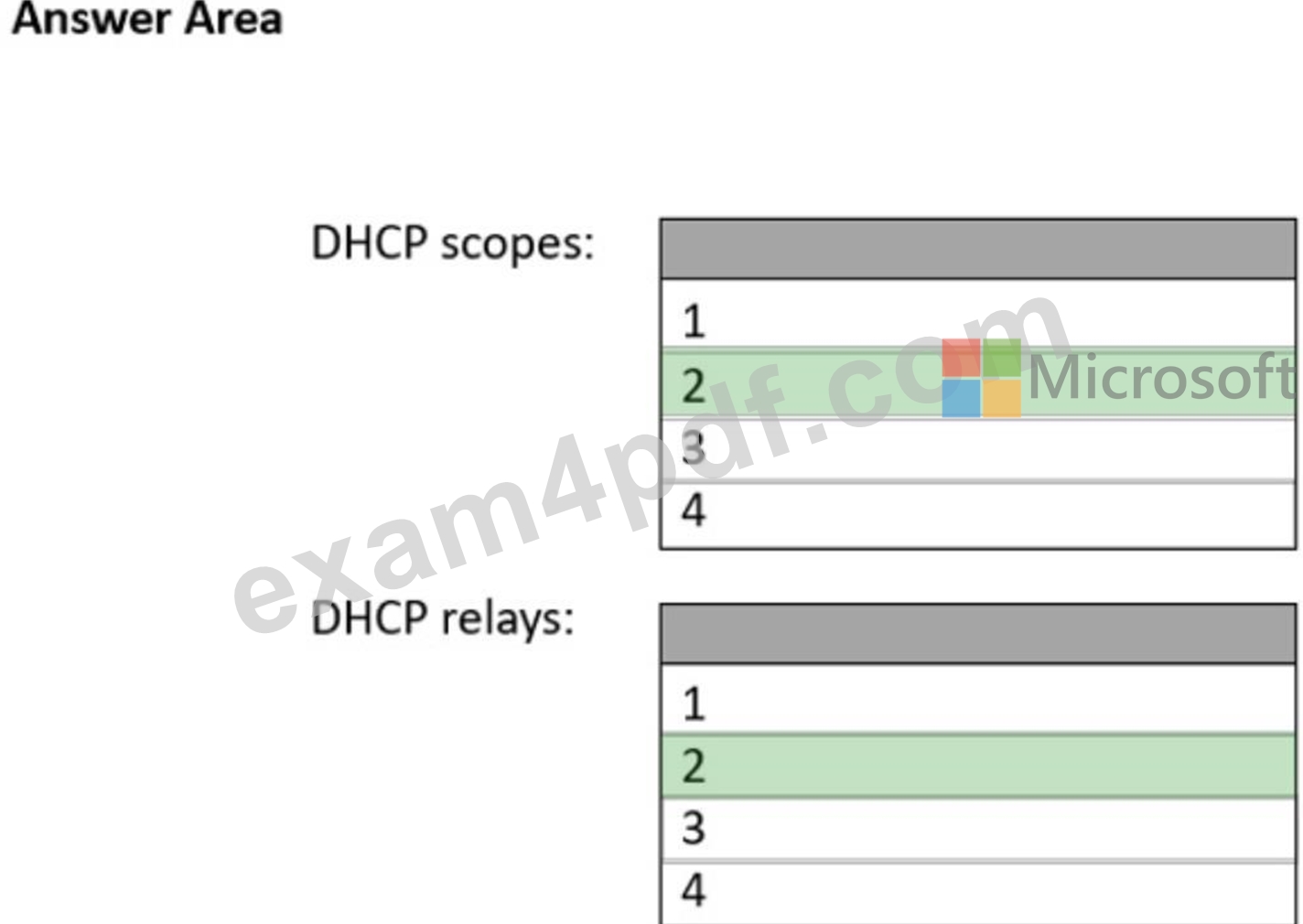
Explanation:
Box 1: 2
You need a scope for each client subnet, but you don't need a scope for the datacenter subnet.
Box 2: 2
The two client VLANs need a DHCP Relay Agent to forward DHCP requests to the DHCP server.
The datacenter VLAN that contains the DHCP server does not require a DHCP Relay Agent.
NEW QUESTION # 29
Your network contains an Active Directory Domain Services (AD DS) forest. The forest contains two domains named contoso.com and east.contoso.com. Contoso.com contains two users named CONTOSO
\User1 and EAST\User2.
You need to ensure that the users can perform the following tasks:
* User1 must deploy an additional domain controller to eastcontoso.com.
* User2 must deploy a new domain controller that will host a domain named west.contoso.com.
The solution must follow the principle of least privilege.
To which group should you add each user? To answer, select the appropriate options in the answer area.
NOTE: Each correct selection is worth one point.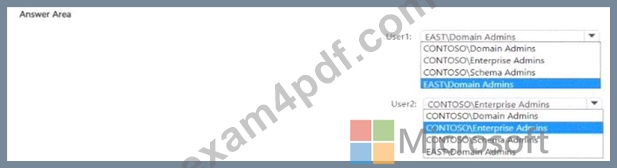
Answer:
Explanation: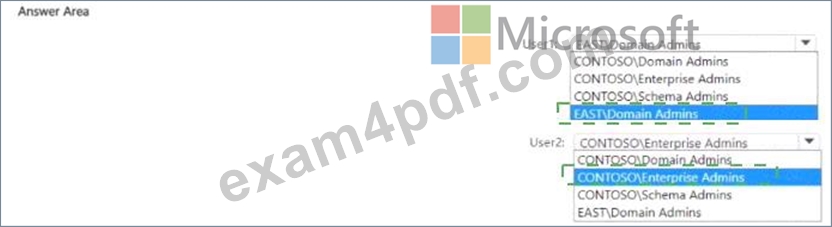
Explanation:
NEW QUESTION # 30
Your network contains an Active Directory Domain Services (AD DS) domain- The domain contains 10 servers that run Windows Server. The servers have static IP addresses.
You plan to use DHCP to assign IP addresses to the servers.
You need to ensure that each server always receives the same IP address.
Which type of identifier should you use to create a DHCP reservation for each server?
- A. MAC address
- B. NetBIOS name
- C. universally unique identifier (UUID)
- D. fully qualified domain name (FQDN)
Answer: A
Explanation:
Reference:
https://docs.microsoft.com/en-us/powershell/module/dhcpserver/add-dhcpserverv4reservation?
view=windowsserver2022-ps
NEW QUESTION # 31
You have an onpremises DNS server named Server1 that runs Windows Server. Server 1 hosts a DNS zone named fabrikam.com You have an Azure subscription that contains the resources shown in the following table.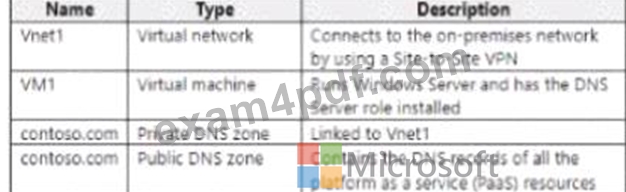
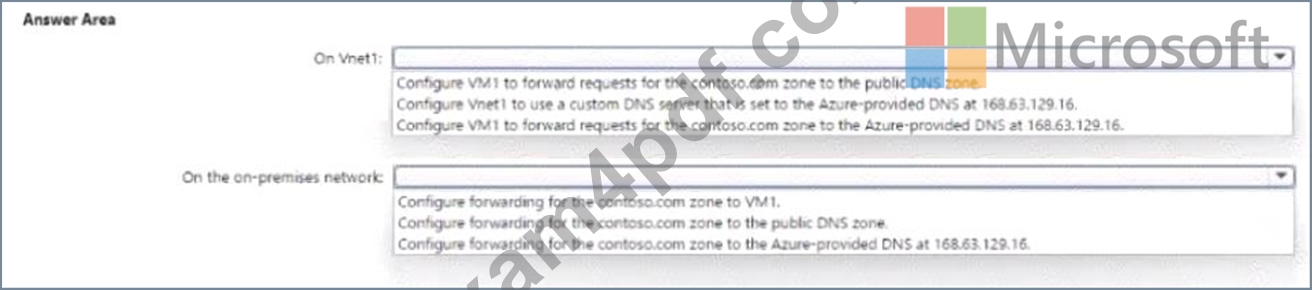
Answer:
Explanation: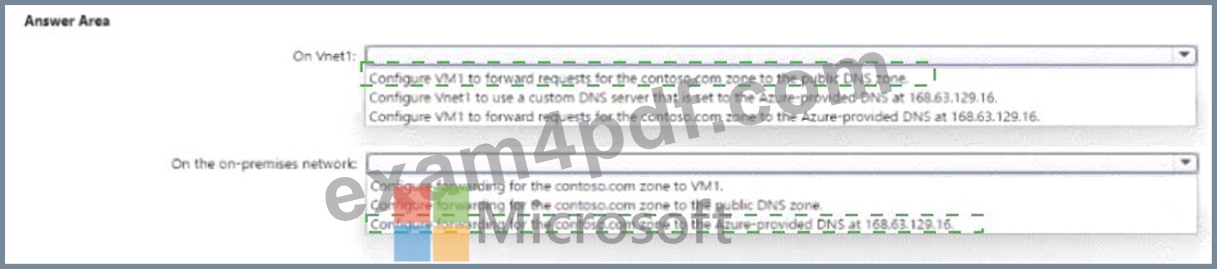
Explanation:
NEW QUESTION # 32
Your network contains an Active Directory Domain Services (AD DS) forest named contoso.com. The forest contains a child domain named east.contoso.com and the servers shown in the following table.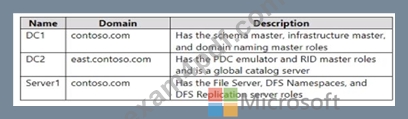
You need to create a folder for the Central Store to manage Group Policy template files for the entire forest.
What should you name the folder, and on which server should you create the folder? To answer, select the appropriate options in the answer area.
NOTE: Each correct selection is worth one point.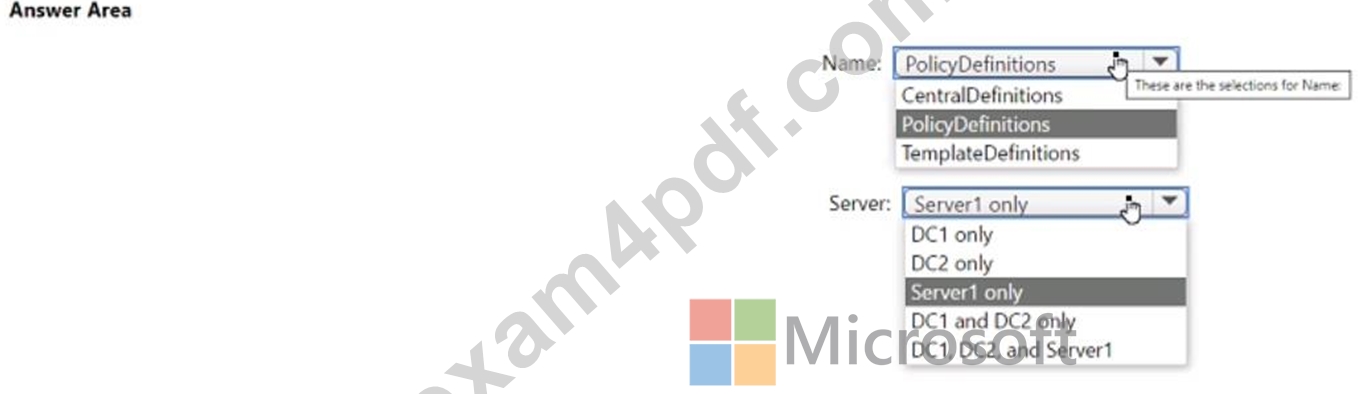
Answer:
Explanation: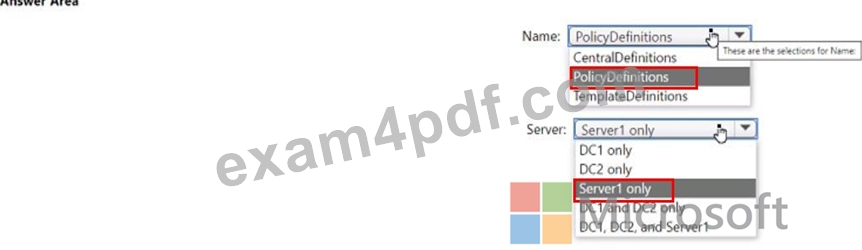
NEW QUESTION # 33
You create an Azure virtual machine named Server1 that runs Windows Server.
Server1 has the disk configuration shown in the following exhibit.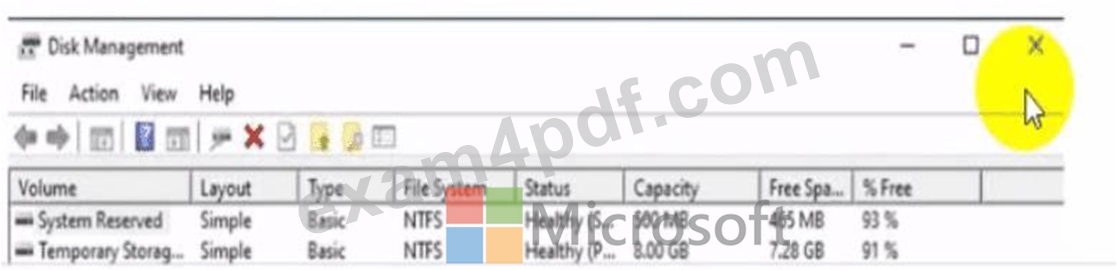

Answer:
Explanation:
Explanation: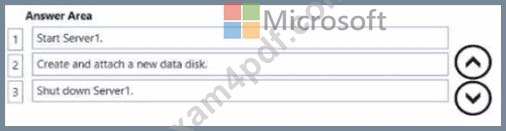
NEW QUESTION # 34
You have an Azure virtual machine named Server1 that runs a network management application. Server1 has the following network configuration.
* Network interface.Nic1
* IP address 10.1.1.1/24
* Connected to: Vnet1/Subnet1
You need connect Server1 to an additional subnet named Vnet1/Subnet2.
What should you do?
- A. Modify the IP configurations of Nic1.
- B. Create a private endpoint on Subnet2
- C. Add an IP configuration to Nic1.
- D. Add a network interface to server1.
Answer: D
Explanation:
In Azure, a single network interface (NIC) can have multiple IP configurations, but all IP configurations on a NIC must belong to the same subnet. The Administering Windows Server Hybrid Core Infrastructure guidance on Azure IaaS networking states that to place a VM on more than one subnet at the same time, you must attach additional NICs, with each NIC connected to the target subnet. Relevant guidance includes:
"Each IP configuration assigned to a network interface is allocated from the subnet to which that NIC is attached; a NIC cannot span subnets." and "To connect a VM to multiple subnets, add one or more additional network interfaces and attach each to the required subnet, subject to the VM size and OS limits for NIC count." Applying this to Server1: Nic1 is already attached to Vnet1/Subnet1 with IP 10.1.1.1/24. You cannot connect Nic1 simultaneously to Vnet1/Subnet2 by adding or modifying IP configurations because that would violate the same-subnet-per-NIC rule. Moving Nic1 to Subnet2 would disconnect it from Subnet1, which does not meet the requirement of connecting to an additional subnet. Therefore, the correct action is to add a second NIC to Server1 and attach it to Vnet1/Subnet2, ensuring the VM size supports multiple NICs.
NEW QUESTION # 35
Hotspot Question
You have an Azure Active Directory Domain Services (Azure AD DS) domain.
You create a new user named Admin1.
You need Admin1 to deploy custom Group Policy settings to all the computers in the domain. The solution must use the principle of least privilege.
What should you include in the solution? To answer, select the appropriate options in the answer area.
NOTE: Each correct selection is worth one point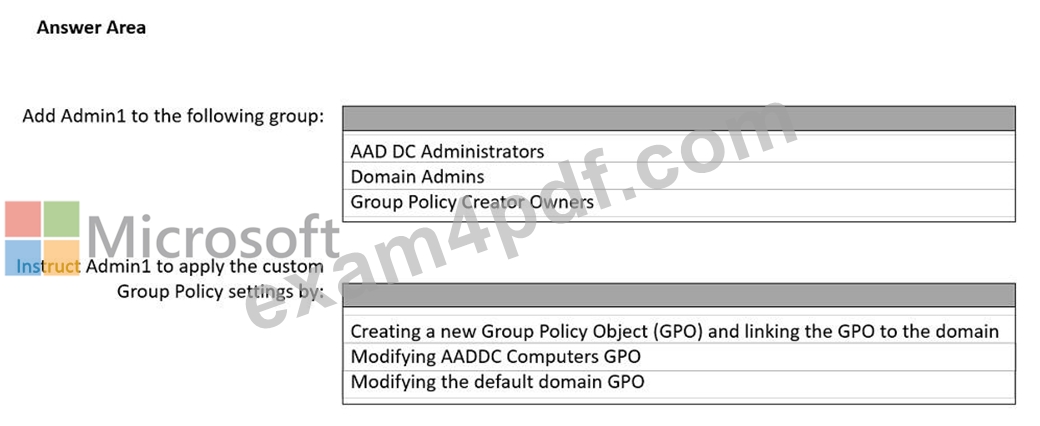
Answer:
Explanation: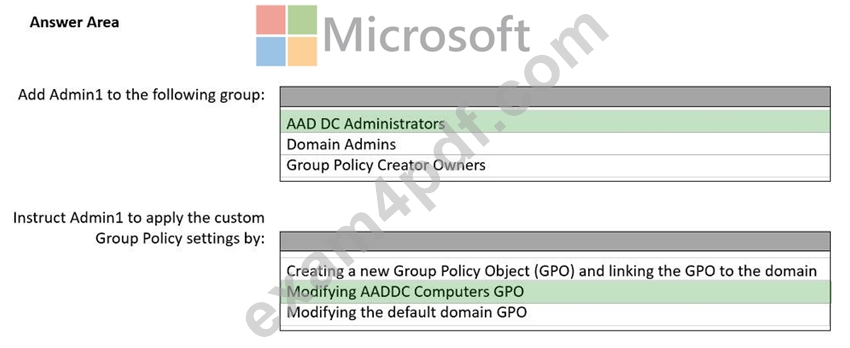
Explanation:
https://docs.microsoft.com/en-us/azure/active-directory-domain-services/manage-group-policy
NEW QUESTION # 36
You have a Windows Server container host named Server1 and an Azure subscription.
You deploy an Azure container registry named Registry1 to the subscription.
On Server1, you create a container image named image1.
You need to store imager in Registry1.
Which command should you run on Server1 ? To answer, select the appropriate options in the answer area.
NOTE: Each correct selection is worth one point.
Answer:
Explanation:
Explanation:
Reference:
https://docs.microsoft.com/en-us/azure/container-registry/container-registry-get-started-docker-cli?tabs=azure-cl
NEW QUESTION # 37
For each of the following statements, select Yes if the statement is true. Otherwise, select No.
NOTE: Each correct selection is worth one point.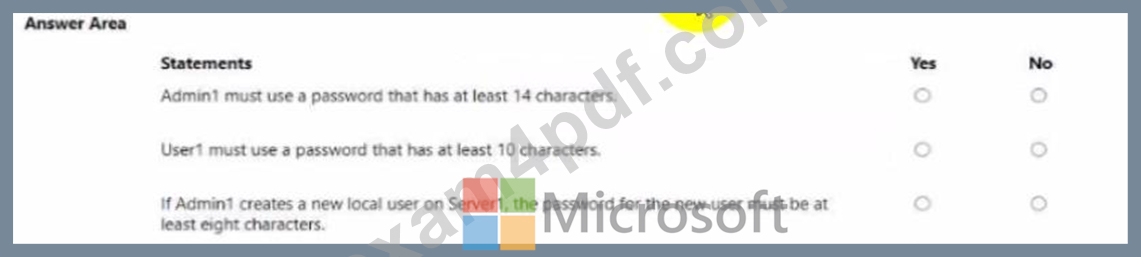
Answer:
Explanation: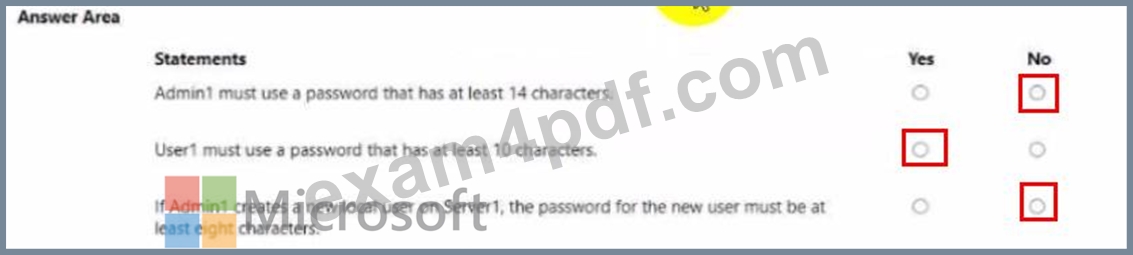
NEW QUESTION # 38
Your network contains an Active Directory Domain Services (AD DS) domain. The domain contains the domain controllers shown in the following table.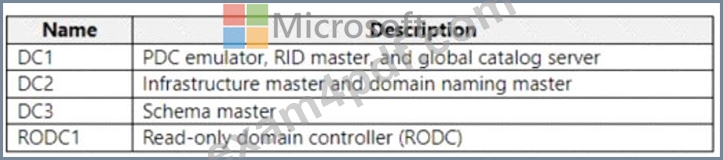
You need to ensure that if an attacker compromises the computer account of RODC1, the attacker cannot view the Employee-Number AD DS attribute. Which partition should you modify?
- A. schema
- B. global catalog
- C. configuration
- D. domain
Answer: A
NEW QUESTION # 39
You have a Windows Server container host named Server1 and an Azure subscription.
You deploy an Azure container registry named Registry1 to the subscription.
On Server1, you create a container image named image1.
You need to store imager in Registry1.
Which command should you run on Server1 ? To answer, select the appropriate options in the answer area.
NOTE: Each correct selection is worth one point.
Answer:
Explanation:
Reference:
https://docs.microsoft.com/en-us/azure/container-registry/container-registry-get-started-docker-cli?tabs=azure-cli#push-the-image-to-your-registry
NEW QUESTION # 40
You create a new Azure subscription.
You plan to deploy Azure Active Directory Domain Services (Azure AD DS) and Azure virtual machines. The virtual machines will be joined to Azure AD DS.
You need to deploy Active Directory Domain Services (AD DS) to ensure that the virtual machines can be deployed and joined to Azure AD DS.
Which three actions should you perform in sequence? To answer, move the appropriate actions from the list of actions to the answer area and arrange them in the correct order.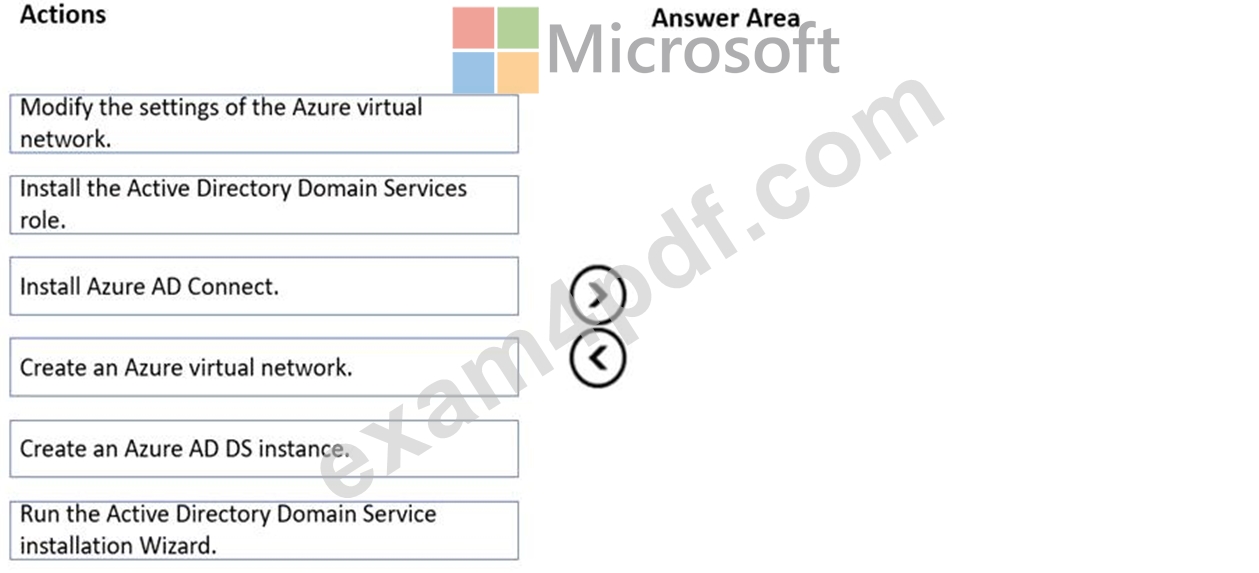
Answer:
Explanation: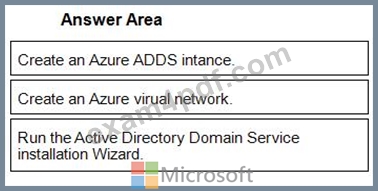
1 - Create an Azure ADDS intance.
2 - Create an Azure virual network.
3 - Run the Active Directory Domain Service installation Wizard.
Reference:
https://docs.microsoft.com/en-us/azure/active-directory-domain-services/tutorial-create-instance
NEW QUESTION # 41
Your network contains an Active Directory Domain Services (AD DS) domain named contoso.com.
The network contains the servers shown in the following table.
You plan to implement IP Address Management (IPAM).
You need to use the Group Policy based provisioning method for managed servers. The solution must support server discovery.
What should you do? To answer, select the appropriate options in the answer area.
NOTE: Each correct selection is worth one point.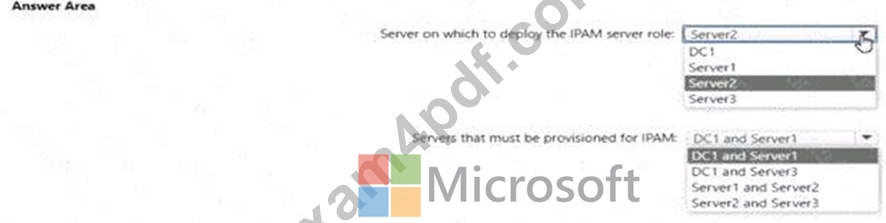
Answer:
Explanation: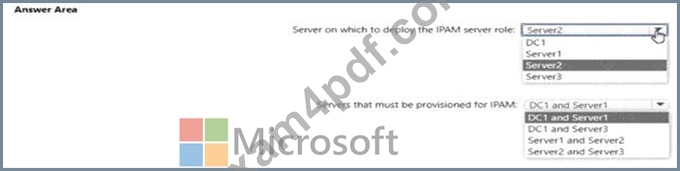
Explanation:
NEW QUESTION # 42
Note: This question is part of a series of questions that present the same scenario. Each question in the series contains a unique solution that might meet the stated goals. Some question sets might have more than one correct solution, while others might not have a correct solution.
After you answer a question in this section, you will NOT be able to return to it. As a result, these questions will not appear in the review screen.
You are planning the deployment of DNS to a new network.
You have three internal DNS servers as shown in the following table.
The contoso.local zone contains zone delegations for east.contoso.local and west.contoso.local. All the DNS servers use root hints.
You need to ensure that all the DNS servers can resolve the names of all the internal namespaces and internet hosts.
Solution: You configure Server2 and Server3 to forward DNS requests to 10.0.1.10.
Does this meet the goal?
- A. No
- B. Yes
Answer: A
NEW QUESTION # 43
You have an onpremises DNS server named Server1 that runs Windows Server. Server 1 hosts a DNS zone named fabrikam.com You have an Azure subscription that contains the resources shown in the following table.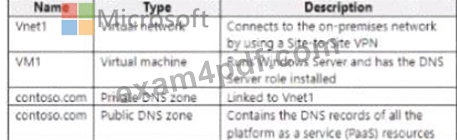
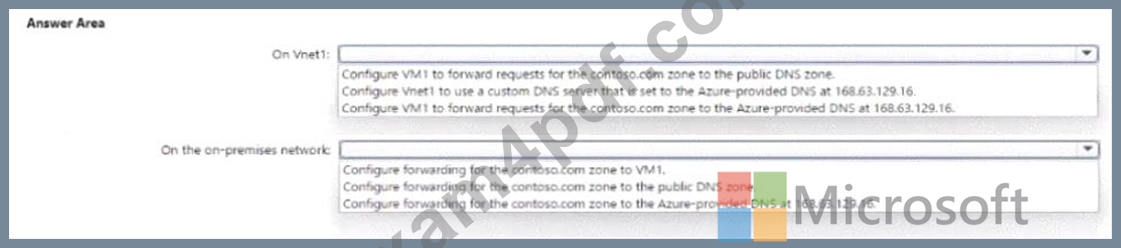
Answer:
Explanation: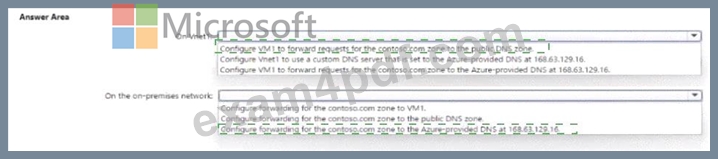
Explanation:
NEW QUESTION # 44
Your network contains an on-premises Active Directory Domain Services (AD DS) domain. The domain contains a user named User1 and the servers shown in the following table.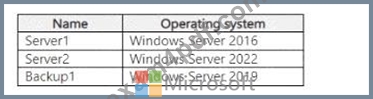
User1 is a member of the Protected Users security group.
User1 performs the following actions:
* From Server1, establishes a remote PowerShell session on Server2
* From the PowerShell session on Server2, attempts to access a resource on Backup1 The request to access the resource on 8ackup1 is denied.
You need to ensure that User1 can access the resources on Backup1 by using the PowerShell session on Server2. The solution must follow the principle of least privilege and minimize administrative effort.
What should you configure?
- A. PSSessionConfigu ration by using RunAs
- B. resource-based Kerberos constrained delegation
- C. Kerberos delegation (unconstrained)
- D. CredSSP
Answer: B
NEW QUESTION # 45
You have an Azure subscription. The subscription contains a virtual machine named VM1 that runs Windows Server and has the following disks:
* OSdislcDisk1
o Size: 512 GiB
o Free space: 260 GiB
o Encryption: SSE with PMK
o Storage type: Standard SSD
* Data disk: Disk2
o Size: 512 GiB
o Free space: 45 GiB
o Storage type: Standard HDD
o Encryption: Platform-managed key
You are planning a maintenance strategy for VM1.
You need to identify which task can be performed on Disk2 without causing downtime to VM1.
What should you do on Disk2?
- A. Increase the size.
- B. Change the storage type to Premium SSD.
- C. Change the encryption type.
- D. Decrease the size.
Answer: A
NEW QUESTION # 46
Note: This question is part of a series of questions that present the same scenario. Each question in the series contains a unique solution that might meet the stated goals. Some question sets might have more than one correct solution, while others might not have a correct solution.
After you answer a question in this section, you will NOT be able to return to it. As a result, these questions will not appear in the review screen.
Your network contains an Active Directory Domain Services (AD DS) forest. The forest contains three Active Directory sites named Site1, Site2, and Site3. Each site contains two domain controllers. The sites are connected by using DEFAULTIPSITELINK.
You open a new branch office that contains only client computers.
You need to ensure that the client computers in the new office are primarily authenticated by the domain controllers in Site1.
Solution: You create an organizational unit (OU) that contains the client computers in the new branch office. You configure the Try Next Closest Site Group Policy Object (GPO) setting in a GPO that is linked to the new OU.
Does this meet the goal?
- A. No
- B. Yes
Answer: A
Explanation:
https://docs.microsoft.com/en-us/windows-server/identity/ad-ds/plan/enabling-clients-to-locate- the-next-closest-domain-controller
NEW QUESTION # 47
You have an Azure Active Directory Domain Services (Azure AD DS) domain.
You create a new user named Admin1.
You need Admin1 to deploy custom Group Policy settings to all the computers in the domain. The solution must use the principle of least privilege.
What should you include in the solution? To answer, select the appropriate options in the answer area.
NOTE: Each correct selection is worth one point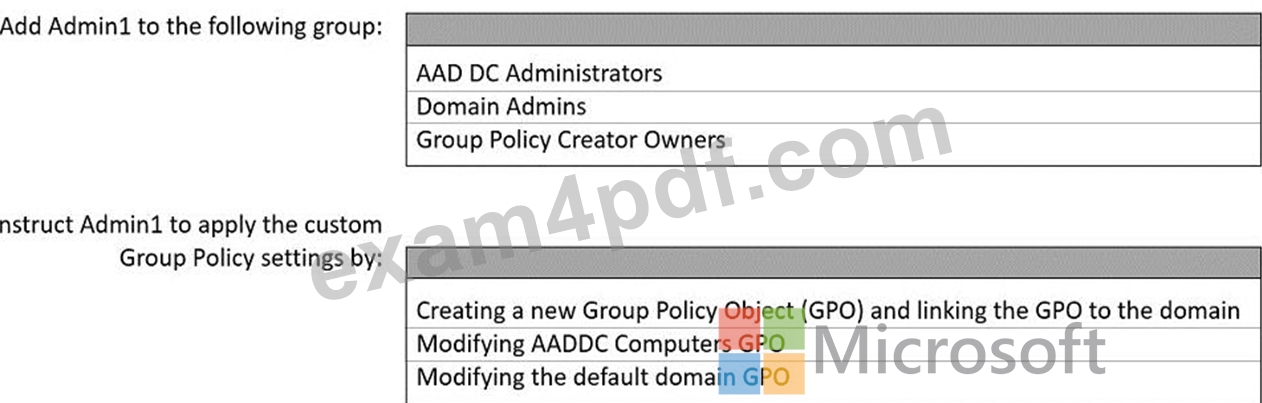
Answer:
Explanation: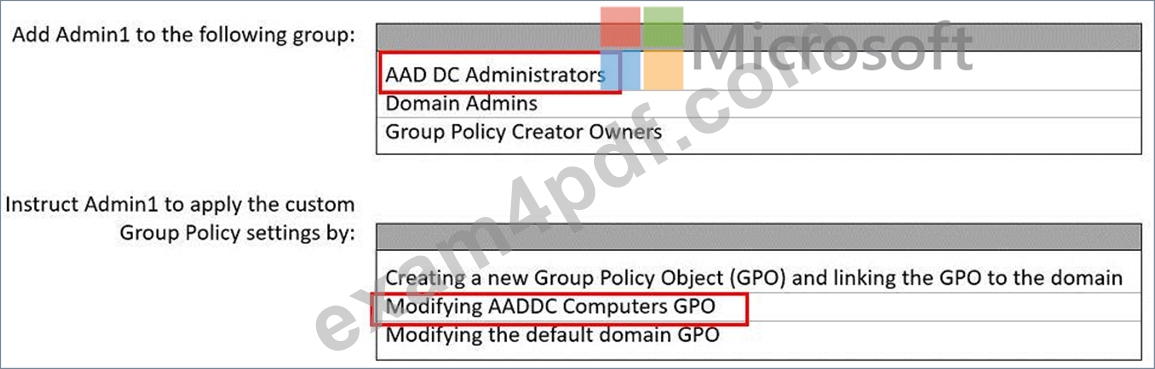
Reference:
https://docs.microsoft.com/en-us/azure/active-directory-domain-services/manage-group-policy
NEW QUESTION # 48
Your network contains an Active Directory Domain Services (AD DS) domain. The domain contains two servers named Server1 and Server2 and the users shown in the following table.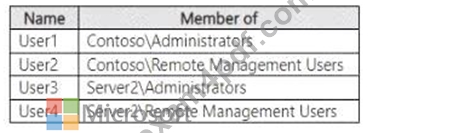
Which users can establish a PowerShell remoting session from Server1 to Server2?
- A. User1, User2, User3, and User4
- B. User2 and User4 only
- C. User1, User3. and User4 only
- D. User1 and User3 only
- E. User3 and User4 only
Answer: C
NEW QUESTION # 49
You have an Azure virtual machine named VM1 that runs Windows Server.
You have an Azure subscription that has Microsoft Defender for Cloud enabled.
You need to ensure that you can use the Azure Policy guest configuration feature to manage VM1.
What should you do?
- A. Add the PowerShell Desired State Configuration (DSC) extension to VM1.
- B. Configure VM1 to use a user-assigned managed identity.
- C. Configure VM1 to use a system-assigned managed identity.
- D. Add the Custom Script Extension to VM1.
Answer: C
Explanation:
Reference:
The Administering Windows Server Hybrid Core Infrastructure materials covering Microsoft Defender for Cloud and Azure Policy guest configuration explain that guest configuration policies use a guest configuration extension and a managed identity on the VM to retrieve policy artifacts and report compliance. The text emphasizes: "When using Azure Policy guest configuration (audit or deployIfNotExists/modify), the virtual machine must have a managed identity enabled. The platform uses the VM's managed identity to securely access content and to send compliance data." It further clarifies that installing DSC or Custom Script extensions is not required to enable the Azure Policy guest configuration feature; the policy assignment deploys the needed guest configuration extension automatically when the VM has an identity. A system-assigned managed identity is the simplest least-privilege option because its lifecycle is tied to the VM and it requires no separate credential management. Hence, enabling a system-assigned managed identity on VM1 fulfills the prerequisite for Azure Policy guest configuration to manage the server.
NEW QUESTION # 50
......
Microsoft AZ-800 certification exam is a great way for IT professionals to demonstrate their expertise in managing Windows Server Hybrid Core Infrastructure. Administering Windows Server Hybrid Core Infrastructure certification is recognized by employers worldwide and can help IT professionals stand out in a competitive job market. Additionally, the certification exam provides a great opportunity for IT professionals to improve their skills and knowledge, which can lead to better job opportunities and higher salaries.
To pass the AZ-800 exam, candidates must demonstrate their expertise in implementing and managing Windows Server technologies, including Active Directory, Hyper-V, and Storage Spaces Direct. They must also have a deep understanding of Azure services such as Azure Virtual Machines, Azure Storage, and Azure Site Recovery. Additionally, candidates must be familiar with hybrid scenarios and be able to manage and monitor hybrid environments.
Use Valid New AZ-800 Test Notes & AZ-800 Valid Exam Guide: https://www.exam4pdf.com/AZ-800-dumps-torrent.html
AZ-800 exam torrent Microsoft study guide: https://drive.google.com/open?id=1qFPceB4YMOVbugKsrSDXr00N7T2uohE4
