

Printable & Easy to Use OGBA-101 Dumps 100% Same Q&A In Your Real Exam
OGBA-101 Practice Test Give You First Time Success with 100% Money Back Guarantee!
The Open Group OGBA-101 Exam Syllabus Topics:
| Topic | Details |
|---|---|
| Topic 1 |
|
| Topic 2 |
|
| Topic 3 |
|
| Topic 4 |
|
| Topic 5 |
|
| Topic 6 |
|
NEW QUESTION # 83
Complete the sentence. A business model is a description of the rationale for how an organization creates, delivers, and captures _________.
- A. strategy
- B. best practices
- C. business function
- D. value
Answer: D
Explanation:
A business model is a description of the rationale for how an organization creates, delivers, and captures value. Value is defined as the worth or importance of something to someone. A business model explains what value proposition the organization offers to its customers, what revenue streams it generates from delivering the value proposition, what cost structure it incurs to create and deliver the value proposition, what key resources and activities are needed to create and deliver the value proposition, and what key partnerships are leveraged to support the value creation and delivery process.
NEW QUESTION # 84
Which of the following describes how the Enterprise Continuum is used when developing an enterprise architecture?
- A. To classify architecture and solution assets
- B. To identify and understand business requirements
- C. To describe how an architecture addresses stakeholder concerns
- D. To coordinate with the other management frameworks in use
Answer: A
Explanation:
The Enterprise Continuum is a tool within the TOGAF framework that provides methods for classifying architecture and solution assets. The continuum is a view of the Architecture Repository that provides methods for classifying, storing, and managing the various architecture assets. These assets include architectures, architectural patterns, architecture descriptions, and other related artifacts. The Enterprise Continuum enables architects to organize the repository in a way that is consistent and understandable, facilitating the reuse of these assets across various architecture development initiatives.
NEW QUESTION # 85
Which of the following is a benefit of information mapping?
- A. It highlights information requirements not addressed by a business architecture.
- B. It provides a framework for effective business requirements analysis.
- C. It enables improved business process integration.
- D. It provides a basis to support decision-making throughout the business.
Answer: D
Explanation:
In TOGAF and business architecture practices,information mappingis a technique used to organize, visualize, and analyze key information assets within an organization. One of the primary benefits of information mapping is that it provides a structured view of information flows, dependencies, and requirements across various parts of the organization, supporting decision-making at multiple levels. By clearly mapping how information is generated, used, and shared, decision-makers can make more informed choices, ensuring alignment with strategic goals and effective use of resources.
Each option can contribute to the business architecture, butOption Dis the most accurate for the benefit of information mapping:
* Option A(Improved business process integration) describes a benefit of process mapping rather than information mapping, although structured information can support process integration indirectly.
* Option B(Framework for effective business requirements analysis) is not the primary benefit of information mapping. While information mapping helps clarify information needs, the analysis of business requirements is more focused on requirements engineering practices.
* Option C(Highlights information requirements not addressed) is incorrect because while information mapping can reveal gaps in information needs, its primary function is not to identify gaps but to provide a clear view of information assets and flows.
Therefore,Option Daccurately reflects the main benefit of information mapping: supporting effective, informed decision-making across the business.
NEW QUESTION # 86
Which approach to model, measure, and analyze business value is primarily concerned with identifying the participants involved in creating and delivering value?
- A. Value streams
- B. Value networks
- C. Lean value streams
- D. Value chains
Answer: B
Explanation:
Value networks are an approach to model, measure, and analyze business value that is primarily concerned with identifying the participants involved in creating and delivering value. Value networks focus on the relationships and interactions among the participants, such as customers, suppliers, partners, employees, and other stakeholders. Value networks can help to understand how value flows through the network and how it can be improved or optimized.
NEW QUESTION # 87
Which of the following defines the type of entitles and relationships between entitles describing the enterprise?
- A. The Enterprise Continuum
- B. The Enterprise Metamodel
- C. The Architecture Repository
- D. The Content Framework
Answer: B
NEW QUESTION # 88
Which of the following best describes the purpose of the Gap Analysis technique?
- A. To allocate resources for architecture projects.
- B. To identify items omitted from the Target Architecture.
- C. To develop a set of general rules and guidelines for the architecture.
- D. To govern the architecture throughout its implementation process.
Answer: B
NEW QUESTION # 89
In business capability mapping, when you have documented all of the business capabilities, what should you do next?
- A. Identify the human and computer actors associated with each business capability.
- B. Map the business capabilities to stakeholder concerns.
- C. Organize the business capabilities in a logical manner.
- D. Draw up a business value assessment for each of the business capabilities.
Answer: C
Explanation:
According to the TOGAF Series Guide: Business Capabilities, after documenting all of the business capabilities, the next step is to organize them in a logical manner1. This can be done by using techniques such as layering, sorting, mapping, and leveling1. These techniques can help to classify, group, and align capabilities into categories for a deeper understanding of how they support the business goals and objectives1. Organizing the business capabilities can also help to identify dependencies, gaps, overlaps, or redundancies among them1.
NEW QUESTION # 90
Consider the following output from Phase A: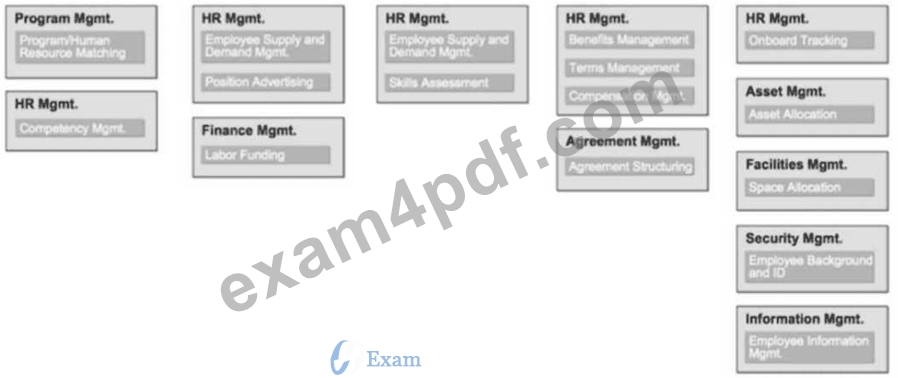
What is this an example of?
- A. Capability Map
- B. Organization Map
- C. Process Map
- D. Value Stream Map
Answer: A
Explanation:
The diagram provided illustrates a Capability Map. Here's why:
Focus on "what" the organization does: The diagram depicts various functions and activities that the organization performs, such as "Program/Human Resource Matching," "Employee Supply and Demand Mgmt," "Benefits Management," etc. These represent the capabilities of the organization, or what it is able to do.
Hierarchical structure: The capabilities are organized hierarchically, with broader functions like
"HR Mgmt." encompassing more specific capabilities like "Position Advertising" and "Skills Assessment." This shows how different capabilities relate to each other and contribute to higher- level functions. No specific process flow: Unlike a process map or value stream map, this diagram doesn't show a sequence of steps or flow of activities. It focuses on the capabilities themselves, not how they are executed
NEW QUESTION # 91
Complete the sentence. The purpose of the Preliminary Phase is to:
- A. Identify the stakeholders and their requirements.
- B. Describe the target architecture.
- C. Architect an Enterprise Architecture Capability.
- D. Define the enterprise strategy.
Answer: C
Explanation:
In the TOGAF ADM, the Preliminary Phase sets up the architecture capability within the organization, establishing architecture governance, defining architecture principles, and setting up necessary processes and tools. This phase is crucial for laying the foundation before formal architecture development begins.
Reference:
The Preliminary Phase is the first phase in the TOGAF Architecture Development Method (ADM). It sets the foundation for successful architecture development within an organization. The primary purpose of this phase is to:
Establish an Enterprise Architecture practice: This involves defining the organizational structure, processes, and resources needed to support architecture activities.
Tailor TOGAF to the organization's needs: TOGAF is a flexible framework. The Preliminary Phase allows for adapting the ADM and other TOGAF components to fit the specific context and requirements of the organization.
Secure senior management commitment: Gaining support from leadership is crucial for the success of any enterprise architecture initiative. This phase helps to ensure that key stakeholders understand and endorse the architecture development process.
Define the scope and approach: This includes determining the initial scope of the architecture work, identifying relevant architecture domains, and selecting appropriate methods and tools
NEW QUESTION # 92
Which of the following is the element of a value stream stage that describes the end state condition denoting the completion of the value stream stage?
- A. End point
- B. Exit criteria
- C. Completion stage
- D. Target state
Answer: B
Explanation:
In the context of a value stream within TOGAF, a value stream stage represents a segment of the overall process that delivers value to stakeholders. Each stage has specific characteristics and elements that help define its progress and completion. The "exit criteria" is a key element that describes the end state condition, denoting the completion of a value stream stage. Here's how TOGAF defines and uses these concepts:
* Value Stream Definition:
* A value stream represents an end-to-end collection of activities that create a result for a customer, stakeholder, or end-user. It provides a visual representation of how value is delivered.
* Value Stream Stages:
* Each value stream consists of multiple stages, each contributing to the overall value delivery.
These stages need to be clearly defined to ensure the value stream can be effectively managed and improved.
* Exit Criteria:
* Definition: Exit criteria are the conditions that must be met to signify the completion of a value stream stage. These criteria ensure that all necessary tasks have been completed and that the output meets the required quality and performance standards.
* Purpose: By defining exit criteria, organizations can ensure that each stage of the value stream is completed before moving to the next, maintaining quality and consistency across the process.
* TOGAF References:
* Phase B: Business Architecture: In this phase, value streams and their stages are modeled.
Defining exit criteria for each stage helps in managing transitions and ensuring that each part of the value stream is delivering the intended value.
In summary, the exit criteria define the end state condition of a value stream stage, ensuring that all necessary tasks are completed and quality standards are met before proceeding to the next stage.
NEW QUESTION # 93
Consider the following extract of a model showing relationships between Business Architecture concepts: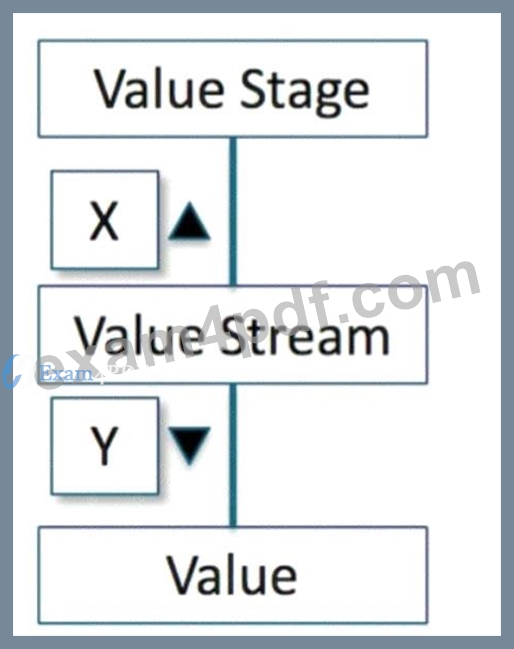
What is the relationship labeled X?
- A. Receives
- B. Enables
- C. Consists of
- D. Creates
Answer: C
Explanation:
In the context of TOGAF and Business Architecture, the diagram depicts the relationship between a Value Stream, Value Stage, and Value.
* Value Stream: Represents the end-to-end set of activities that create and deliver value to a stakeholder.
* Value Stage: A distinct step or phase within the Value Stream.
* Value: The benefit delivered to the stakeholder.
The relationship "X" indicates that a Value Stream is composed of multiple Value Stages.
Think of it like a journey (Value Stream) with multiple stops along the way (Value Stages). Each stage contributes to the overall value delivered at the end of the journey.
NEW QUESTION # 94
Consider the following modeling example, relating business capabilities to organization units so as to highlight duplication and redundancy: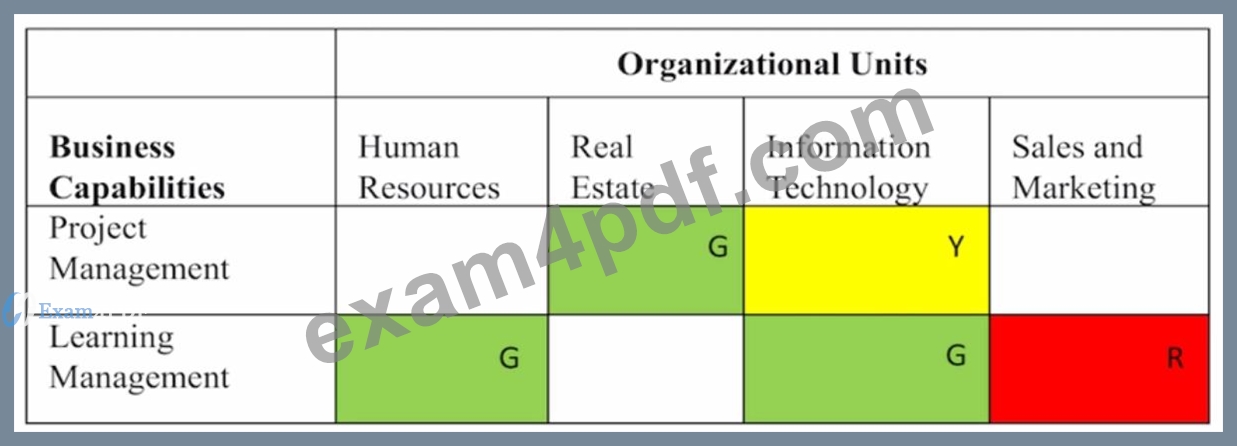
(Note in this example the cells colored green, yellow, and red, are also marked G. Y, and R, respectively) Which of the following best describes this technique?
- A. Gap Analysis
- B. Capability Mapping
- C. Perspective Analysis
- D. Relationship Mapping
Answer: D
Explanation:
The technique shown in the example is called relationship mapping. It is a technique that can be used to show how a business architecture addresses stakeholder concerns across different parts of an organization2. It can highlight gaps or overlaps in the coverage of stakeholder concerns by a business architecture. In this case, the technique is used to relate business capabilities to organization units so as to highlight duplication and redundancy.
NEW QUESTION # 95
Which of the following best describes this diagram?
- A. Business Relationships diagram
- B. Business Capability/Value Stream Mapping
- C. Business Capability Map
- D. Business Capabilities Layer diagram
Answer: C
Explanation:
The diagram presented is best described as a Business Capability Map. Here's a detailed explanation:
* Business Capability Map:
* Definition: A Business Capability Map represents the various capabilities an organization requires to deliver its products and services and achieve its strategic objectives. It typically categorizes capabilities into different levels or tiers, such as strategic, core, and supporting capabilities.
* Diagram Analysis:
* Layers and Groupings: The diagram shows capabilities grouped into three categories: Strategic, Core, and Supporting. Each group lists specific business capabilities necessary for the organization's functioning.
* Color Coding: The use of different colors (green, red, yellow, purple) may indicate various aspects such as priority, status, or different business units. However, the primary purpose is to visually represent and categorize capabilities.
* TOGAF References:
* Phase B: Business Architecture: In this phase, creating a Business Capability Map is a crucial activity. It helps in understanding the business functions and aligning them with strategic goals.
* Capability-Based Planning: TOGAF promotes capability-based planning, which involves identifying, mapping, and analyzing business capabilities to ensure they support the overall strategy and objectives.
* Purpose and Benefits:
* Strategic Alignment: The Business Capability Map helps in aligning business capabilities with the strategic objectives of the organization. It provides a clear view of what the organization needs to do to achieve its goals.
* Gap Analysis: It is useful for conducting gap analysis by comparing current capabilities with the desired state, helping to identify areas for improvement.
* Resource Allocation: By understanding the different capabilities, organizations can allocate resources more effectively to areas that need development or enhancement.
In summary, the diagram is best described as a Business Capability Map because it visually represents and categorizes the various capabilities needed by the organization into strategic, core, and supporting layers, aligning them with the business strategy and objectives.
NEW QUESTION # 96
Which of the following can be used to help define information concepts in an information map?
- A. Statement of business goals and drivers
- B. Value streams
- C. Organization Map
- D. Stakeholder Map
Answer: A
Explanation:
A statement of business goals and drivers can be used to help define information concepts in an information map. This statement provides the context and rationale for the information requirements of the enterprise, which can then be reflected in the information map, ensuring that the information architecture supports the business objectives.
NEW QUESTION # 97
In what TOGAF ADM phase is the information map linked to other business blueprints?
- A. Preliminary Phase
- B. Phase E
- C. Phase A
- D. Phase B
Answer: B
Explanation:
Phase E Explanation of Correct answer: In Phase E (Opportunities and Solutions) of the TOGAF ADM, the information map is linked to other business blueprints such as the Business Capability Map, the Value Stream Map, and the Business Process Model2. This helps to identify and prioritize opportunities for business improvement and transformation2.
In the TOGAF Architecture Development Method (ADM), the information map is linked to other business blueprints during Phase B, Business Architecture. This phase involves the development of a business architecture to support an agreed Architecture Vision. It is during this phase that the information architecture is developed in detail, which involves mapping the information to the business, hence linking the information map to other business blueprints.
NEW QUESTION # 98
Which artifact identifies business information concepts without considering implementation?
- A. Data Model
- B. Technology Catalog
- C. Application Portfolio
- D. Information Map
Answer: D
Explanation:
An Information Map defines key business information concepts and their relationships. It remains independent of databases, applications, or physical storage, ensuring information architecture reflects business requirements instead of technical implementation decisions.
NEW QUESTION # 99
Which of the following best describes "value" in the context of Business Architecture?
- A. The market price of something.
- B. A numerical quantity assigned to something.
- C. The benefit of something.
- D. The monetary worth of something.
Answer: C
Explanation:
In Business Architecture, "value" refers to the benefit provided to stakeholders, aligning with TOGAF's goal to capture and deliver value in business processes and capabilities. Business value is viewed as outcomes or improvements that meet stakeholder needs, rather than purely financial or numerical metrics.
NEW QUESTION # 100
......
Fully Updated Free Actual The Open Group OGBA-101 Exam Questions: https://www.exam4pdf.com/OGBA-101-dumps-torrent.html
All Obstacles During OGBA-101 Exam Preparation with OGBA-101 Real Test Questions: https://drive.google.com/open?id=1SowpK44YKDilMc1mMN0LTHaFFoLt2l2d
