

Updated AZ-700 Dumps PDF - AZ-700 Real Valid Brain Dumps With 319 Questions!
100% Free AZ-700 Exam Dumps Use Real Microsoft Certified: Azure Network Engineer Associate Dumps
NEW QUESTION # 116
You need to restrict traffic from VMScaleSet1 to VMScaleSet2. The solution must meet the virtual networking requirements.
What is the minimum number of custom NSG rules and NSG assignments required? To answer, select the appropriate options in the answer area.
NOTE: Each correct selection is worth one point.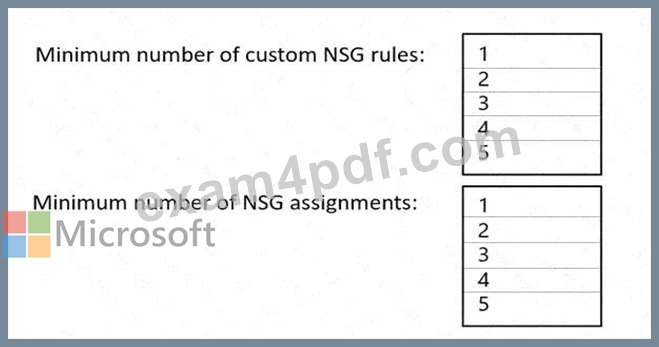
Ite rule for the
Answer:
Explanation: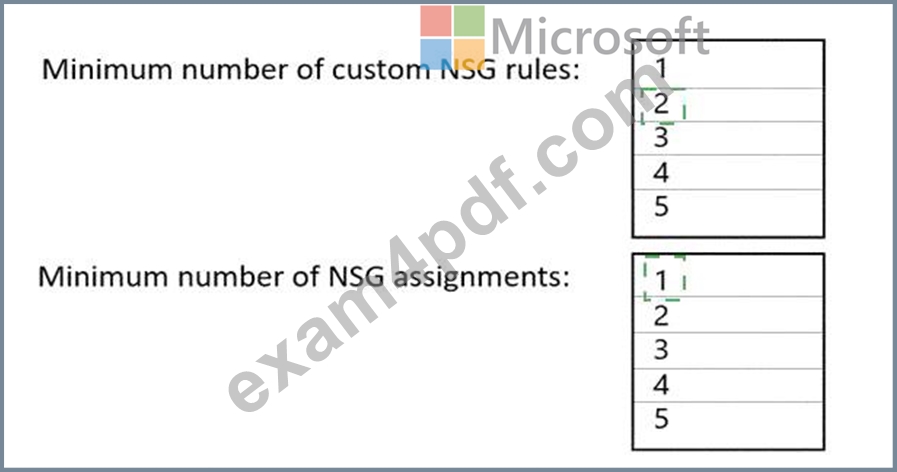
Explanation: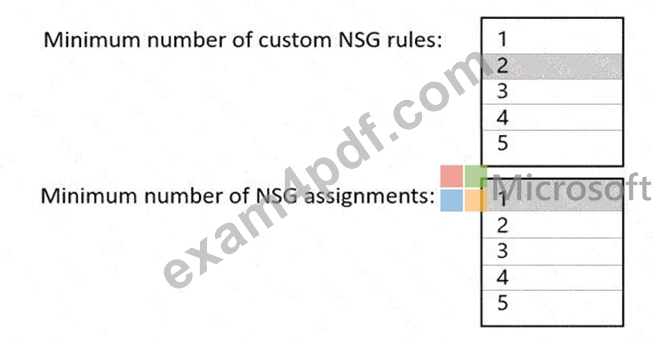
Box 2: One NSG
The minimum requirement is one NSG. You could attach the NSG to VMScaleSet1 and restrict outbound traffic, or you could attach the NSG to VMScaleSet2 and restrict inbound traffic. Either way you would need two custom NSG rules.
Box 1: Two custom rules
With the NSG attached to VMScaleSet2, you would need to create a custom rule blocking all traffic from VMScaleSet1. Then you would need to create another custom rule with a higher priority than the first rule that allows traffic on port 443.
The default rules in the NSG will allow all other traffic to VMScaleSet2.
NEW QUESTION # 117
Hotspot Question
You have an Azure subscription that contains the resources shown in the following table.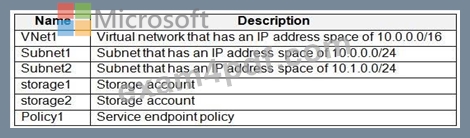
Policy1 has the following settings:
- Service: Microsoft Storage
- Allowed Resources: storage1
Subnet1 has the following settings:
- Name: Subnet
- Subnet address range: 10.0.0.0/24
- NAT gateway: None
- Network security group: None
- Route table: None
- Service Endpoints
- Services: Microsoft Storage
- Service endpoint policies: Policy1
- Subnet delegation
- Delegate subnet to a service: None
Subnet2 has the following settings:
- Name: Subnet2
- Subnet address range: 10.0.1.0/24
- NAT gateway: None
- Network security group: None
- Route table: None
- Service Endpoints
- Services: 0 selected
- Subnet Delegation
- Delegate subnet to a service: None
For each of the following statements, select Yes if the statement is true. Otherwise, select No.
NOTE: Each correct selection is worth one point.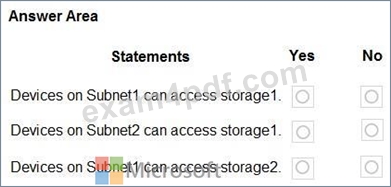
Answer:
Explanation: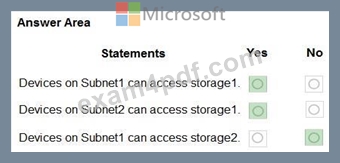
NEW QUESTION # 118
You need to implement name resolution for the cloud.liwareinc.com. The solution must meet the networking requirements.
What should you do? To answer, select the appropriate options in the answer area.
NOTE: Each correct selection is worth one point.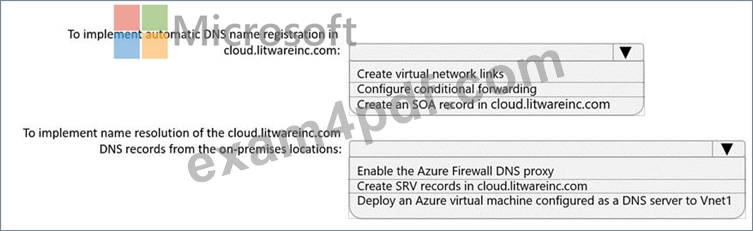
Answer:
Explanation: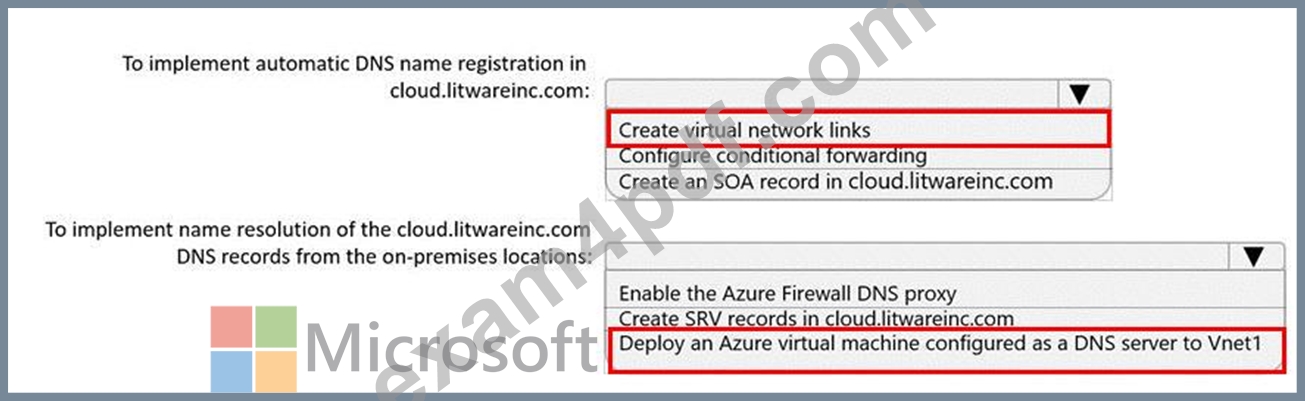
Reference:
https://docs.microsoft.com/en-us/azure/dns/private-dns-autoregistration
https://docs.microsoft.com/en-us/azure/virtual-network/virtual-networks-name-resolution-for-vms-and-role-instances
NEW QUESTION # 119
You have an Azure subscription that contains an Azure key vault named Vaultl and an app registration for an Azure AD app named App1.
You have a DNS domain named contoso.com that is hosted by a third-party DNS provider.
You plan to deploy App1 by using Azure App Service. App1 will have the following configurations:
* App1 will be hosted across five App Service apps.
* Users will access App1 by using a URL of https://app1.contoso.com.
* The user traffic of App1 will be managed by using Azure Front Door.
* The traffic between Front Door and the App Service apps will be sent by using HTTP.
* App1 will be secured by using an SSL certificate from a third-party certificate authority (CA).
You need to support the Front Door deployment.
Which two DNS records should you create, and to where should you import the SSL certificate for App1? To answer, select the appropriate options in the answer area.
NOTE: Each correct selection is worth one point.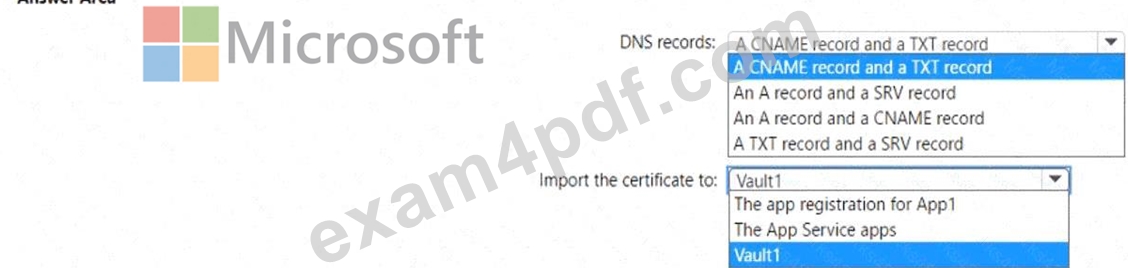
Answer:
Explanation: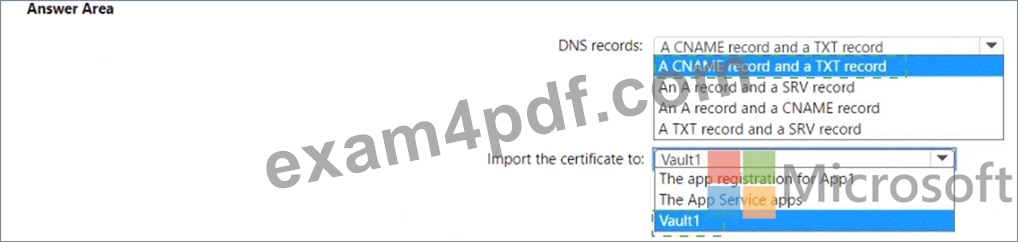
Explanation:
NEW QUESTION # 120
You have an Azure subscription
You plan to use Azure Virtual WAN.
You need to deploy a virtual WAN hub that meets the following requirements:
* Supports 4 Gbps of Site-to-Site (S2S) VPN traffic
* Supports 8 Gbps of ExpressRoute traffic
* Minimizes costs
How many scale units should you configure? To answer select the appropriate options in the answer area.
NOTE Each correct selection is worth one point.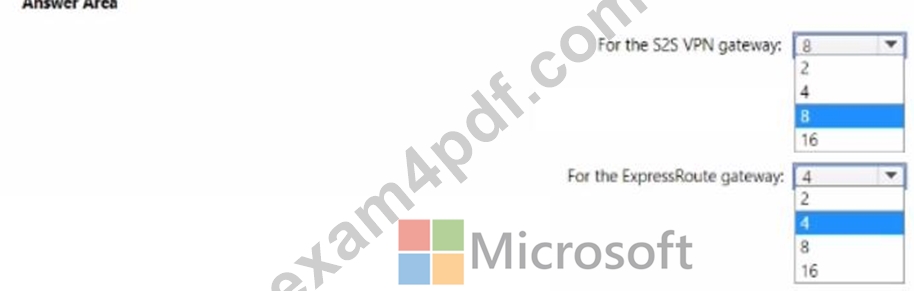
Answer:
Explanation: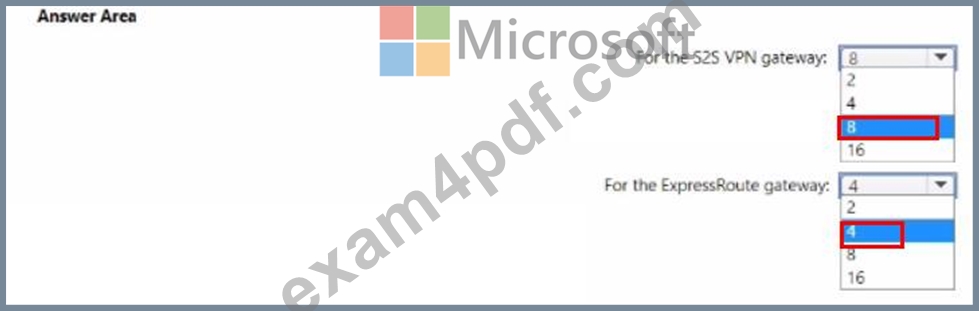
NEW QUESTION # 121
You have an Azure subscription. The subscription contains 500 virtual machines that run either Windows 11 or Linux.
You need to identify which Linux virtual machines are accessible from the internet. The solution must minimize administrative effort.
What should you use, and what should you configure? To answer, select the appropriate options in the answer area.
NOTE: Each correct selection is worth one point.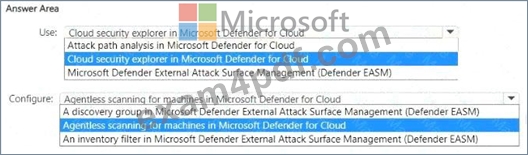
Answer:
Explanation: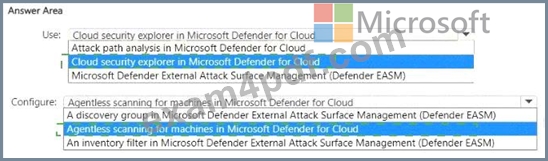
Explanation:
NEW QUESTION # 122
You have art Azure subscription.
You plan to deploy Azure Front Door with Azure Web Application Firewall (WAF).
You plan to implement custom rules and managed rules that meet the following requirements:
* Block malicious bots.
* Throttle client IP addresses that exceed 100 connections per minute.
You need to identify which Front Door SKU to configure, and which type of rule to configure for each requirement. The solution must minimize administrative effort and costs.
What should identify? To answer, drag the appropriate options to the correct targets. Each option may be used once, more than once, or not at all. You may need to drag the split bar between panes or scroll to view content.
NOTE: Each correct selection is worth one point.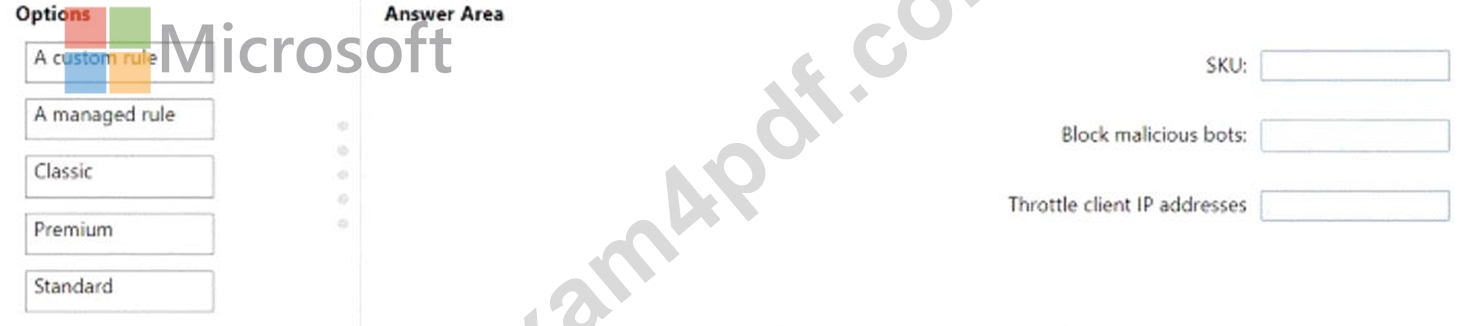
Answer:
Explanation: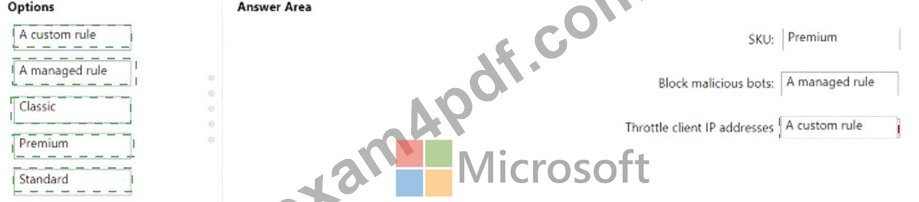
Explanation: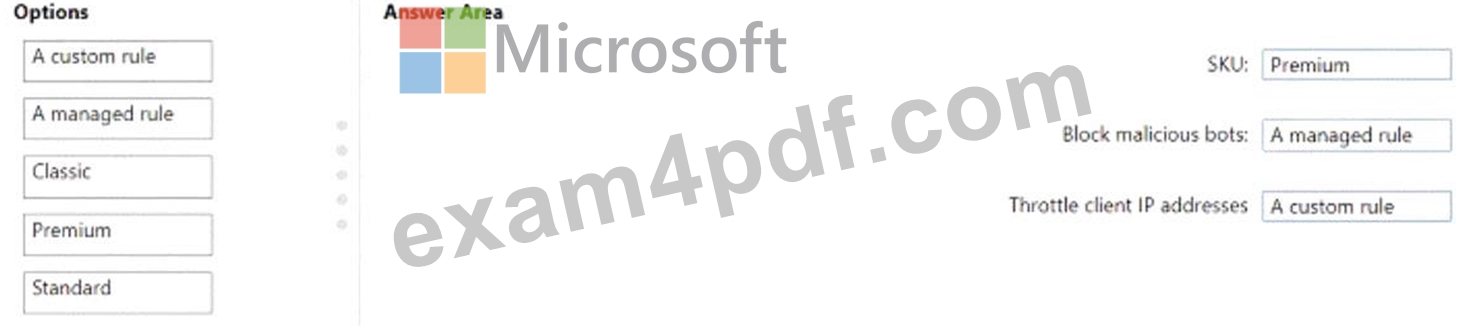
NEW QUESTION # 123
You have an Azure subscription that contains the virtual networks shown in the following table.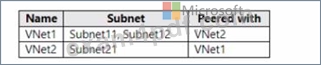
The subscription contains the virtual machines shown in the following table.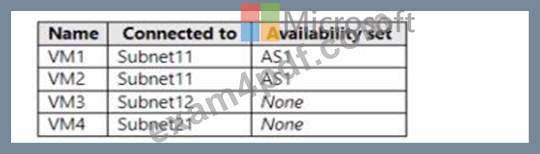
You create a load balancer named LB1 that has the following configurations:
* SKU: Basic
* Type: Internal
* Subnet: Subnetl2
* Virtual network VNet1
For each of the following statements, select Yes if the statement is true. Otherwise, select No. NOTE: Each correct selection is worth one point.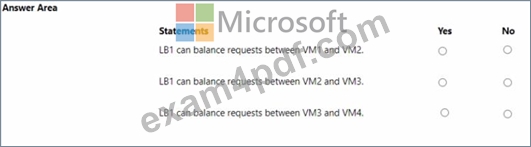
Answer:
Explanation: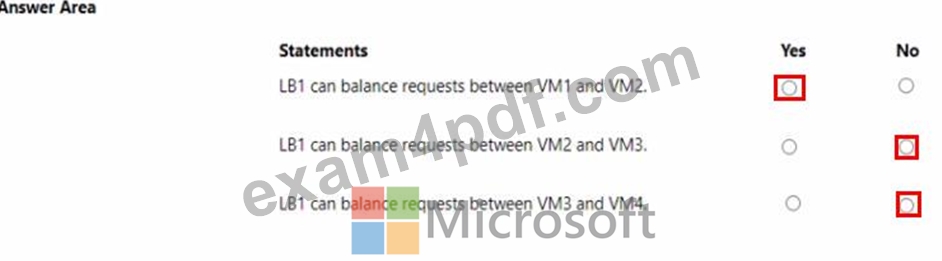
NEW QUESTION # 124
You have an Azure subscription that contains an Azure App Service web app named WebApp1 and an Azure Front Door profile named FDProfile1 FDProfile1 forwards requests addressed to https://www.contoso.com to WebApp1.
You need to ensure that only requests addressed to https://www.contoso.com/users/are forwarded to WebApp1.
What should you modify in FDProfile1?
- A. the origin group
- B. the routes
- C. the domain
- D. the endpoint
Answer: B
Explanation:
Topic 1, Contoso Case Study 2
Overview
This is a case study. Case studies are not timed separately. You can use as much exam time as you would like to complete each case. However, there may be additional case studies and sections on this exam. You must manage your time to ensure that you are able to complete all questions included on this exam in the time provided.
To answer the questions included in a case study, you will need to reference information that is provided in the case study. Case studies might contain exhibits and other resources that provide more information about the scenario that is described in the case study. Each question is independent of the other questions in this case study.
At the end of this case study, a review screen will appear. This screen allows you to review your answers and to make changes before you move to the next section of the exam. After you begin a new section, you cannot return to this section.
To start the case study
To display the first question in this case study, click the Next button. Use the buttons in the left pane to explore the content of the case study before you answer the questions. Clicking these buttons displays information such as business requirements, existing environment, and problem statements. If the case study has an All Information tab. note that the information displayed is identical to the information displayed on the subsequent tabs. When you are ready to answer a question, click the Question button to return to the question.
Existing Environment:
Azure Network Infrastructure
Contoso has an Azure Active Directory (Azure AD) tenant named contoso.com.
The Azure subscription contains the virtual networks shown in the following table.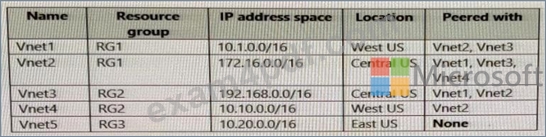
Vnet1 contains a virtual network gateway named GW1.
Azure Virtual Machines
The Azure subscription contains virtual machines that run Windows Server 2019 as shown in the following table.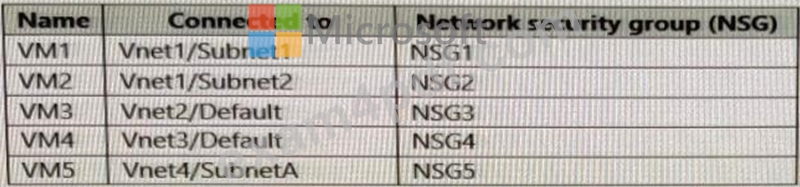
The NSGs are associated to the network interfaces on the virtual machines. Each NSG has one custom security rule that allows RDP connections from the internet. The firewall on each virtual machine allows ICMP traffic.
An application security group named ASG1 is associated to the network interface of VM1.
Azure Private DNS Zones
The Azure subscription contains the Azure private DNS zones shown in the following table.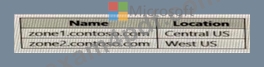
Zone1.contoso.com has the virtual network links shown in the following table.
Other Azure Resources
The Azure subscription contains additional resources as shown in the following table.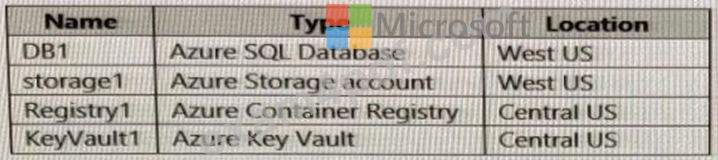
Requirements:
Virtual Network Requirements
Contoso has the following virtual networks requirements:
* Create a virtual network named Vnet6 in West US that will contain the following resources and configurations:
Two container groups that connect to Vnet6
Three virtual machines that connect to Vnet6
Allow VPN connections to be established to Vnet6
Allow the resources in Vnet6 to access KeyVault1, DB1, and Vnet1 over the Microsoft backbone network
* The virtual machines in Vnet4 and Vnet5 must be able to communicate over the Microsoft backbone network.
* A virtual machine named VM-Analyze will be deployed to Subnet1. VM-Analyze must inspect the outbound network traffic from Subnet2 to the internet.
Network Security Requirements
Contoso has the following network security requirements:
* Configure Azure Active Directory (Azure AD) authentication for Point-to-Site (P2S) VPN users.
* Enable NSG flow logs for NSG3 and NSG4.
* Create an NSG named NSG10 that will be associated to Vnet1/Subnet1 and will have the custom inbound security rules shown in the following table.
* Create an NSG named NSG11 that will be associated to Vnet1/Subnet2 and will have the custom outbound security rules shown in the following table.
NEW QUESTION # 125
Your company has 10 instances of a web service. Each instance is hosted in a different Azure region and is accessible through a public endpoint.
The development department at the company is creating an application named App1. Every 10 minutes. App1 will use a list of end points and connect to the first available endpoint.
You plan to use Azure Traffic Manager to maintain the list of endpoints.
You need to configure a Traffic Manager profile that will minimize the impact of DNS caching.
What should you configure? To answer, select the appropriate options in the answer area.
NOTE: Each correct selection is worth one point.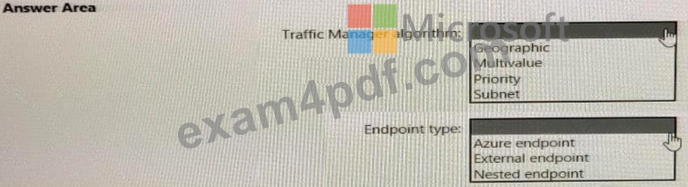
Answer:
Explanation: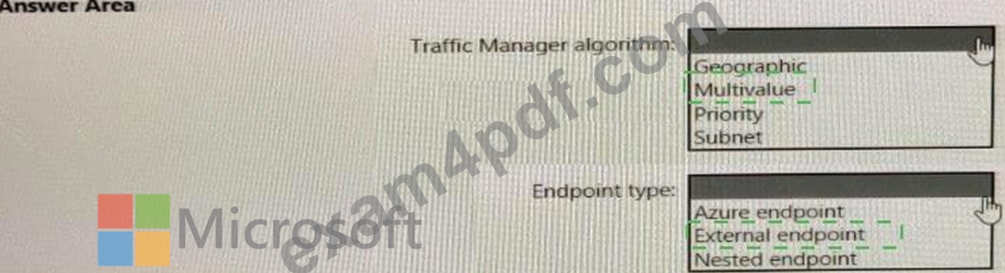
Explanation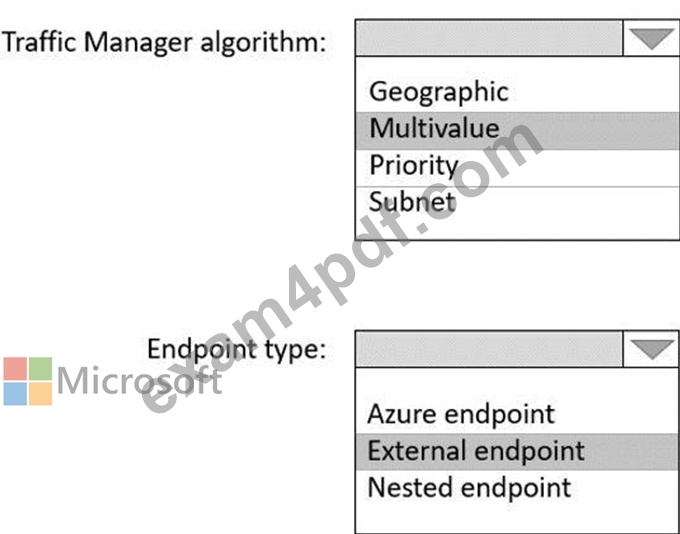
Reference:
https://docs.microsoft.com/en-us/azure/traffic-manager/traffic-manager-routing-methods
https://docs.microsoft.com/en-us/azure/traffic-manager/traffic-manager-endpoint-types
NEW QUESTION # 126
You are implementing the Virtual network requirements for Vnet6.
What is the minimum number of subnets and service endpoints you should create? To answer, select the appropriate options in the answer area.
NOTE: Each correct selection is worth one point.
- A. See in Explanation
Answer: A
Explanation:
2, 4
NEW QUESTION # 127
You have an Azure subscription that contains a virtual network named VNet1. VNet1 contains the following subnets.
* AzureFirewallSubnet
* GatewaySubnet
* Subnet 1
* Subnet2
* Subnet3
Subnet2 has a delegation to the Microsoft.Web/serverfarms service. The subscription contains the resources shown in the following table.
You need to implement an Azure application gateway named AG1 that will be integrated with an Azure Web Application Firewall (WAF). AG1 will be used to publish VMSS1.
To which subnet should you connect AG1?
- A. GatewaySubnet
- B. Subrwt2
- C. Subnet3
- D. Subnet 1
- E. AzureFjrewall Subnet
Answer: C
NEW QUESTION # 128
Note: This question is part of a series of questions that present the same scenario. Each question in the series contains a unique solution that might meet the stated goals. Some question sets might have more than one correct solution, while others might not have a correct solution.
After you answer a question in this section, you will NOT be able to return to it. As a result, these questions will not appear in the review screen.
You have an Azure application gateway that has Azure Web Application Firewall (WAF) enabled.
You configure the application gateway to direct traffic to the URL of the application gateway.
You attempt to access the URL and receive an HTTP 403 error. You view the diagnostics log and discover the following error.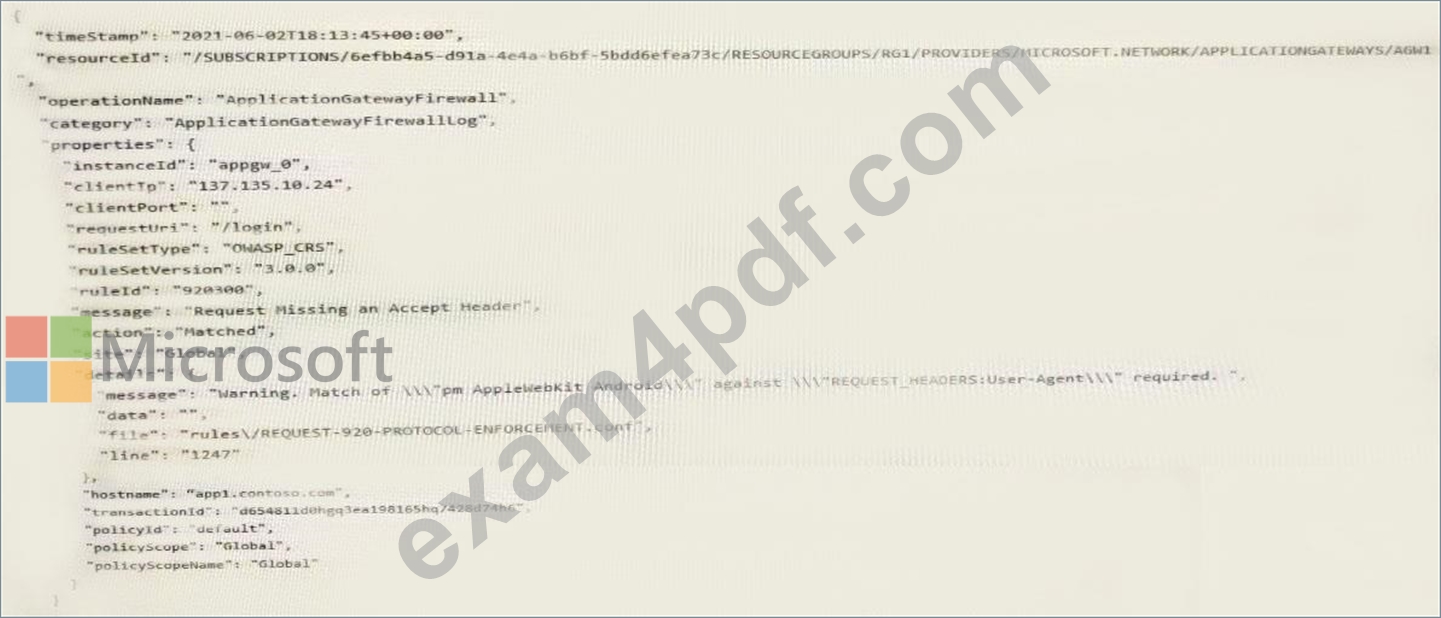
You need to ensure that the URL is accessible through the application gateway.
Solution: You configure a custom cookie and an exclusion rule.
Does this meet the goal?
- A. Yes
- B. No
Answer: A
NEW QUESTION # 129
You need to connect an on-premises network and an Azure environment. The solution must use ExpressRoute and support failing over to a Site-to-Site VPN connection if there is an ExpressRoute failure.
What should you configure? To answer, select the appropriate options in the answer area.
NOTE: Each correct selection is worth one point.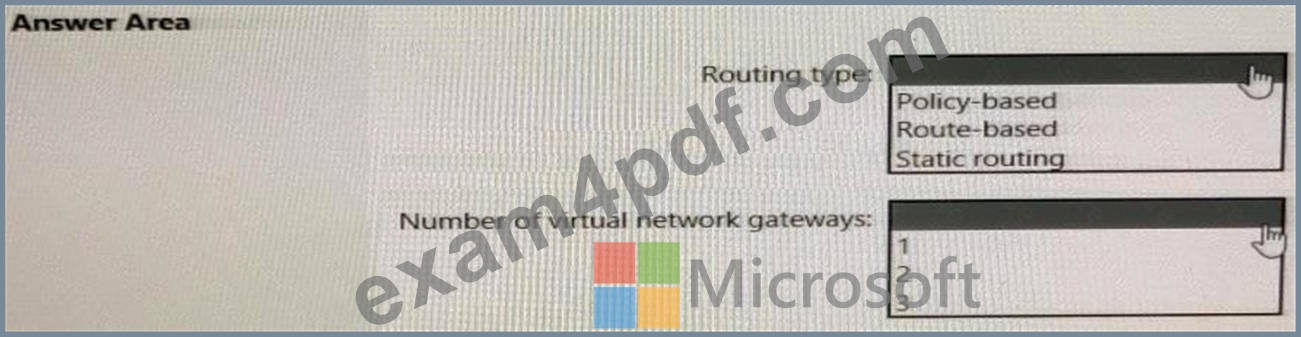
Answer:
Explanation: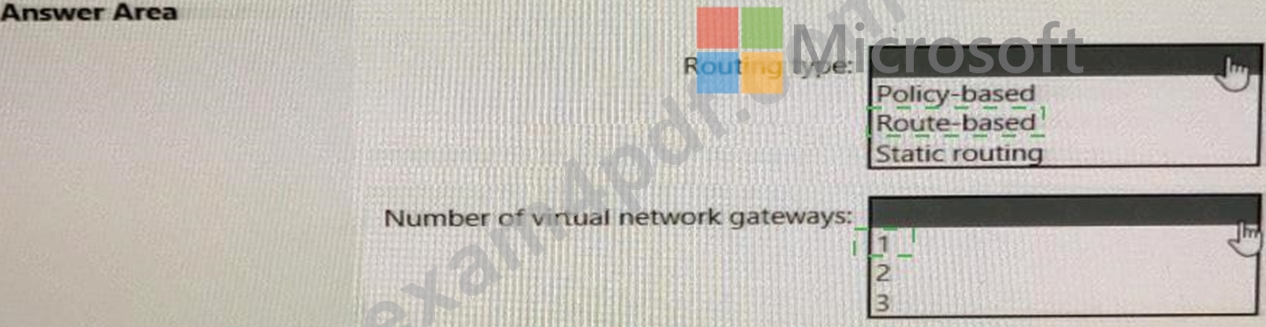
Explanation: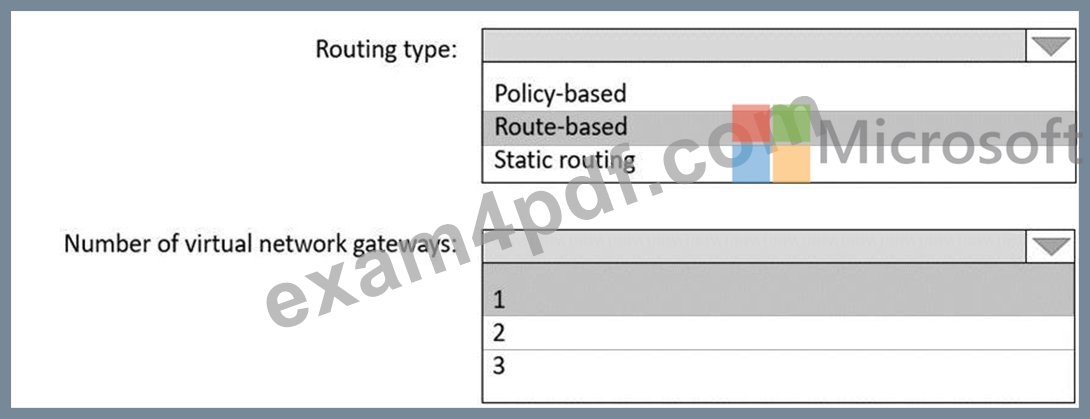
Reference:
https://docs.microsoft.com/en-us/azure/expressroute/expressroute-howto-coexist-resource-manager
NEW QUESTION # 130
You have a network security group named NSG1.
You need to enable network security group (NSG) flow logs for NSG1. The solution must support retention policies.
What should you create first?
- A. A premium Block blobs Azure Storage account
- B. A standard general-purpose v2 Azure Storage account
- C. A standard general-purpose v1 Azure Storage account
- D. An Azure Log Analytics workspace
Answer: B
NEW QUESTION # 131
You have an Azure subscription that contains the route tables and routes shown in the following table.
The subscription contains the subnets shown in the following table.
The subscription contains the virtual machines shown in the following table.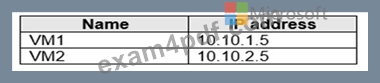
There is a Site-to-Site VPN connection to each local network gateway.
For each of the following statements, select Yes of the statement is true. Otherwise, select No.
NOTE: Each correct selection is worth one point.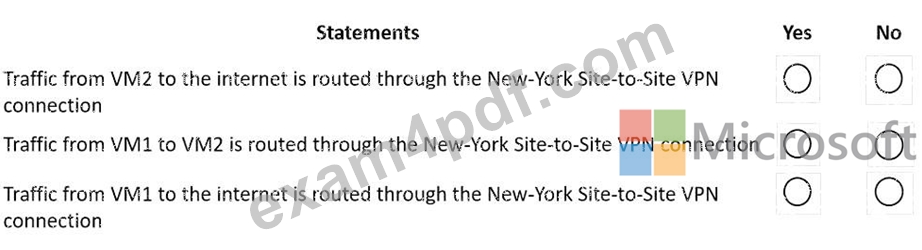
Answer:
Explanation: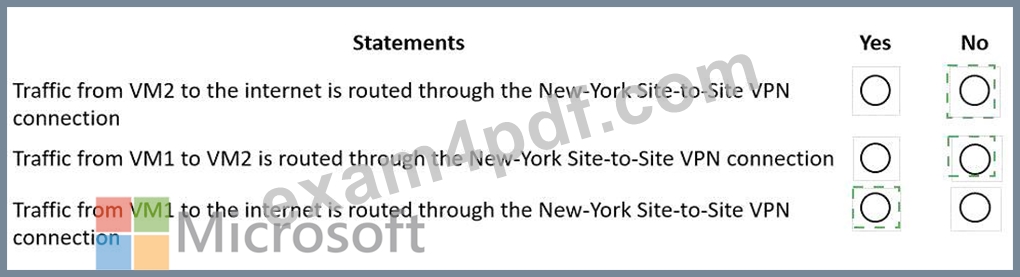
Explanation
A screenshot of a computer Description automatically generated with medium confidence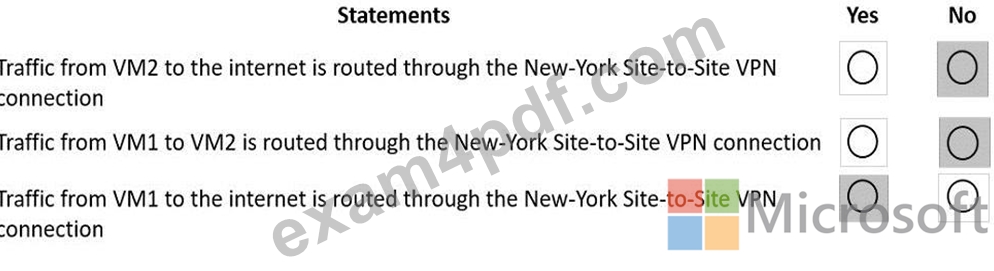
Reference:
https://docs.microsoft.com/en-us/azure/virtual-network/virtual-networks-udr-overview
NEW QUESTION # 132
You have an Azure virtual network and an on-premises datacenter that connect by using a Site-to-Site VPN tunnel.
You need to ensure that all traffic from the virtual network to the internet is routed through the datacenter.
How should you complete the PowerShell script to configure forced tunneling? To answer, select the appropriate options in the answer area.
NOTE: Each correct selection is worth one point.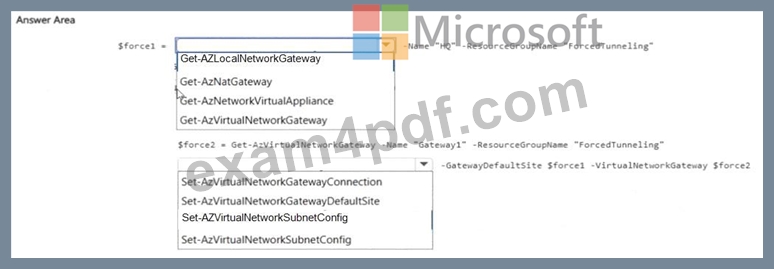
Answer:
Explanation: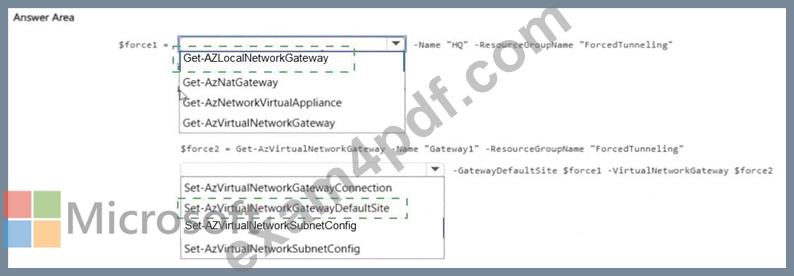
Explanation: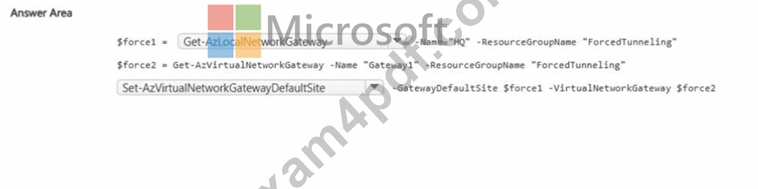
NEW QUESTION # 133
Your company has offices in Montreal. Seattle, and Paris. The outbound traffic from each office originates from a specific public IP address.
You create an Azure Front Door instance named FD1 that has Azure Web Application Firewall (WAF) enabled. You configure a WAF policy named Policy! that has a rule named Rule1. Rule1 applies a rate limit of 100 requests for traffic that originates from the office in Montreal.
You need to apply a rate limit of 100 requests for traffic that originates from each office.
What should you do?
- A. Create two additional associations.
- B. Modify the rate limit threshold of Rule1.
- C. Modify the conditions of Rule1.
- D. Modify the rule type of Rule1.
Answer: C
Explanation:
Reference:
https://techcommunity.microsoft.com/t5/azure-network-security-blog/rate-limiting-feature-for-azure-waf-on-application-gateway-now/ba-p/3934957#:~:text=Rate%20limiting%20is%20configured%20using,and%20a%20group%20by%20variable.
NEW QUESTION # 134
You have an Azure virtual network named Vnet1 that contains two subnets named Subnet1 and Subnet2.
You have the NAT gateway shown in the NATgateway1 exhibit.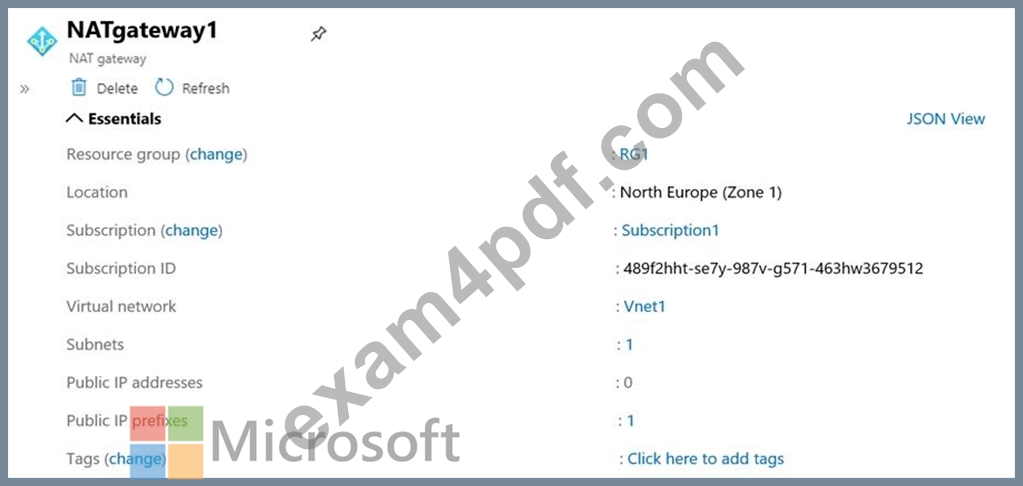
You have the virtual machine shown in the VM1 exhibit.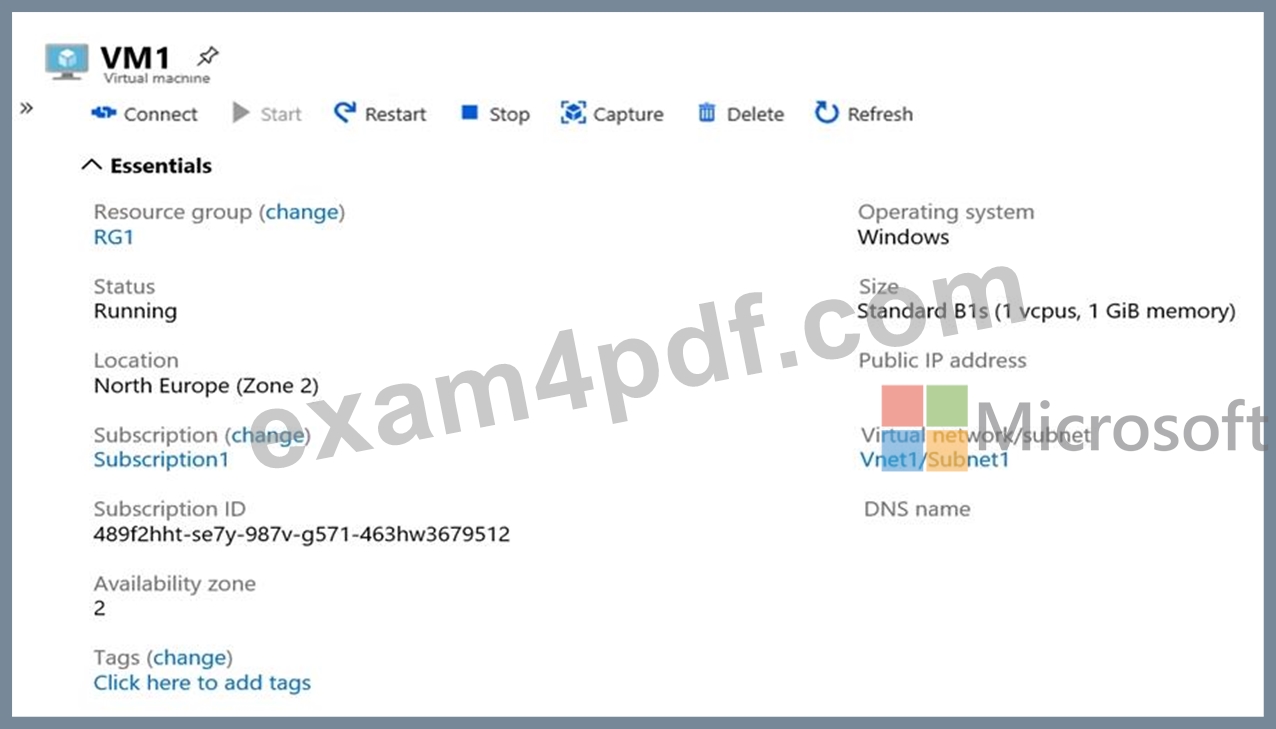
Subnet1 is configured as shown in the Subnet1 exhibit.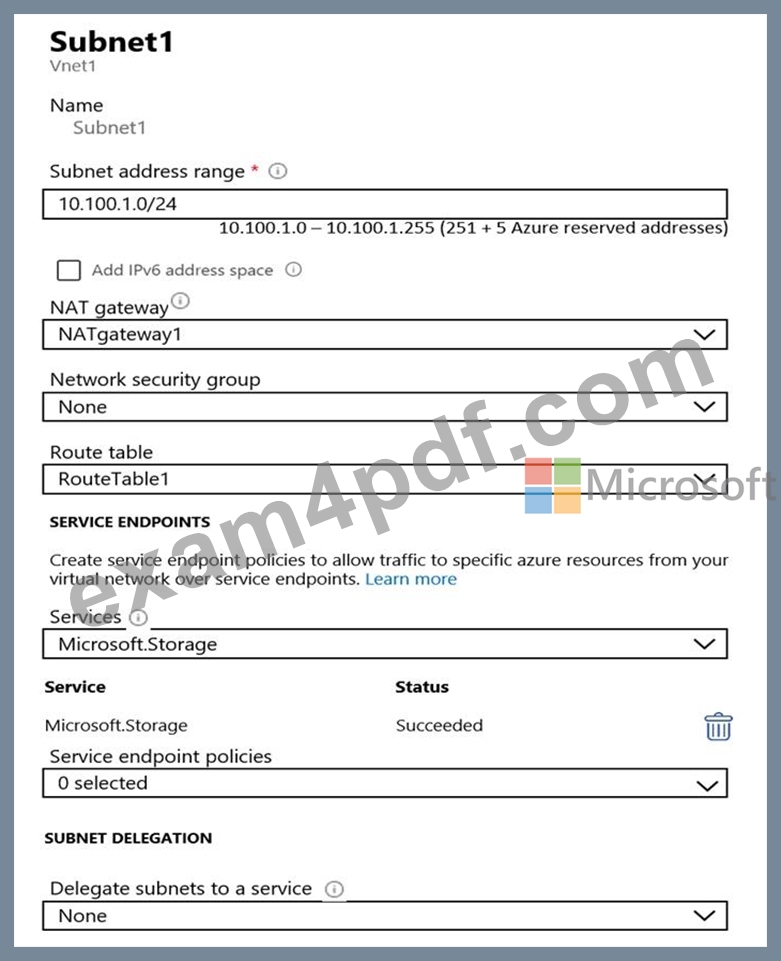
For each of the following statements, select Yes of the statement is true. Otherwise, select No.
NOTE: Each correct selection is worth one point.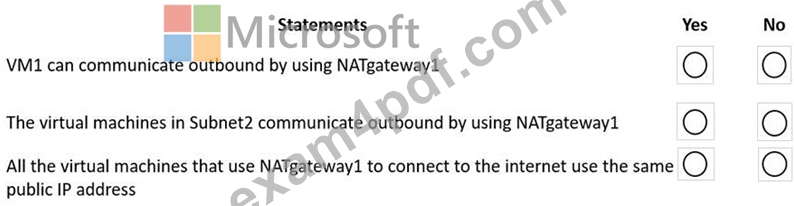
Answer:
Explanation: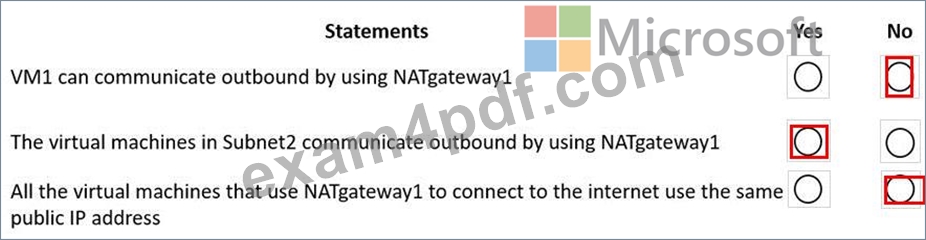
Reference:
https://docs.microsoft.com/en-us/azure/virtual-network/nat-gateway/nat-gateway-resource
NEW QUESTION # 135
Your company has 40 branch offices across North America and Europe. You have an Azure subscription that contains the following virtual networks:
* Two networks in the East US Azure region
* Three networks in the West Europe Azure region
You need to implement Azure Virtual WAN. The solution must meet the following requirements:
* Each branch office in North America must have an ExpressRoute circuit and a Site-to-Site VPN that connects to the East US region.
* Each branch office in Europe must have an ExpressRoute circuit and a Site-to-Site VPN that connects to the West Europe region.
* Transitive connections must be supported between all the branch offices and all the virtual networks.
* Costs must be minimized.
What is the minimum number of Virtual WAN resources required? To answer, select the appropriate options in the answer area. NOTE: Each correct selection is worth one point.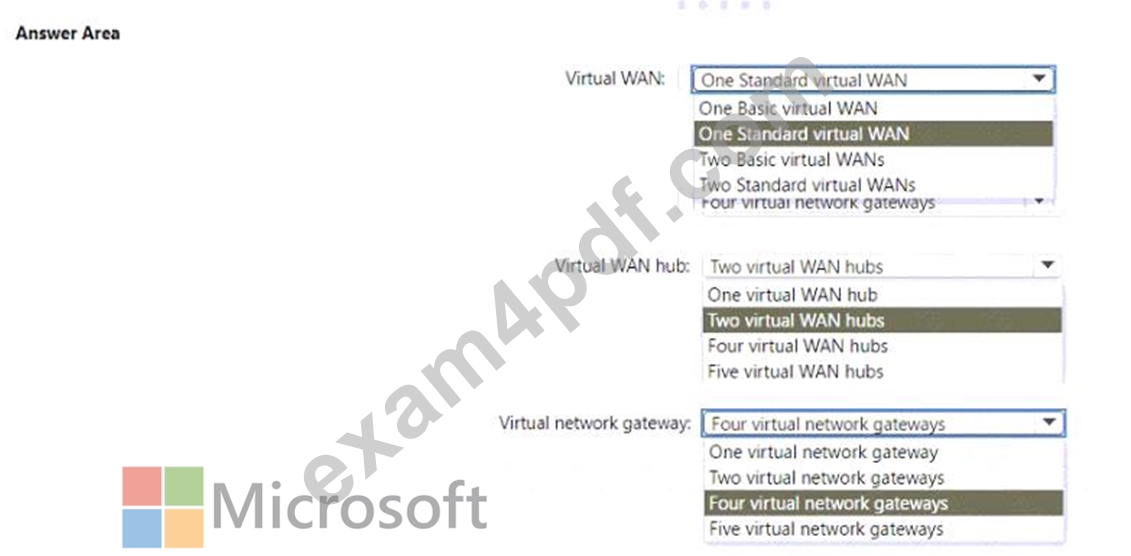
Answer:
Explanation: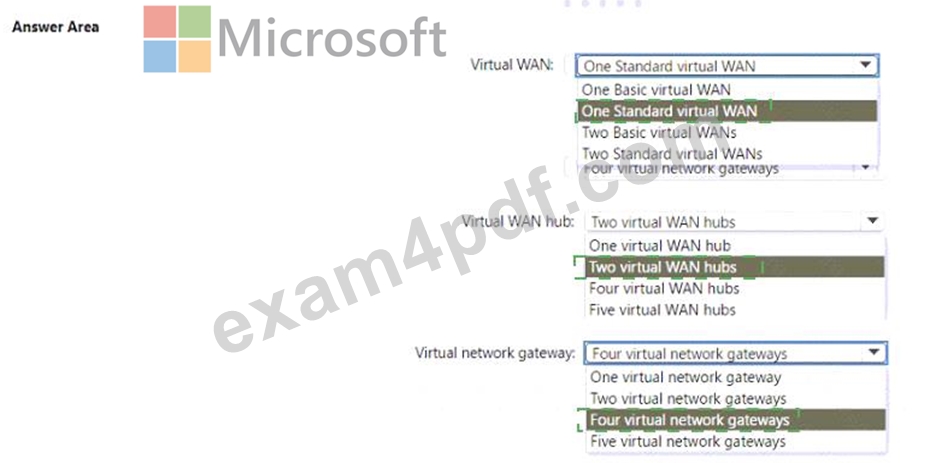
Explanation: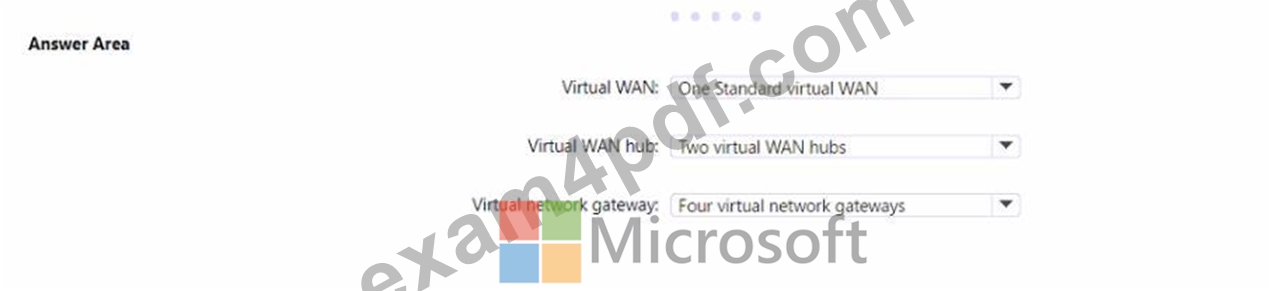
NEW QUESTION # 136
Your on-premises network contains a DNS server named Server 1.
You have an Azure subscription that contains the resources shown in the following table.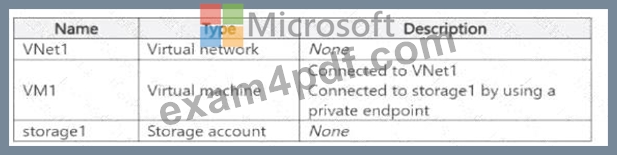
The on-premises network is connected to VNet1 by using a Site-to-Site (S2S) VPN.
You need to ensure that Server1 can resolve the DNS name of storage1. The solution must minimize costs and administrative effort.
What should you use?
- A. an Azure virtual machine that hosts a DNS service
- B. an Azure Private DNS zone
- C. Azure DNS Private Resolver
- D. an Azure public DNS zone
Answer: C
NEW QUESTION # 137
Note: This question is part of a series of questions that present the same scenario. Each question in the series contains a unique solution that might meet the stated goals. Some question sets might have more than one correct solution, while others might not have a correct solution.
After you answer a question in this section, you will NOT be able to return to it. As a result, these questions will not appear in the review screen.
You have an Azure application gateway that has Azure Web Application Firewall (WAF) enabled.
You configure the application gateway to direct traffic to the URL of the application gateway. You attempt to access the URL and receive an HTTP 403 error. You view the diagnostics log and discover the following error.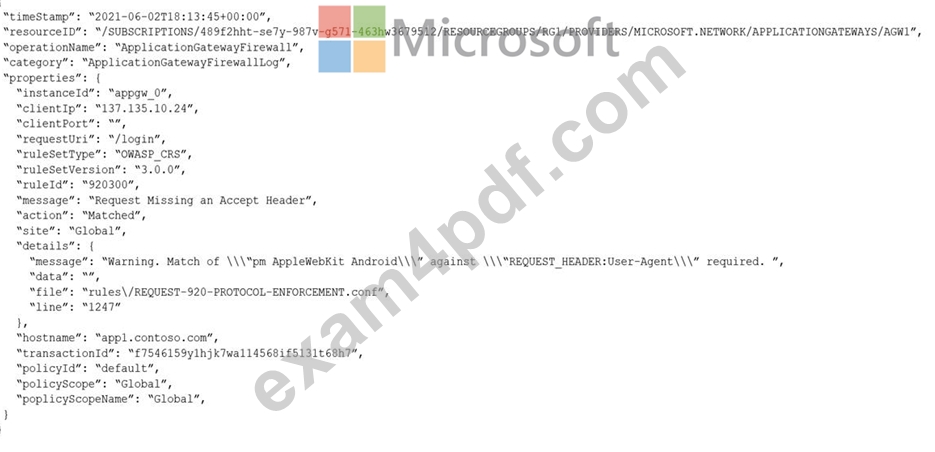
You need to ensure that the URL is accessible through the application gateway.
Solution: You disable the WAF rule that has a ruleld of 920300.
Does this meet the goal?
- A. Yes
- B. No
Answer: A
NEW QUESTION # 138
Note: This question is part of a series of questions that present the same scenario. Each question in the series contains a unique solution that might meet the stated goals. Some question sets might have more than one correct solution, while others might not have a correct solution.
After you answer a question in this section, you will NOT be able to return to it. As a result, these questions will not appear in the review screen.
You have an Azure application gateway that has Azure Web Application Firewall (WAF) enabled.
You configure the application gateway to direct traffic to the URL of the application gateway.
You attempt to access the URL and receive an HTTP 403 error. You view the diagnostics log and discover the following error.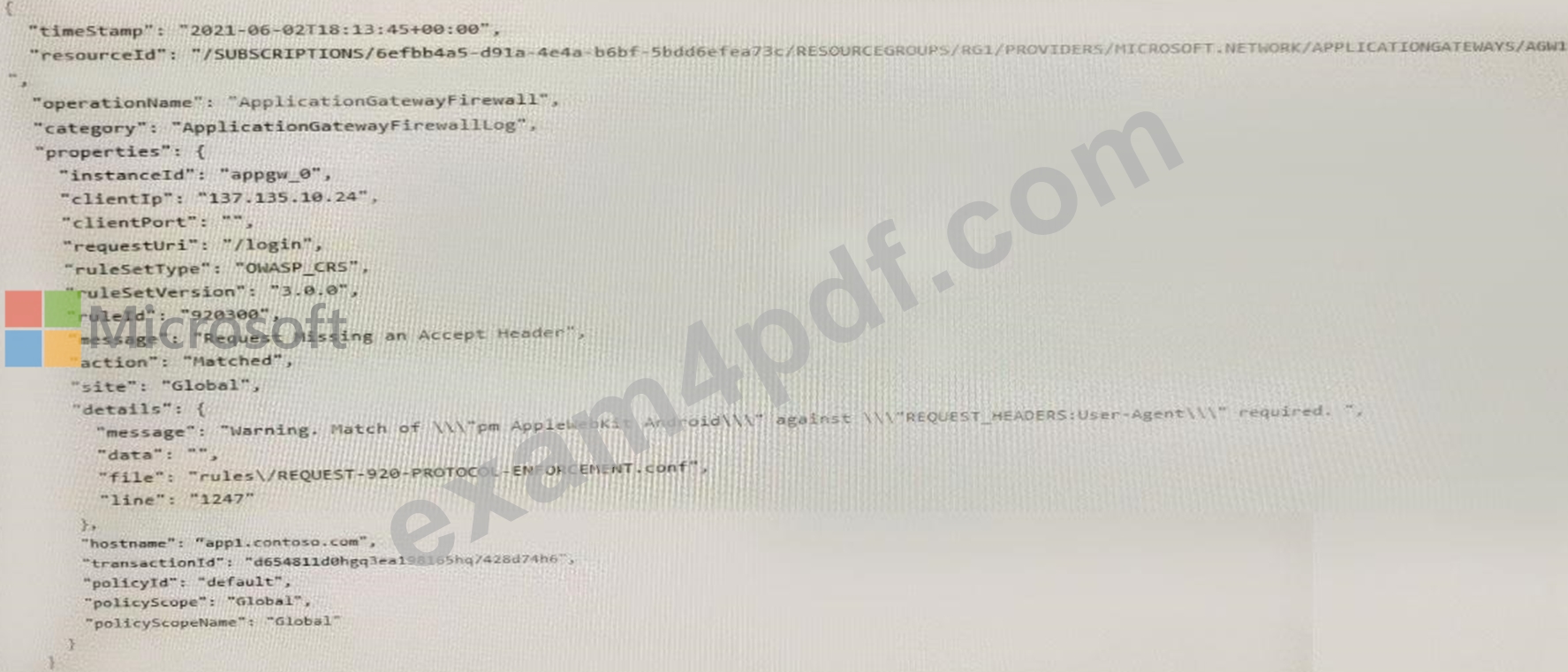
You need to ensure that the URL is accessible through the application gateway.
Solution: You disable the WAF rule that has a ruleld of 920300.
Does this meet the goal?
- A. Yes
- B. No
Answer: A
NEW QUESTION # 139
......
Pass Your AZ-700 Exam Easily With 100% Exam Passing Guarantee: https://www.exam4pdf.com/AZ-700-dumps-torrent.html
AZ-700 Dumps are Available for Instant Access: https://drive.google.com/open?id=1B6gIXS2Dq2IIoqg_NQ2OwGuwfxZqccJy
