

Master 2026 Latest The Questions CompTIA CASP and Pass CAS-005 Real Exam!
Penetration testers simulate CAS-005 exam PDF
CompTIA CAS-005 Exam Syllabus Topics:
| Topic | Details |
|---|---|
| Topic 1 |
|
| Topic 2 |
|
| Topic 3 |
|
| Topic 4 |
|
NEW QUESTION # 278
During a recentsecurity event, access from thenon-production environment to the production environmentenabledunauthorized usersto:
Installunapproved software
Makeunplanned configuration changes
During theinvestigation, the following findings were identified:
Several new users were added in bulkby theIAM team
Additionalfirewalls and routerswere recently added
Vulnerability assessmentshave been disabled formore than 30 days
Theapplication allow listhas not been modified intwo weeks
Logs were unavailablefor various types of traffic
Endpoints have not been patchedinover ten days
Which of the following actions would most likely need to be taken toensure proper monitoring?(Select two)
- A. Routinely update allendpoints and network devicesas soon as new patches/hot fixes are available
- B. Configure firewall rules toonly allow production-to-non-productiontraffic
- C. Disable bulk user creationsby the IAM team
- D. Review the application allow listdaily
- E. Ensure allnetwork and security devicesare sending relevant data to theSIEM
- F. Extend log retention for all security and network devices to180 daysfor all traffic
Answer: A,C,E
Explanation:
Understanding the Security Event:
Unauthorized usersgained access from non-production to production.
IAM policies were weak, allowingbulk user creation.
Vulnerability assessments were disabled, andpatching was delayed.
Logs were unavailable, making incident response difficult.
Why Options A, D, and E areCorrect:
A (Disable bulk user creation by IAM team)# Prevents unauthorized mass user account creation, which could beexploited by attackers.
D (Routine updates for endpoints & network devices)# Patch management ensuresvulnerabilities are not left open for attackers.
E (Ensure all security/network devices send logs to SIEM)# Helps withreal-time monitoring and detection of unauthorized activities.
Why Other Options Are Incorrect:
B (180-day log retention)# While log retention is good,real-time monitoring is the priority.
C (Review application allow list daily)# Reviewing itdaily is impractical. Regular audits are better.
F (Restrict production-to-non-production traffic)# The issue isunauthorized access, not traffic routing.
Reference:
CompTIA SecurityX CAS-005 Official Study Guide:IAM, Patch Management & SIEM Logging Best Practices NIST 800-53 (AC-2, AU-12):Audit Logging & Access Control
NEW QUESTION # 279
A company that uses several cloud applications wants to properly identify:
All the devices potentially affected by a given vulnerability.
All the internal servers utilizing the same physical switch.
The number of endpoints using a particular operating system.Which of the following is the best way to meet the requirements?
- A. SBoM
- B. GRC
- C. CMDB
- D. CASB
Answer: C
Explanation:
The requirements demand detailed asset tracking and inventory management. Let's analyze:
A). SBoM (Software Bill of Materials):Tracks software components, not hardware or network topology.
B). CASB (Cloud Access Security Broker):Secures cloud apps but doesn't map physical switches or OS counts.
C). GRC(Governance, Risk, and Compliance):Focuses on risk management, not detailed asset tracking.
Reference:CompTIA SecurityX (CAS-005) objectives, Domain 4: Governance, Risk, and Compliance, covering asset management.
NEW QUESTION # 280
A software company deployed a new application based on its internal code repository Several customers are reporting anti-malware alerts on workstations used to test the application Which of the following is the most likely cause of the alerts?
- A. Misconfigured code commit
- B. Unsecure bundled libraries
- C. Data leakage
- D. Invalid code signing certificate
Answer: B
Explanation:
The most likely cause of the anti-malware alerts on customer workstations is unsecure bundled libraries. When developing and deploying new applications, it is common for developers to use third-party libraries. If these libraries are not properly vetted for security, they can introduce vulnerabilities or malicious code.
Why Unsecure Bundled Libraries?
Third-Party Risks: Using libraries that are not secure can lead to malware infections if the libraries contain malicious code or vulnerabilities.
Code Dependencies: Libraries may have dependencies that are not secure, leading to potential security risks.
Common Issue: This is a frequent issue in software development where libraries are used for convenience but not properly vetted for security.
Other options, while relevant, are less likely to cause widespread anti-malware alerts:
A . Misconfigured code commit: Could lead to issues but less likely to trigger anti-malware alerts.
C . Invalid code signing certificate: Would lead to trust issues but not typically anti-malware alerts.
D . Data leakage: Relevant for privacy concerns but not directly related to anti-malware alerts.
Reference:
CompTIA SecurityX Study Guide
"Securing Open Source Libraries," OWASP
"Managing Third-Party Software Security Risks," Gartner Research
NEW QUESTION # 281
A global organization wants to manage all endpoint and user telemetry. The organization also needs to differentiate this data based on which office it is correlated to. Which of the following strategies best aligns with this goal?
- A. Data labeling
- B. Sensor placement
- C. Centralized logging
- D. Continuous monitoring
Answer: A
Explanation:
Comprehensive and Detailed
Managing telemetry and differentiating it by office requires a way to categorize data. Let's evaluate:
A . Sensor placement:Useful for data collection but doesn't inherently differentiate by office.
B . Data labeling:Assigns metadata (e.g., office location) to telemetry, enabling differentiation. This aligns with CAS-005's focus on data management for security operations.
C . Continuous monitoring:Ensures ongoing data collection but doesn't address differentiation.
NEW QUESTION # 282
Which of the following best describes the reason PQC preparation is important?
- A. To protect data against decryption due to increases in computational resource availability
- B. To leverage asymmetric encryption for large amounts of data
- C. To have larger key lengths available through key stretching
- D. To improve encryption performance and speed using lightweight cryptography
Answer: A
Explanation:
Post-quantum cryptography (PQC) is about ensuring that encrypted data remains secure even when attackers have access to quantum computers, vastly more powerful computational resources than today's systems. Without PQC algorithms, future quantum capabilities could decrypt today's protected data, so preparing now safeguards information against that upcoming threat.
NEW QUESTION # 283
During a gap assessment, an organization notes that OYOD usage is asignificant risk. The organization implemented administrative policies prohibiting BYOD usage However, the organization has not implemented technical controls to prevent the unauthorized use of BYOD assets when accessing the organization's resources. Which of the following solutions should the organization implement to b»« reduce the risk of OYOD devices? (Select two).
- A. Cloud 1AM to enforce the use of token based MFA
- B. NAC, to enforce device configuration requirements
- C. SD-WAN. to enforce web content filtering through external proxies
- D. Conditional access, to enforce user-to-device binding
- E. PAM. to enforce local password policies
- F. DLP, to enforce data protection capabilities
Answer: B,D
Explanation:
To reduce the risk of unauthorized BYOD (Bring Your Own Device) usage, the organization should implement Conditional Access and Network Access Control (NAC).
Why Conditional Access and NAC?
Conditional Access:
User-to-Device Binding: Conditional access policies can enforce that only registered and compliant devices are allowed to access corporate resources.
Context-Aware Security: Enforces access controls based on the context of the access attempt, such as user identity, device compliance, location, and more.
Network Access Control (NAC):
DeviceConfiguration Requirements: NAC ensures that only devices meeting specific security configurations are allowed to connect to the network.
Access Control: Provides granular control over network access, ensuring that BYOD devices comply with security policies before gaining access.
Other options, while useful, do not address the specific need to control and secure BYOD devices effectively:
A . Cloud IAM to enforce token-based MFA: Enhances authentication security but does not control device compliance.
D . PAM to enforce local password policies: Focuses on privileged account management, not BYOD control.
E . SD-WAN to enforce web content filtering: Enhances network performance and security but does not enforce BYOD device compliance.
F . DLP to enforce data protection capabilities: Protects data but does not control BYOD device access and compliance.
Reference:
CompTIA SecurityX Study Guide
"Conditional Access Policies," Microsoft Documentation
"Network Access Control (NAC)," Cisco Documentation
NEW QUESTION # 284
Source code snippets for two separate malware samples are shown below:
Sample 1:
knockEmDown(String e) {
if(target.isAccessed()) {
target.toShell(e);
System.out.printIn(e.toString());
c2.sendTelemetry(target.hostname.toString + " is " + e.toString());
} else {
target.close();
}
}
Sample 2:
targetSys(address a) {
if(address.islpv4()) {
address.connect(1337);
address.keepAlive("paranoid");
String status = knockEmDown(address.current);
remote.sendC2(address.current + " is " + status);
} else {
throw Exception e;
}
}
Which of the following describes the most important observation about the two samples?
- A. Telemetry is first buffered and then transmitted in paranoid mode.
- B. Sample 1 is the target agent while Sample 2 is the C2 server.
- C. Both samples use IP connectivity for command and control.
- D. The samples were probably written by the same developer.
Answer: D
Explanation:
Comprehensive and Detailed Step-by-Step
Both samples share similar function names, variable naming styles, and logic flow, indicating that they were likely written by the same developer. This is a key observation in malware attribution, as cyber threat analysts often look for unique coding styles to link malware to specific threat actors.
NEW QUESTION # 285
Which of the following best explains the business requirement a healthcare provider fulfills by encrypting patient data at rest?
- A. Providing for non-repudiation data
- B. Securing data transfer between hospitals
- C. Protecting privacy while supporting portability.
- D. Reducing liability from identity theft
Answer: C
Explanation:
Encrypting patient data at rest is a critical requirement for healthcare providers to ensure compliance with regulations such as the Health Insurance Portability and Accountability Act (HIPAA). The primary business requirement fulfilled by this practice is the protection of patient privacy while supporting the portability of medical information. By encrypting data at rest, healthcare providers safeguard sensitive patient information from unauthorized access, ensuring that privacy is maintained even if the storage media are compromised. Additionally, encryption supports the portability of patient records, allowing for secure transfer and access across different systems and locations while ensuring that privacy controls are in place.
NEW QUESTION # 286
Which of the following best explains the business requirement a healthcare provider fulfills by encrypting patient data at rest?
- A. Providing for non-repudiation data
- B. Securing data transfer between hospitals
- C. Protecting privacy while supporting portability.
- D. Reducing liability from identity theft
Answer: C
Explanation:
Encrypting patient data at rest is a critical requirement for healthcare providers to ensure compliance with regulations such as the Health Insurance Portability and Accountability Act (HIPAA). The primary business requirement fulfilled by this practice is the protection of patient privacy while supporting the portability of medical information. By encrypting data at rest, healthcare providers safeguard sensitive patient information from unauthorized access, ensuring that privacy is maintained even if the storage media are compromised. Additionally, encryption supports the portability of patient records, allowing for secure transfer and access across different systems and locations while ensuring that privacy controls are in place.
Reference:
CompTIA SecurityX Study Guide: Emphasizes the importance of data encryption for protecting sensitive information and ensuring compliance with regulatory requirements.
HIPAA Security Rule: Requires healthcare providers to implement safeguards, including encryption, to protect patient data.
"Health Informatics: Practical Guide for Healthcare and Information Technology Professionals" by Robert E. Hoyt: Discusses encryption as a key measure for protecting patient data privacy and supporting data portability.
NEW QUESTION # 287
An organization is increasing its focus on training that addresses new social engineering and phishing attacks. Which of the following is the organization most concerned about?
- A. Generative AI tools increasing the quality of exploits
- B. Differential analysis using AI models
- C. Meeting existing regulatory compliance
- D. Overreliance on AI support bots
Answer: A
Explanation:
The organization is concerned that generative AI tools can increase the quality and sophistication of phishing and social engineering attacks, making them harder to detect and more convincing to victims.
NEW QUESTION # 288
A company migrating to a remote work model requires that company-owned devices connect to a VPN before logging in to the device itself. The VPN gateway requires that a specific key extension is deployed to the machine certificates in the internal PKI. Which of the following best explains this requirement?
- A. The certificate is an additional factor to meet regulatory MFA requirements for VPN access.
- B. The VPN client selected the certificate with the correct key usage without user interaction.
- C. The internal PKI certificate deployment allows for Wi-Fi connectivity before logging in to other systems.
- D. The server connection uses SSL VPN, which uses certificates for secure communication.
Answer: B
Explanation:
Comprehensive and Detailed Explanation:
This scenario describes an enterprise VPN setup that requires machine authentication before a user logs in. The best explanation for this requirement is that the VPN client selects the appropriate certificate automatically based on the key extension in the machine certificate.
* Understanding the Key Extension Requirement:
* PKI (Public Key Infrastructure) issues machine certificates that include specific key usages such as Client Authentication or IPSec IKE Intermediate.
* Key usage extensions define how a certificate can be used, ensuring that only valid certificates are selected by the VPN client.
* Why Option B is Correct:
* The VPN automatically selects the correct machine certificate with the appropriate key extension.
* The process occurs without user intervention, ensuring seamless VPN authentication before login.
* Why Other Options Are Incorrect:
* A (MFA requirement): Certificates used in this scenario are for machine authentication, not user MFA. MFA typically involves user credentials plus a second factor (like OTPs or biometrics), which is not applicable here.
* C (Wi-Fi connectivity before login): This refers to pre-logon networking, which is a separate concept where devices authenticate to a Wi-Fi network before login, usually via 802.1X EAP- TLS. However, this question specifically mentions VPN authentication, not Wi-Fi authentication.
* D (SSL VPN with certificates): While SSL VPNs do use certificates, this scenario involves machine certificates issued by an internal PKI, which are commonly used in IPSec VPNs, not SSL VPNs.
NEW QUESTION # 289
You are a security analyst tasked with interpreting an Nmap scan output from company's privileged network.
The company's hardening guidelines indicate the following:
There should be one primary server or service per device.
Only default ports should be used.
Non-secure protocols should be disabled.
INSTRUCTIONS
Using the Nmap output, identify the devices on the network and their roles, and any open ports that should be closed.
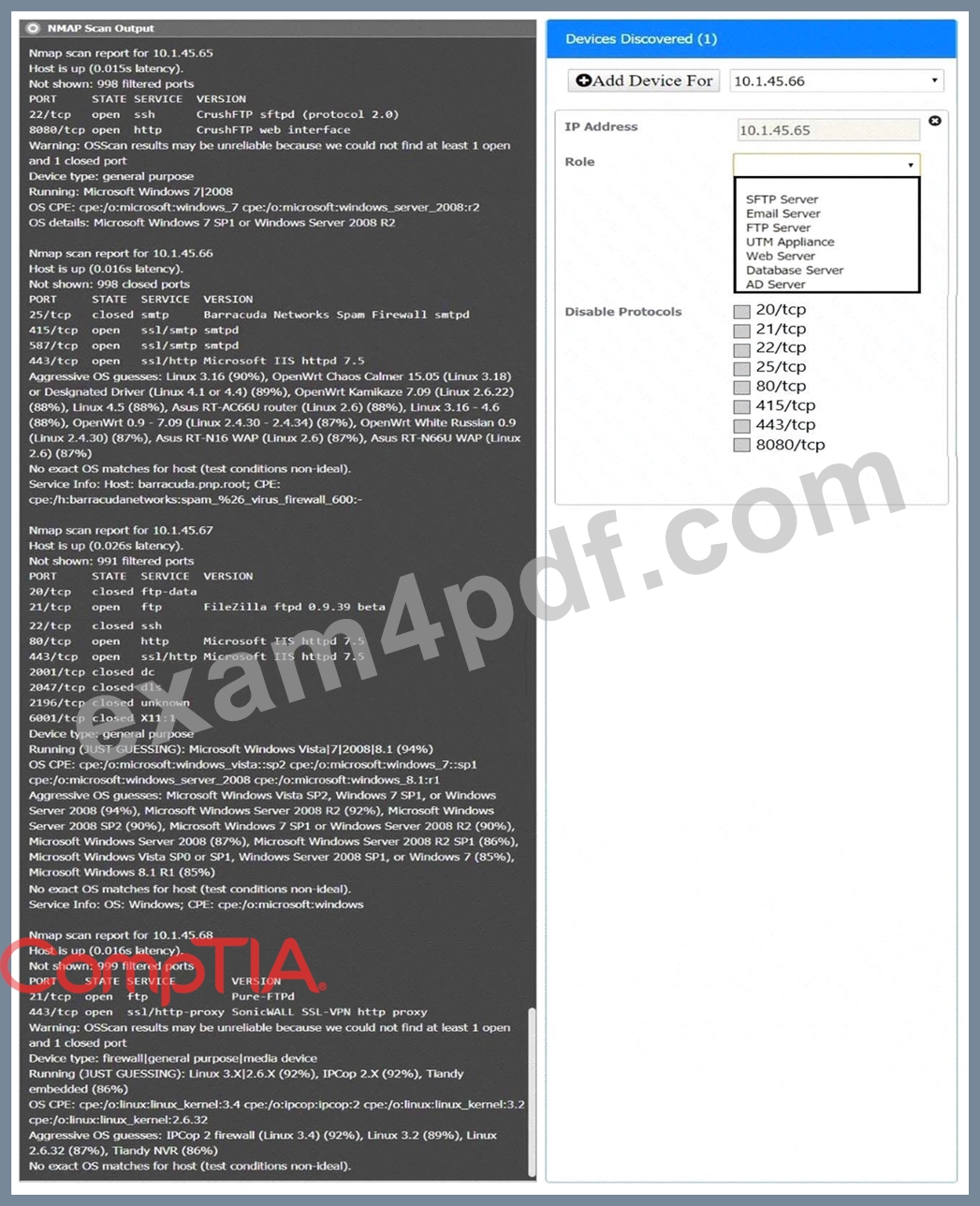
For each device found by Nmap, add a device entry to the Devices Discovered list, with the following information:
The IP address of the device
The primary server or service of the device (Note that each IP should by associated with one service/port only) The protocol(s) that should be disabled based on the hardening guidelines (Note that multiple ports may need to be closed to comply with the hardening guidelines) If at any time you would like to bring back the initial state of the simulation, please click the Reset All button.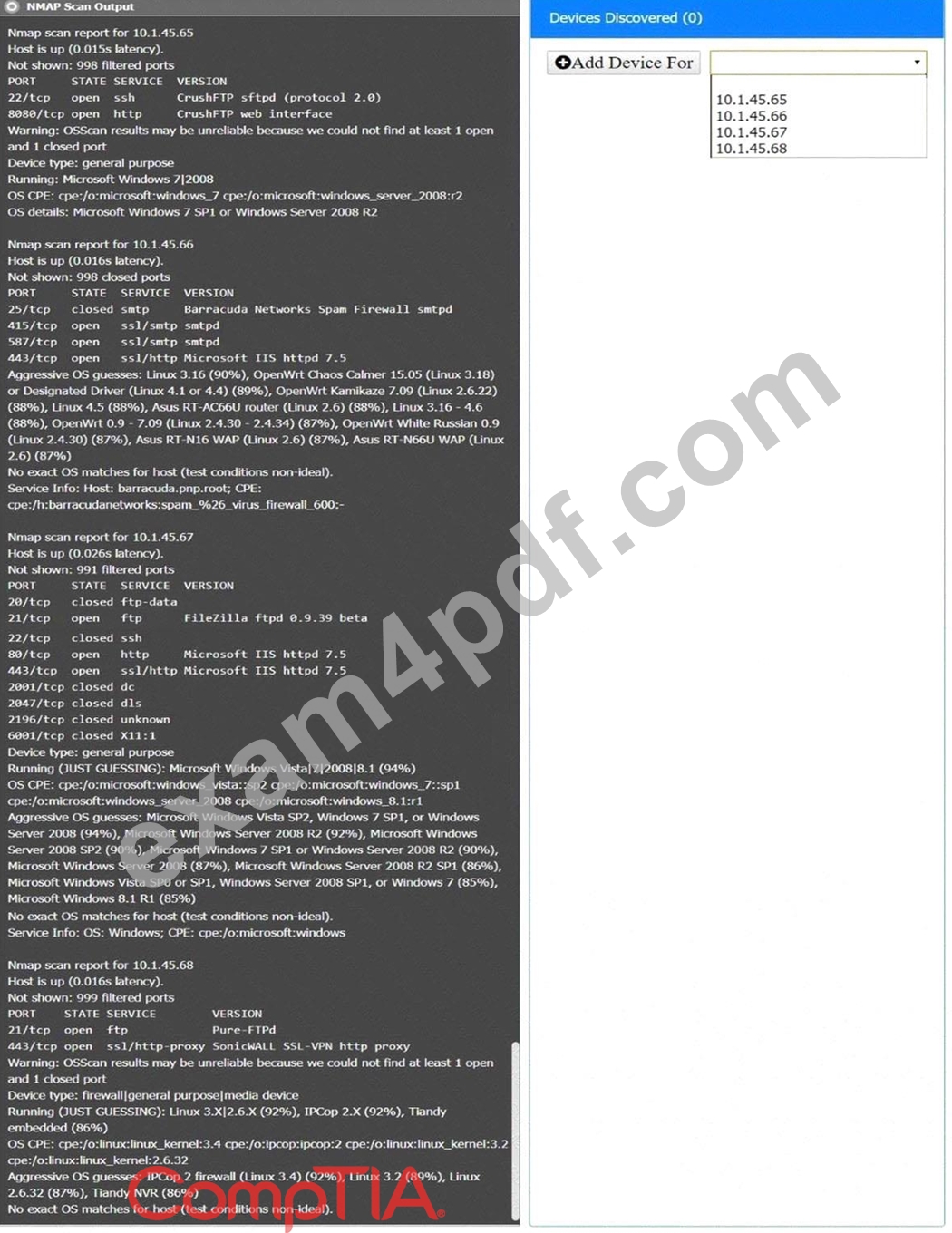
Answer:
Explanation:
See explanation below.
Explanation:
10.1.45.65 SFTP Server Disable 8080
10.1.45.66 Email Server Disable 415 and 443
10.1.45.67 Web Server Disable 21, 80
10.1.45.68 UTM Appliance Disable 21
NEW QUESTION # 290
A security analystreviews the following report:
Which of the following assessments is the analyst performing?
- A. System
- B. Organizational
- C. Supply chain
- D. Quantitative
Answer: C
Explanation:
The table shows detailed information about products, includinglocation, chassis manufacturer, OS, application developer, and vendor. This type of information is typically assessed in a supply chain assessment to evaluate the security and reliability of components and services from different suppliers.
Why Supply Chain Assessment?
Component Evaluation: Assessing the origin and security of each component used in the products, including hardware, software, and third-party services.
Risk Management: Identifying potential risks associated with the supply chain, such as vulnerabilities in third-party components or insecure development practices.
Other types of assessments do not align with the detailed supplier and component information provided:
A . System: Focuses on individual system security, not the broader supply chain.
C . Quantitative: Focuses on numerical risk assessments, not supplier information.
D . Organizational: Focuses on internal organizational practices, not external suppliers.
Reference:
CompTIA SecurityX Study Guide
NIST Special Publication 800-161, "Supply Chain Risk Management Practices for Federal Information Systems and Organizations"
"Supply Chain Security Best Practices," Gartner Research
NEW QUESTION # 291
A company needs to quickly assess whether software deployed across the company's global corporate network contains specific software libraries. Which of the following best enables the company's SOC to respond quickly when such an assessment is required?
- A. Implementing a GRC tool to maintain a list of all software vendors and internal developers
- B. Contractually requiring all software vendors to attest to third-party risk mitigations
- C. Requiring all suppliers and internal developers to implement a thorough SBoM
- D. Maintaining SAST/DAST reports on a server with access restricted to SOC staff
Answer: C
Explanation:
The best way for a SOC to rapidly identify whether deployed applications contain specific libraries is through the use of a Software Bill of Materials (SBOM). An SBOM is a formal, machine-readable inventory of all components, including third-party and open-source libraries, used in a software product. When a new vulnerability is disclosed (such as Log4Shell in Log4j), organizations with a comprehensive SBOM can immediately search across their application landscape to determine which systems are impacted.
Other options are less effective. Maintaining SAST/DAST reports (A) only provides snapshots of vulnerabilities at the time of scanning, but does not dynamically track components across all software in production. Vendor attestations (B) improve supply chain governance but do not provide immediate visibility into internal or custom software. A GRC tool (D) helps track vendors and policies but does not show technical dependencies inside applications.
Requiring suppliers and internal developers to provide and maintain SBOMs ensures continuous visibility into dependencies. This allows the SOC to quickly query and respond to emerging vulnerabilities, reducing risk exposure and accelerating remediation timelines.
NEW QUESTION # 292
A security officer performs due diligence activities before implementing a third-party solution into the enterprise environment. The security officer needs evidence from the third party that a data subject access request handling process is in place. Which of the following is the security officer most likely seeking to maintain compliance?
- A. Information security standards
- B. Reporting frameworks
- C. Privacy regulations
- D. Certification requirements
- E. E-discovery requirements
Answer: C
Explanation:
Step-by-Step
Privacy regulations (C), such as GDPR (General Data Protection Regulation) and CCPA (California Consumer Privacy Act), require companies to provide data subject access request (DSAR) handling processes. A DSAR allows individuals to request details about their personal data stored by a company and request modifications or deletions.
Information security standards (A) focus on overall security controls, while e-discovery requirements (B) relate to legal investigations rather than ongoing compliance.
NEW QUESTION # 293
......
Penetration testers simulate CAS-005 exam: https://www.exam4pdf.com/CAS-005-dumps-torrent.html
Bestselling On-The-Job Reference Exam Questions: https://drive.google.com/open?id=15HmXSG5ERDf2pRpoP-FmZDLzE6gwO5z2
