

SnowPro-Core Practice Exam Tests Latest Updated on Sep-2025
Pass SnowPro-Core Exam in First Attempt Guaranteed Dumps!
The SnowPro-Core certification exam is designed to test the candidate’s knowledge of Snowflake’s architecture, data loading, querying, and administration. Candidates who pass the SnowPro-Core exam will have a solid understanding of Snowflake’s core concepts, features, and capabilities. SnowPro Core Certification Exam certification is ideal for data professionals who want to acquire the foundational skills required to work with Snowflake.
The benefit of obtaining the SnowPro Core Certification Certification
Snowflake is a multi-tenant, secure, highly scalable and elastic data platform with full SQL support. It has built-in extensions for semi-structured and schema-less data and is offered as a pay-as-you-go service. There is no hardware and software to install, configure, or manage, no tuning knobs and no storage combing tasks. All ongoing maintenance, management, and tuning is handled by Snowflake as part of their SaaS services. Thus it is verymuch appreciated by organizations which are on the lookout for certified people.
NEW QUESTION # 356
What service is provided as an integrated Snowflake feature to enhance Multi-Factor Authentication (MFA) support?
- A. Single Sign-On (SSO)
- B. OAuth
- C. Okta
- D. Duo Security
Answer: D
Explanation:
Snowflake provides Multi-Factor Authentication (MFA) support as an integrated feature, powered by the Duo Security service. This service is managed completely by Snowflake, and users do not need to sign up separately with Duo1
NEW QUESTION # 357
A virtual warehouse is created using the following command:
Create warehouse my_WH with
warehouse_size = MEDIUM
min_cluster_count = 1
max_cluster_count = 1
auto_suspend = 60
auto_resume = true;
The image below is a graphical representation of the warehouse utilization across two days.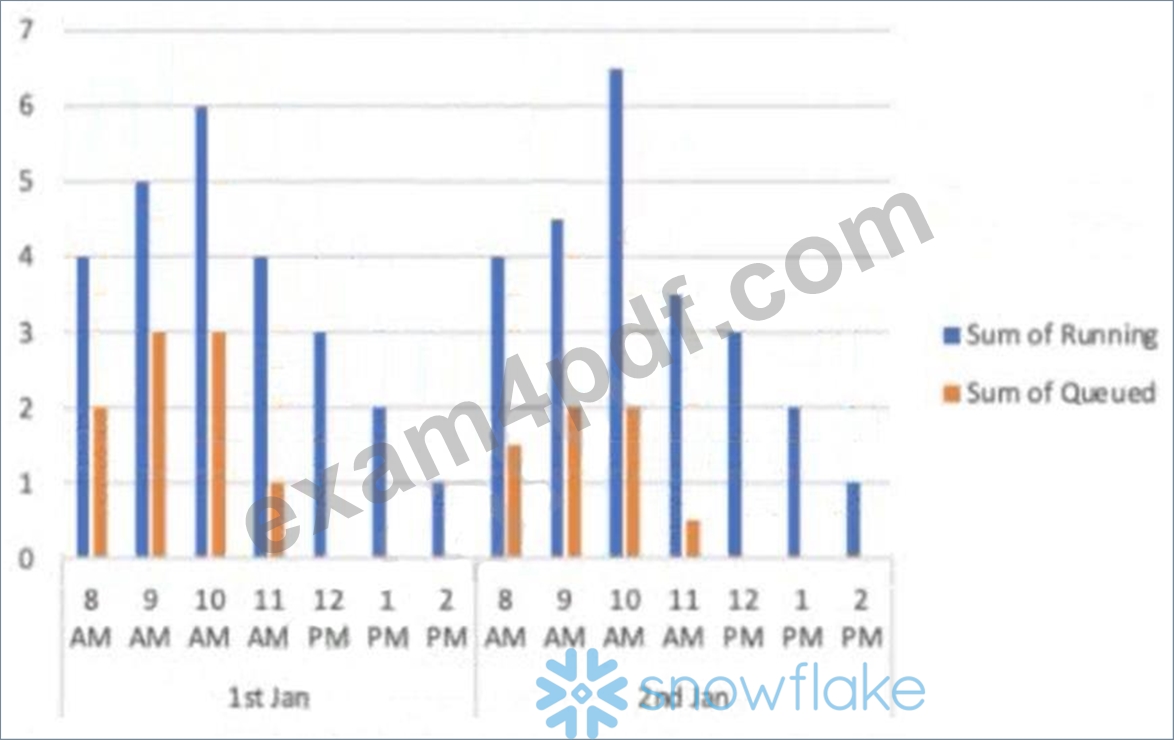
What action should be taken to address this situation?
- A. Lower the value of the parameter STATEMENT_QUEUED_TIMEOUT_IN_SECONDS.
- B. Increase the value for the parameter MAX_CONCURRENCY_LEVEL.
- C. Configure the warehouse to a multi-cluster warehouse.
- D. Increase the warehouse size from Medium to 2XL.
Answer: B
NEW QUESTION # 358
A Snowflake user has two tables that contain numeric values and is trying to find out which values are present in both tables. Which set operator should be used?
- A. UNION
- B. INTERSECT
- C. MINUS
- D. MFRCK
Answer: B
Explanation:
To find out which numeric values are present in both tables, the INTERSECT set operator should be used. This operator returns rows from one query's result set which also appear in another query's result set, effectively finding the common elements between the two tables45.
NEW QUESTION # 359
Which of the following SQL statements will list the version of the drivers currently being used?
- A. Execute SELECT CURRENT_CLIENT(); from an application
- B. Execute SELECT CURRENT_JDBC_VERSION() ; from SnowSQL
- C. Execute SELECT CURRENT_VERSION (); from the Python Connector
- D. Execute SELECT CURRENT_ODBC_CLlENT(); from the Web Ul
Answer: B
Explanation:
The correct SQL statement to list the version of the JDBC (Java Database Connectivity) drivers currently being used is to execute SELECT CURRENT_JDBC_VERSION(); from within SnowSQL or any client application that utilizes JDBC for connecting to Snowflake. Snowflake provides specific functions to query the version of the client drivers or connectors being used, such as JDBC, ODBC, and others. The CURRENT_JDBC_VERSION() function is designed specifically to return the version of the JDBC driver in use.
It's important to note that Snowflake supports various types of drivers and connectors for connecting to different client applications, including ODBC, JDBC, Python, and others. Each of these connectors has its own method or function for querying the current version in use. For JDBC, the appropriate function is CURRENT_JDBC_VERSION(), reflecting the specificity required to obtain version information relevant to the JDBC driver specifically.
References:
* Snowflake Documentation on Client Functions: This information can typically be found in the Snowflake documentation under the section that covers SQL functions, particularly those functions that provide information about the client or session.
NEW QUESTION # 360
A virtual warehouse is created using the following command:
Create warehouse my_WH with
warehouse_size = MEDIUM
min_cluster_count = 1
max_cluster_count = 1
auto_suspend = 60
auto_resume = true;
The image below is a graphical representation of the warehouse utilization across two days.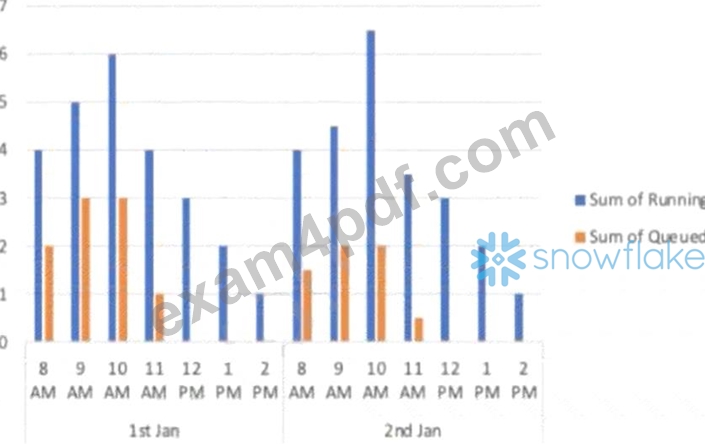
What action should be taken to address this situation?
- A. Configure the warehouse to a multi-cluster warehouse.
- B. Lower the value of the parameter STATEMENT_QUEUED_TIMEOUT_IN_SECONDS.
- C. Increase the value for the parameter MAX_CONCURRENCY_LEVEL.
- D. Increase the warehouse size from Medium to 2XL.
Answer: A
Explanation:
The graphical representation of warehouse utilization indicates periods of significant queuing, suggesting that the current single cluster cannot efficiently handle all incoming queries. Configuring the warehouse to a multi-cluster warehouse will distribute the load among multiple clusters, reducing queuing times and improving overall performance1.
References = Snowflake Documentation on Multi-cluster Warehouses1
NEW QUESTION # 361
Which data types are supported by Snowflake when using semi-structured data? (Choose two.)
- A. QUEUE
- B. VARIANT
- C. ARRAY
- D. VARRAY
- E. STRUCT
Answer: B,C
NEW QUESTION # 362
Which of the following best describes where Snowflake's metadata is stored?
- A. In the Cloud Services Layer
- B. Inside the Virtual Warehouses
- C. Within the data files
- D. within the drivers
Answer: A
NEW QUESTION # 363
Which of the following statements describe features of Snowflake data caching? (Choose two.)
- A. When the data cache is full, the least-recently used data will be cleared to make room.
- B. The RESULT_SCAN table function can access and filter the contents of the query result cache.
- C. A user must set USE_METADATA_CACHE to TRUE to use the metadata cache in queries.
- D. A user can only access their own queries from the query result cache.
- E. When a virtual warehouse is suspended, the data cache is saved on the remote storage layer.
Answer: A,C
NEW QUESTION # 364
What services does Snowflake automatically provide for customer that they may have been responsible for with their on premise system? Select all the below that apply.
- A. Physical security
- B. Installing and configuring hardware
- C. Maintaining metadata and statists
- D. Patching software
Answer: B,C,D
NEW QUESTION # 365
Snowflake recommends, as a minimize, that all users with the following roles(s) should be enrolled in Multi-Factor Authentication (MFA):
Select one:
- A. ACCOUNTADMIN
- B. SECURITYADMIN ACCOUNTADMIN, SYSADMIN
- C. SECURITYADMIN, ACCOUNTADMIN
- D. SECURITYADMIN, ACCOUNTADMIN, PUBLIC, SYSADMIN
Answer: B
NEW QUESTION # 366
What is the minimum Snowflake edition that provides multi-cluster warehouses and up to 90 days of Time Travel?
- A. Business Critical Edition
- B. Premier
- C. Enterprise
- D. Standard
Answer: C
NEW QUESTION # 367
When loading data into Snowflake, the COPY command supports:
Choose 2 answers
- A. Aggregates
- B. Data type conversions
- C. Fitters
- D. Column reordering
- E. Joins
Answer: B,D
NEW QUESTION # 368
Based on Snowflake recommendations, when creating a hierarchy of custom roles, the top-most custom role should be assigned to which role?
- A. USERADMIN
- B. ACCOUNTADMIN
- C. SECURITYADMIN
- D. SYSADMIN
Answer: B
Explanation:
Based on Snowflake recommendations, when creating a hierarchy of custom roles, the top-most custom role should ideally be granted to the ACCOUNTADMIN role. This recommendation stems from the best practices for implementing a least privilege access control model, ensuring that only the necessary permissions are granted at each level of the role hierarchy. The ACCOUNTADMIN role has the highest level of privileges in Snowflake, including the ability to manage all aspects of the Snowflake account. By assigning the top-most custom role to ACCOUNTADMIN, you ensure that the administration of role hierarchies and the assignment of roles remain under the control of users with the highest level of oversight and responsibility within the Snowflake environment.
References:
* Snowflake Documentation on Access Control: Managing Access Control
NEW QUESTION # 369
True or False: Some queries can be answered through the metadata cache and do not require an active Virtual Warehouse.
- A. True
- B. False
Answer: A
Explanation:
Some aggregate queries are answered thru micro partitions metadata only not requiring any VW spin ups.
NEW QUESTION # 370
Which of the following terms best describes Snowflake's database architecture?
- A. Shared disk
- B. Cloud-native shared memory
- C. Columnar shared nothing
- D. Multi-cluster, shared data
Answer: D
Explanation:
Explanation
https://www.snowflake.com/product/architecture/
Built from the ground up for the cloud, Snowflake's unique multi-cluster shared data architecture delivers the performance, scale, elasticity, and concurrency today's organizations require.
NEW QUESTION # 371
Which statement accurately describes how a virtual warehouse functions?
- A. Each virtual warehouse is an independent compute cluster that shares compute resources with other warehouses.
- B. Increasing the size of a virtual warehouse will always improve data loading performance.
- C. Each virtual warehouse is a compute cluster composed of multiple compute nodes allocated by Snowflake from a cloud provider.
- D. All virtual warehouses share the same compute resources so performance degradation of one warehouse can significantly affect all the other warehouses.
Answer: C
Explanation:
A virtual warehouse in Snowflake is an independent compute cluster that performs data processing tasks such as executing SQL queries. Each virtual warehouse is dynamically allocated by Snowflake from the cloud provider's resources and does not share compute resources with other warehouses. This architecture ensures that the performance of one warehouse does not impact the performance of another. Adjusting the size of a virtual warehouse affects its computational power by increasing or decreasing the number of compute nodes, which can improve the performance of data processing tasks depending on the workload.
References:
* Snowflake Documentation: Understanding Virtual Warehouses
NEW QUESTION # 372
When using SnowSQL, which configuration options are required when unloading data from a SQL query run on a local machine? {Select TWO).
- A. force_put_overwrite
- B. output_format
- C. quiet
- D. echo
- E. output_file
Answer: B,E
Explanation:
When unloading data from SnowSQL (Snowflake's command-line client), to a file on a local machine, you need to specify certain configuration options to determine how and where the data should be outputted. The correct configuration options required are:
* C. output_file: This configuration option specifies the file path where the output from the query should be stored. It is essential for directing the results of your SQL query into a local file, rather than just displaying it on the screen.
* D. output_format: This option determines the format of the output file (e.g., CSV, JSON, etc.). It is crucial for ensuring that the data is unloaded in a structured format that meets the requirements of downstream processes or systems.
These options are specified in the SnowSQL configuration file or directly in the SnowSQL command line. The configuration file allows users to set defaults and customize their usage of SnowSQL, including output preferences for unloading data.
References:
* Snowflake Documentation: SnowSQL (CLI Client) at Snowflake Documentation
* Snowflake Documentation: Configuring SnowSQL at Snowflake Documentation
NEW QUESTION # 373
True or False: An active warehouse is required to run a COPY INTO statement.
- A. True
- B. False
Answer: A
NEW QUESTION # 374
What is the maximum total Continuous Data Protection (CDP) charges incurred for a temporary table?
- A. 30 days
- B. 24 hours
- C. 7 days
- D. 48 hours
Answer: B
NEW QUESTION # 375
True or False: It is possible for a user to run a query against the query result cache without requiring an active Warehouse.
- A. True
- B. False
Answer: A
Explanation:
Snowflake's architecture allows for the use of a query result cache that stores the results of queries for a period of time. If the same query is run again and the underlying data has not changed, Snowflake can retrieve the result from this cache without needing to re-run the query on an active warehouse, thus saving on compute resources.
NEW QUESTION # 376
When unloading data with the COPY into <location> command, what is the purpose of the PARTITION BY
<expression> parameter option?
- A. To sort the contents of the output file by the specified expression.
- B. To delimit the records in the output file using the specified expression.
- C. To include a new column in the output using the specified window function expression.
- D. To split the output into multiple files, one for each distinct value of the specified expression.
Answer: D
Explanation:
The PARTITION BY <expression> parameter option in the COPY INTO <location> command is used to split the output into multiple files based on the distinct values of the specified expression. This feature is particularly useful for organizing large datasets into smaller, more manageable files and can help with optimizing downstream processing or consumption of the data. For example, if you are unloading a large dataset of transactions and use PARTITION BY DATE(transactions.transaction_date), Snowflake generates a separate output file for each unique transaction date, facilitating easier data management and access.
This approach to data unloading can significantly improve efficiency when dealing with large volumes of data by enabling parallel processing and simplifying data retrieval based on specific criteria or dimensions.
References:
* Snowflake Documentation on Unloading Data: COPY INTO <location>
NEW QUESTION # 377
True or False: You can query the files in an External Stage directly without having to load the data into a table.
- A. True
- B. False
Answer: A
Explanation:
Reference: https://docs.snowflake.com/en/user-guide/tables-external-intro.html External tables are read-only, therefore no DML operations can be performed on them; however, external tables can be used for query and join operations. Views can be created against external tables.
NEW QUESTION # 378
True or False: Snowflake charges additional fees to Data providers for each share they create.
- A. True
- B. False
Answer: A
NEW QUESTION # 379
What does Snowflake attempt to do if any of the compute resources for a virtual warehouse fail to provision during start-up?
- A. Queue the failed resources
- B. Repair the failed resources.
- C. Restart failed resources.
- D. Provision the failed resources
Answer: C
Explanation:
If any compute resources for a virtual warehouse fail to provision during startup, Snowflake will attempt to restart those failed resources. The system is designed to automatically handle transient issues that might occur during the provisioning of compute resources. By restarting the failed resources, Snowflake aims to ensure that the virtual warehouse has the necessary compute capacity to handle the user's workloads without manual intervention.References: Snowflake Documentation on Virtual Warehouses
NEW QUESTION # 380
What is the MINIMUM role required to set the value for the parameter
ENABLE_ACCOUNT_DATABASE_REPLICATION?
- A. ACCOUNTADMIN
- B. ORGADMIN
- C. SECURITYADMIN
- D. SYSADMIN
Answer: A
Explanation:
The ENABLE_ACCOUNT_DATABASE_REPLICATION parameter is a critical setting in Snowflake that allows or restricts the replication of databases across Snowflake accounts. Given the significant impact of this parameter on data management and security, only the ACCOUNTADMIN role has the minimum required privileges to set or modify it. This ensures that only users with the highest level of access and responsibility within the Snowflake environment can control database replication settings, maintaining strict governance and security standards.References: Snowflake Documentation on Database Replication
NEW QUESTION # 381
......
SnowPro Core Free Certification Exam Material from Exam4PDF with 630 Questions: https://www.exam4pdf.com/SnowPro-Core-dumps-torrent.html
SnowPro-Core Dumps Full Questions - Exam Study Guide: https://drive.google.com/open?id=1DQpO6ASWjWYRSXS7cvLlnkFp-EbNHfQq
