

Unique Top-selling 1Z0-1078-26 Exams - New 2026 Oracle Pratice Exam
Oracle Cloud Dumps 1Z0-1078-26 Exam for Full Questions - Exam Study Guide
NEW QUESTION # 29
Identify two task names for defining a Source System in Oracle Product Hub Cloud for importing items.
Response:
- A. Manage Source System Entities
- B. Manage Source System Lookups
- C. Manage Spoke Systems
- D. Manage Trading Community Source Systems
- E. Manage Trading Community Messages
Answer: A,C
NEW QUESTION # 30
Identify three capabilities of the Centralized Data Governance Processes and Policies product function of Oracle Product Hub Cloud.
Response:
- A. spreadsheet user interfaces
- B. acceleration of time to market by reducing overhead and eliminating complex transformations
- C. streamlined product management and approval
- D. configurable governance processes
- E. granular version management and incremental release capabilities
Answer: B,C,E
NEW QUESTION # 31
One of your customer employees is assigned as an application administrator. What three functions can the employee perform using Security Console?
Response:
- A. Create customers
- B. Perform role analysis
- C. Manage users
- D. Assign Roles to users
- E. Create Items
Answer: B,C,D
NEW QUESTION # 32
Your customer wants a group of employees to only be able to submit ideas.
How should you set up these users?
- A. Create each employee as an application user and assign the Product Design Engineer role.
- B. Create each employee as an application user and assign the Employee role only
- C. Create each employee as an application user and assign the Product Manager role.
- D. Create each employee as an application user and assign the Employee role, and the Product Idea Engineer role
Answer: A
NEW QUESTION # 33 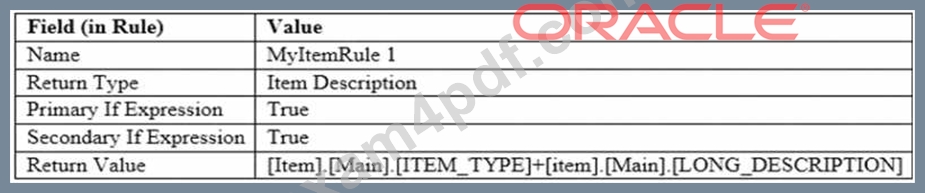
On the Edit Rule Set page, the details of a rule are as shown in the following table. What is the expected behavior of the rule? Response:
- A. Composite rule: Validates the item description, and then assigns the concatenated value of the item type and long description
- B. Item Description Rule: Auto-generates the item description by concatenating the item type and long description attributes
- C. Validation rule: Validates the item type and the long description
- D. Assignment rule: Concatenates the long description with the item type attribute
- E. Assignment rule: Concatenates the item type with the long description attribute
Answer: A
NEW QUESTION # 34
Which two statements are true about implementation projects?
Response:
- A. You cannot customize the task list and assign and track each task.
- B. Each implementation project can only include one offering and its associated functional areas.
- C. When an implementation project is created, you cannot add and/or delete any tasks
- D. You can customize the task list and assign and track each task.
- E. You can use implementation projects to identifying what setup data will be exported and imported
Answer: B,D
NEW QUESTION # 35
Your Product Manager has created an Engineering Change Order by using the Save As action. The Revision field is blank for the Change Order created.
Which statement is true?
- A. You can submit the change order for approval with a blank revision.
- B. You can manually enter a new revision number later.
- C. You cannot have a change order with a blank revision.
- D. You can see the revision-level attachments for the affected object in the change order context with a blank revision.
Answer: C
NEW QUESTION # 36
Your customer wants to automate the Item Category assignment process for all purchasable Items by providing purchase related attributes in Create Item templates.
Identify the Catalog configuration function that you would use to enable the automatic category assignment.
Response:
- A. catalog code
- B. default category
- C. catalog structure
- D. controlled at
- E. allow multiple item category assignment
Answer: B
NEW QUESTION # 37
You created a new field for Proposals. How do you put the new field on the Proposals page?
- A. On a new or existing page layout, open the Summary section, add the field and then deploy the layout.
- B. On a new or existing page layout, move the new field from Available Fields to Selected Fields within the desired page section.
- C. On a new or existing page layout, click the Add button and search for the new field.
- D. While creating the new field, click the Assign button to assign it to the desired page layout.
Answer: D
NEW QUESTION # 38
Your customer wants to initiate a change order when the value of the Weight attribute in an item is changed by more than 15% in Oracle Product Hub Cloud. What would you do to fulfill this requirement?
Response:
- A. Lock updates to the Weight attribute by using edit privileges.
- B. Set up a change policy on the Weight attribute based on the lifecycle phase.
- C. Define an item rule of type 'Validation' and severity 'Needs Approval' on the Weight attribute.
- D. Define an item rule of type 'Assignment' on the Weight attribute to add it to a change order.
Answer: C
NEW QUESTION # 39
Your customer wants to add default approvers to their change order workflow, to review and approve proposed item changes. How would you configure this?
Response:
- A. Setup and Maintenance > Manage Change Statuses > Select Approval status line > In Status Details section, Add Default Approvers
- B. Setup and Maintenance > Manage Change Statuses >Edit Change Order > Click the Workflow tab > Select Approval status line > In Status Details section, Add Default Approvers
- C. Setup and Maintenance > Manage Change Order Types > Edit Workflow tab > Select Approval status line > In Status Details section, Add Default Approvers
- D. Setup and Maintenance > Manage Change Order Types > Edit Workflow tab > Select Approval status line > Add Default Approvers
- E. Setup and Maintenance > Manage Change Order Types > Edit Change Order > Click the Workflow tab > Select Approval status line > In Status Details section, Add Default Approvers
Answer: E
NEW QUESTION # 40
Your customer has been using Product Hub and has decided to extend it's manufacturing operations to a new facility. They want to transfer the manufacturing of some of their existing items to this new facility.
Identify the two required setups in Product Hub to support this change.
Response:
- A. Define Lifecycle Phases and Assign to Item Class
- B. Define Key Flexfield for Categories
- C. Define Item or Inventory Organization
- D. Define Item Class Security
- E. Define Units of Measures
- F. Define Catalogs
Answer: E,F
NEW QUESTION # 41
You have scheduled item publication to a spoke system with specific item publication criteria and the following details:
Day 1: First publication date to the spoke system with a publication schedule that runs every five days Day 5: Next schedule process Day 10: Next schedule process Day 15: Next schedule process On Day 12, your customer decides to publish from Day 6.
Identify the parameters that are required to run this request and the data set that would result from this request.
Response:
- A. Set Criteria Date as Day 6, which will publish all records updated from Day 6 up to Day 12.
- B. Set Last Publication Date as Day 6, which will publish all records updated from Day 6 up to Day 10.
- C. Set Criteria Date as Day 6, which will publish all records updated from Day 6 up to Day 10.
- D. Set Last Publication Date as Day 1, which will publish all records updated from Day 6 up to Day 12.
Answer: C
NEW QUESTION # 42
Your customer wants to synchronize Item Attribute Group definitions for an item class in Oracle Product Hub Cloud with a merchandising system. The customer decided to use the standard publishing capability in Oracle Product Hub Cloud to publish the attributes definition.
Which standard publication feature would you enable to fulfill this requirement?
Response:
- A. catalogs publication for an export option
- B. items publication for a spoke system
- C. attribute groups and attributes publication for a spoke system
- D. catalogs publication for a spoke system
- E. item classes publication for a spoke system
Answer: C
NEW QUESTION # 43
When item metadata publish is enabled for an item class in Oracle Product Hub Cloud, which entities are included in the published payload during the first publish?
Response:
- A. item class definition, associated attribute groups and attributes, and associated transactional item attributes.
- B. value set definition, associated attribute groups and attributes, and associated transactional item attributes
- C. associated attribute groups and attributes, associated transactional item attributes, and Item Operational attributes definition
- D. item profile options definition, value set definition, and Item Operational attributes definition
- E. value set definition, associated transactional item attributes, and item Operational attributes definition
Answer: A
NEW QUESTION # 44
Your customer has a requirement to publish the entire pack hierarchy from Oracle Product Hub Cloud whenever there is a change in any of the items within the pack hierarchy.
Which two options can you set to fulfill this requirement? (Choose all correct answers)
- A. Set All Pack Items in the Publication Criteria for a spoke system.
- B. Set Yes for Item Catalog while submitting the Product Hub Publication ESS
- C. Set Yes for Items while submitting the Product Hub Publication ESS.
- D. Set Item Category Assignments in the Publication Criteria for a spoke system.
- E. Set All Structures in the Publication Criteria for a spake system.
Answer: C,D,E
NEW QUESTION # 45
As part of your implementation project, it is required to set up validation rules on items in Product Data Hub. Which option outlines the correct steps needed to create validation rules?
Response:
- A. Create Rule Set > Create Rule button > Select Composite = No > Select Type = Validations > Go to "Edit Rule Set" page and select "Rule Tab"
- B. Create Rule Set > Select Composite = Yes > Select Type = Assignment > Go to "Edit Rule Set" page and select "Rule Tab" > Create Rule button
- C. Create Rule button, Create Rule set > Select Composite = No > Select Type = Validations > Go to "Edit Rule Set" page and select "Rule Tab"
- D. Create Rule Set > Select Composite = No > Select Type = Validations > Go to "Edit Rule Set" page and select "Rule Set" > Create Rule button
- E. Create Rule Set > Select Composite = Yes > Select Type = Validations > Go to "Edit Rule Set" page and select "Rule Tab" > Create Rule button
Answer: A
NEW QUESTION # 46
Which three statements are true in regard to Pack Types?
Response:
- A. Pack Types define each level in a packaging hierarchy.
- B. Pack Types are defined as Catalogs in Product Hub
- C. Pack Types are defined as items in Product Hub.
- D. They are known as Trade Item Unit Descriptors (TIUD)
- E. They are used to describe Global Trade Item Number (GTIN) hierarchy level.
Answer: A,D,E
NEW QUESTION # 47
Which statement is true about the relationship between Requirements and Requirement-Specification?
- A. A Requirement-Specification object contains and organizes a hierarchical set of Requirements objects.
- B. A Requirement-Specification object contains and organizes a hierarchical set of proposal objects and a set of Requirements objects.
- C. The Requirements object contains and organizes a hierarchical set of Requirement-Specification objects.
- D. The Requirements object contains and organizes a hierarchical set of proposal objects and a set of Requirement-Specification objects.
Answer: A
NEW QUESTION # 48
Your customer has created an implementation project with three offerings: Oracle Financials Cloud, Oracle Procurement Cloud, and Oracle Product Hub Cloud.
Although the customer has not implemented Transactional Business Intelligence, the Implementation Manager found that tasks related to Transactional Business Intelligence are still available for all selected offerings.
Which action can the Implementation Manager take to prevent these unwanted tasks from appearing on the FSM (Functional Set up Manager) task list?
Response:
- A. Delete the unwanted Business Intelligence tasks.
- B. Avoid entering any data for these tasks.
- C. Deselect Offerings for Business Intelligence.
- D. Avoid provisioning the environment for Transactional Business Intelligence.
- E. Avoid using the Transactional Business Intelligence reports.
Answer: A
NEW QUESTION # 49
......
Best way to practice test for Oracle 1Z0-1078-26: https://www.exam4pdf.com/1Z0-1078-26-dumps-torrent.html
