

Use Free AZ-500 Exam Questions that Stimulates Actual EXAM
Get 100% Real AZ-500 Free Online Practice Test
NEW QUESTION # 200
You need to create Role1 to meet the platform protection requirements.
How should you complete the role definition of Role1? To answer, select the appropriate options in the answer area.
NOTE: Each correct selection is worth one point.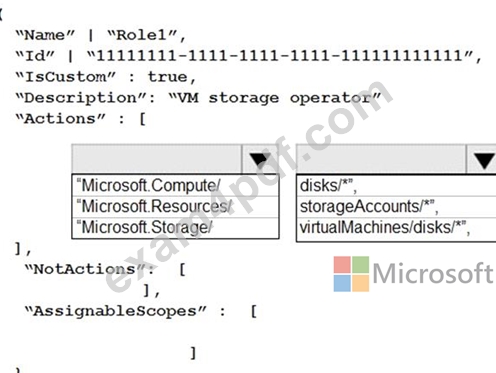
Answer:
Explanation: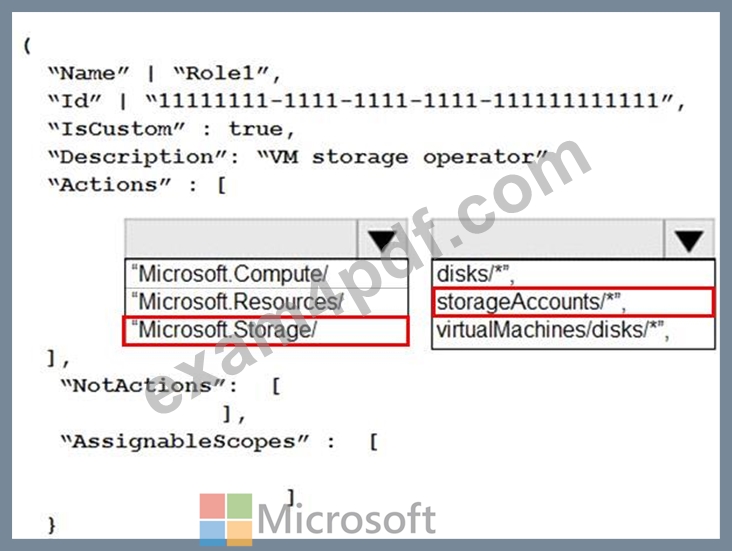
Explanation:
Scenario: A new custom RBAC role named Role1 must be used to delegate the administration of the managed disks in Resource Group1. Role1 must be available only for Resource Group1.
Azure RBAC template managed disks "Microsoft.Storage/"
References:
https://blogs.msdn.microsoft.com/azureedu/2017/02/11/new-managed-disk-storage-option-for-your-azure-vms/
NEW QUESTION # 201
You have two Azure virtual machines in the East US2 region as shown in the following table.
You deploy and configure an Azure Key vault.
You need to ensure that you can enable Azure Disk Encryption on VM1 and VM2.
What should you modify on each virtual machine? To answer, select the appropriate options in the answer area.
NOTE: Each correct selection is worth one point.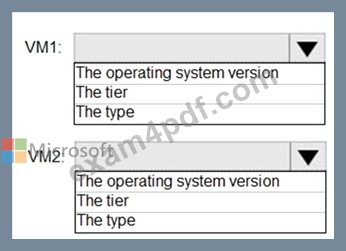
Answer:
Explanation: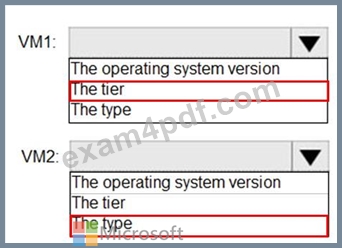
Explanation:
VM1: The Tier
The Tier needs to be upgraded to standard.
Disk Encryption for Windows and Linux IaaS VMs is in General Availability in all Azure public regions and Azure Government regions for Standard VMs and VMs with Azure Premium Storage.
VM2: The type
Need to change the VMtype to any of A, D, DS, G, GS, F, and so on, series IaaS VMs.
Not the operating system version: Ubuntu 16.04 is supported.
References:
https://docs.microsoft.com/en-us/azure/security/azure-security-disk-encryption-overview
https://docs.microsoft.com/en-us/azure/security/azure-security-disk-encryption-faq#bkmk_LinuxOSSupport
NEW QUESTION # 202
You have an Azure subscription that contains the following resources:
* A virtual network named VNET1 that contains two subnets named Subnet1 and Subnet2.
* A virtual machine named VM1 that has only a private IP address and connects to Subnet1.
You need to ensure that Remote Desktop connections can be established to VM1 from the internet.
Which three actions should you perform in sequence? To answer, move the appropriate actions from the list of actions to the answer area and arrange then in the correct order.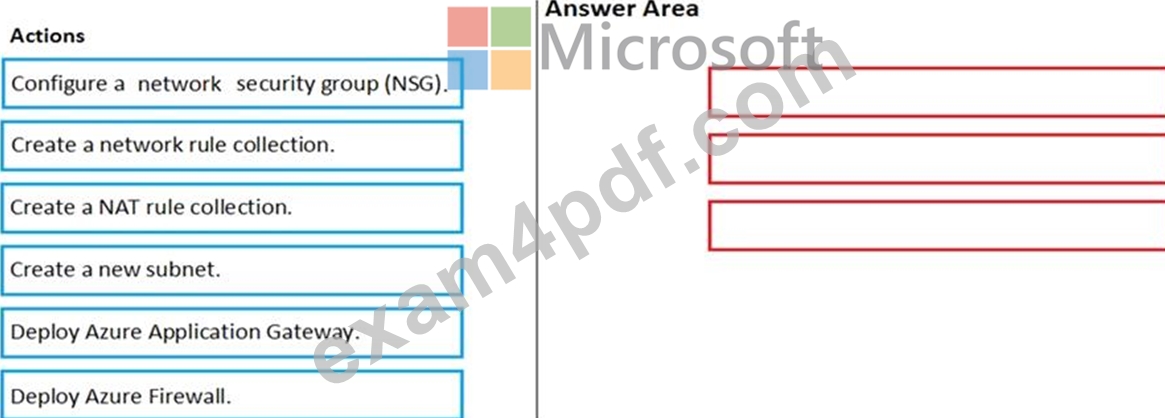
Answer:
Explanation: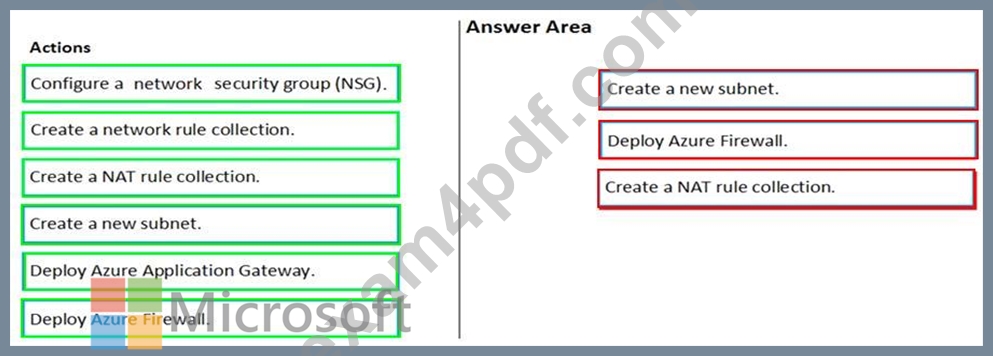
NEW QUESTION # 203
You have Azure Resource Manager templates that you use to deploy Azure virtual machines.
You need to disable unused Windows features automatically as instances of the virtual machines are provisioned.
What should you use?
- A. device configuration policies in Microsoft Intune
- B. application security groups
- C. an Azure Desired State Configuration (DSC) virtual machine extension
- D. device compliance policies in Microsoft Intune
Answer: C
Explanation:
You can use Azure Automation State Configuration to manage Azure VMs (both Classic and Resource Manager), on-premises VMs, Linux machines, AWS VMs, and on-premises physical machines.
Note: Azure Automation State Configuration provides a DSC pull server similar to the Windows Feature DSC- Service so that target nodes automatically receive configurations, conform to the desired state, and report back on their compliance. The built-in pull server in Azure Automation eliminates the need to set up and maintain your own pull server. Azure Automation can target virtual or physical Windows or Linux machines, in the cloud or on-premises.
Reference:
https://docs.microsoft.com/en-us/azure/automation/automation-dsc-getting-started
NEW QUESTION # 204
You have an Azure subscription that contains the storage accounts shown in the following table.
You need to configure authorization access.
Which authorization types can you use for each storage account? To answer, select the appropriate options in the answer area.
NOTE: Each correct selection is worth one point.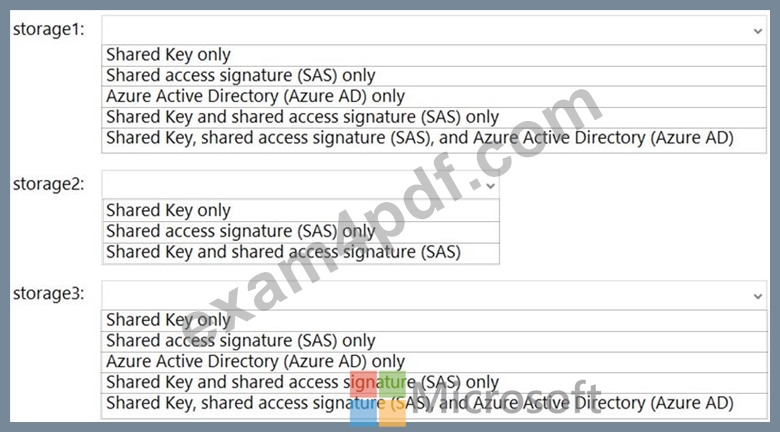
Answer:
Explanation: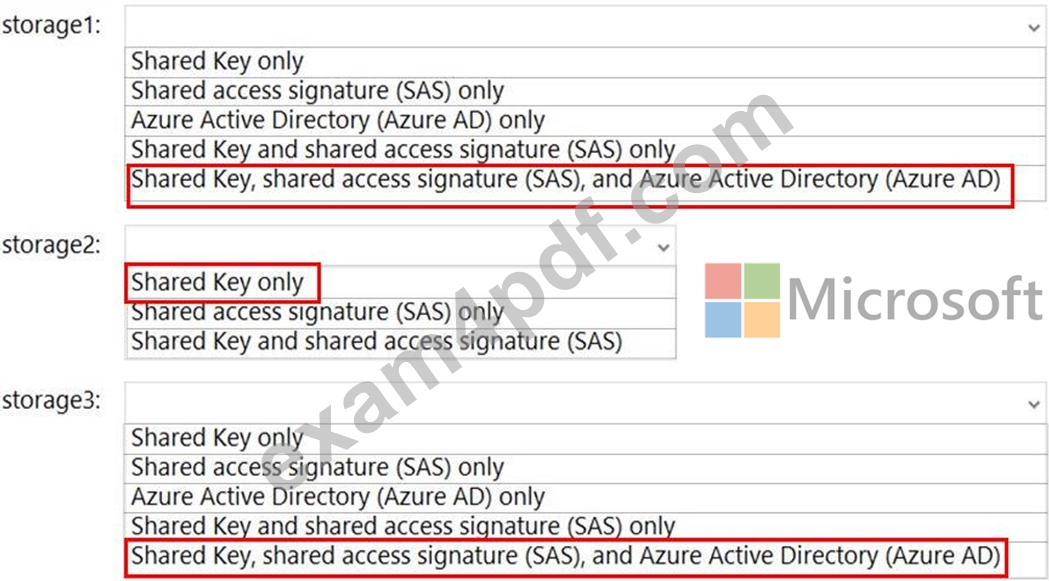
Reference:
https://docs.microsoft.com/en-us/azure/storage/common/authorize-data-access
NEW QUESTION # 205
You assign User8 the Owner role for RG4, RG5, and RG6.
In which resource groups can User8 create virtual networks and NSGs? To answer, select the appropriate options in the answer area.
NOTE: Each correct selection is worth one point.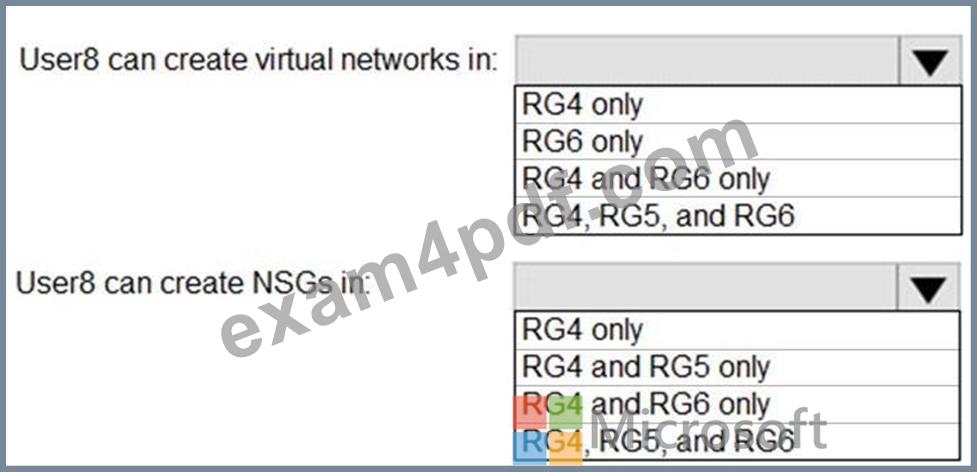
Answer:
Explanation: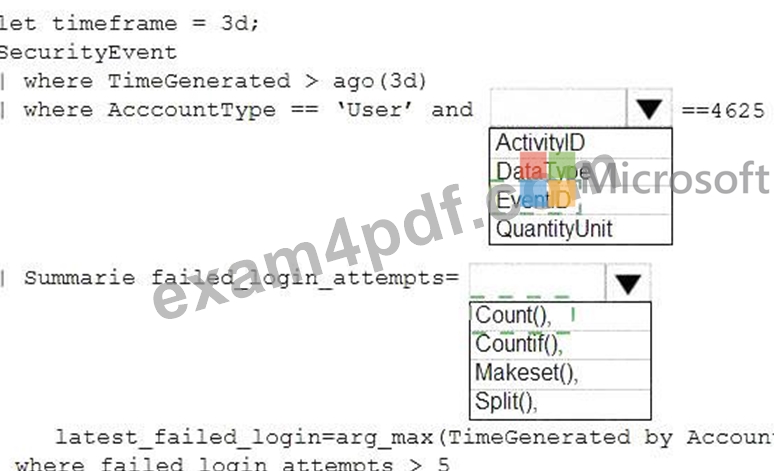
Explanation
Box1: RG6 only as there is not option for RG5 & RG6 which it should be.
Box2: RG4 & RG6
Topic 3, Fabrikam inc
This is a case study. Case studies are not timed separately. You can use as much exam time as you would like to complete each case. However, there may be additional case studies and sections on this exam. You must manage your time to ensure that you are able to complete all questions included on this exam in the time provided.
To answer the questions included in a case study, you will need to reference information that is provided in the case study. Case studies might contain exhibits and other resources that provide more information about the scenario that is described in the case study. Each question is independent of the other questions in this case study.
At the end of this case study, a review screen will appear. This screen allows you to review your answers and to make changes before you move to the next section of the exam. After you begin a new section, you cannot return to this section.
To start the case study
To display the first question in this case study, click the button. Use the buttons in the left pane to explore the content of the case study before you answer the questions. Clicking these buttons displays information such as business requirements, existing environment, and problem statements. If the case study has an All Information tab, note that the information displayed is identical to the information displayed on the subsequent tabs. When you are ready to answer a question, click the button to return to the question.
General Overview
Fabrikam, Inc. is a consulting company that has a main office in Montreal and branch offices in Seattle and New York. Fabrikam has IT, human resources (HR), and finance departments.
Existing Environment
Network Environment
Fabrikam has a Microsoft 365 subscription and an Azure subscription named subscription1.
The network contains an on-premises Active Directory domain named Fabrikam.com. The domain contains two organizational units (OUs) named OU1 and OU2. Azure AD Connect cloud sync syncs only OU1.
The Azure resources hierarchy is shown in the following exhibit.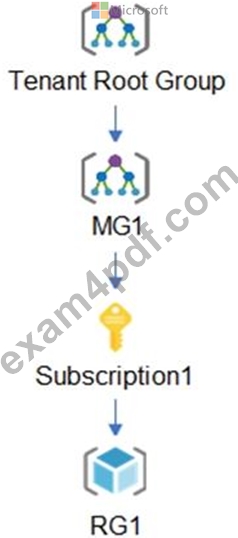
The Azure Active Directory (Azure AD) tenant contains the users shown in the following table.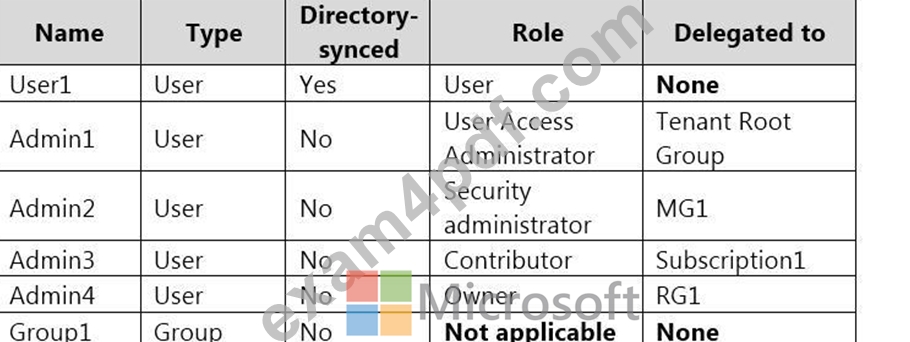
Azure AD contains the resources shown in the following table.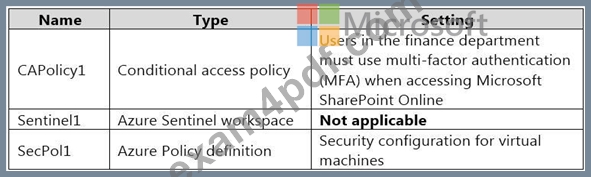
Subscription1 Resources
Subscription1 contains the virtual networks shown in the following table.
Subscription1 contains the network security groups (NSGs) shown in the following table.
Subscription1 contains the virtual machines shown in the following table.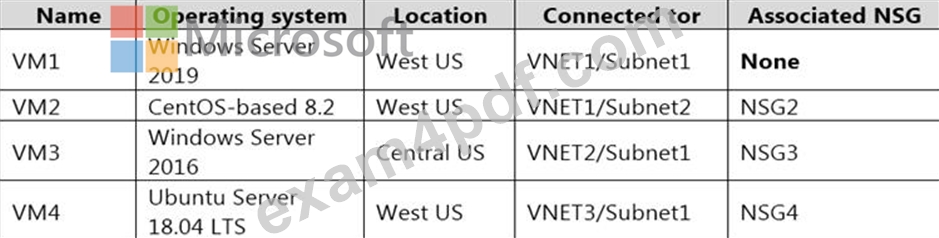
Subscription1 contains the Azure key vaults shown in the following table.
Subscription1 contains a storage account named storage1 in the West US Azure region.
Planned Changes and Requirements
Planned Changes
Fabrikam plans to implement the following changes:
* Create two application security groups as shown in the following table.
* Associate the network interface of VM1 to ASG1.
* Deploy SecPol1 by using Azure Security Center.
* Deploy a third-party app named App1. A version of App1 exists for all available operating systems.
* Create a resource group named RG2.
* Sync OU2 to Azure AD.
* Add User1 to Group1.
Technical Requirements
Fabrikam identifies the following technical requirements:
* The finance department users must reauthenticate after three hours when they access SharePoint Online.
* Storage1 must be encrypted by using customer-managed keys and automatic key rotation.
* From Sentinel1, you must ensure that the following notebooks can be launched:
* Entity Explorer - Account
* Entity Explorer - Windows Host
* Guided Investigation Process Alerts
* VM1, VM2, and VM3 must be encrypted by using Azure Disk Encryption.
* Just in time (JIT) VM access for VM1, VM2, and VM3 must be enabled.
* App1 must use a secure connection string stored in KeyVault1.
* KeyVault1 traffic must NOT travel over the internet.
NEW QUESTION # 206
You need to ensure that users can access VM0. The solution must meet the platform protection requirements.
What should you do?
- A. On Firewall, configure a network traffic filtering rule.
- B. Move VM0 to Subnet1.
- C. Assign RT1 to AzureFirewallSubnet.
- D. On Firewall, configure a DNAT rule.
Answer: D
Explanation:
Reference:
https://docs.microsoft.com/en-us/azure/firewall/tutorial-firewall-dnat
NEW QUESTION # 207
You have an Azure subscription named Subscription1 that contains the resources shown in the following table.
You have an Azure subscription named Subscription2 that contains the following resources:
An Azure Sentinel workspace
An Azure Event Grid instance
You need to ingest the CEF messages from the NVAs to Azure Sentinel.
What should you configure for each subscription? To answer, select the appropriate options in the answer area.
NOTE: Each correct selection is worth one point.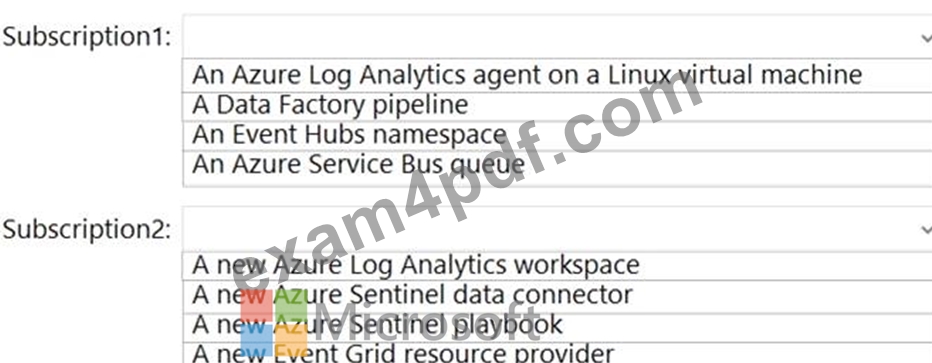
Answer:
Explanation: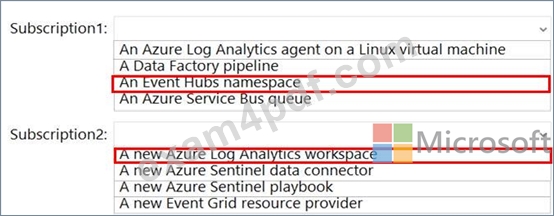
NEW QUESTION # 208
You plan to use Azure Resource Manager templates to perform multiple deployments of identically configured Azure virtual machines. The password for the administrator account of each deployment is stored as a secret in different Azure key vaults.
You need to identify a method to dynamically construct a resource ID that will designate the key vault
containing the appropriate secret during each deployment. The name of the key vault and the name of the
secret will be provided as inline parameters.
What should you use to construct the resource ID?
- A. an automation account
- B. a key vault access policy
- C. a linked template
- D. a parameters file
Answer: D
Explanation:
https://docs.microsoft.com/en-us/azure/azure-resource-manager/templates/key-vault-parameter?tabs=azure-cli#reference-secrets-with-dynamic-id
NEW QUESTION # 209
From the Azure portal, you are configuring an Azure policy.
You plan to assign policies that use the DeployIfNotExist, AuditIfNotExist, Append, and Deny effects.
Which effect requires a managed identity for the assignment?
- A. DeployIfNotExist
- B. Deny
- C. AuditIfNotExist
- D. Append
Answer: A
Explanation:
Explanation
When Azure Policy runs the template in the deployIfNotExists policy definition, it does so using a managed identity.
References:
https://docs.microsoft.com/bs-latn-ba/azure/governance/policy/how-to/remediate-resources
Topic 2, Litware, inc
This is a case study. Case studies are not timed separately. You can use as much exam time as you would like to complete each case. However, there may be additional case studies and sections on this exam. You must manage your time to ensure that you are able to complete all questions included on this exam in the time provided.
To answer the questions included in a case study, you will need to reference information that is provided in the case study. Case studies might contain exhibits and other resources that provide more information about the scenario that is described in the case study. Each question is independent of the other question on this case study.
At the end of this case study, a review screen will appear. This screen allows you to review your answers and to make changes before you move to the next sections of the exam. After you begin a new section, you cannot return to this section.
To start the case study
To display the first question on this case study, click the Next button. Use the buttons in the left pane to explore the content of the case study before you answer the questions. Clicking these buttons displays information such as business requirements, existing environment, and problem statements. If the case study has an All Information tab, note that the information displayed is identical to the information displayed on the subsequent tabs. When you are ready to answer a question, click the Question button to return to the question.
Overview
Litware, Inc. is a digital media company that has 500 employees in the Chicago area and 20 employees in the San Francisco area.
Existing Environment
Litware has an Azure subscription named Sub1 that has a subscription ID of
43894a43-17c2-4a39-8cfc-3540c2653ef4.
Sub1 is associated to an Azure Active Directory (Azure AD) tenant named litwareinc.com. The tenant contains the user objects and the device objects of all the Litware employees and their devices. Each user is assigned an Azure AD Premium P2 license. Azure AD Privileged Identity Management (PIM) is activated.
The tenant contains the groups shown in the following table.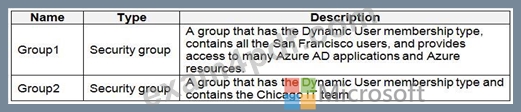
The Azure subscription contains the objects shown in the following table.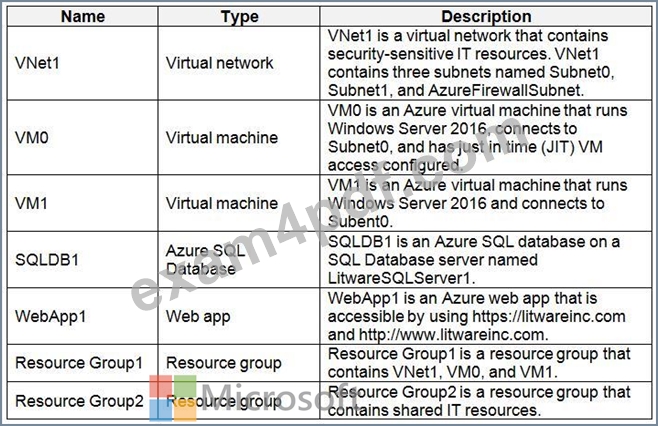
Azure Security Center is set to the Free tier.
Planned changes
Litware plans to deploy the Azure resources shown in the following table.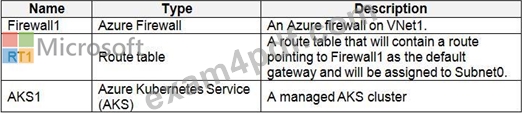
Litware identifies the following identity and access requirements:
* All San Francisco users and their devices must be members of Group1.
* The members of Group2 must be assigned the Contributor role to Resource Group2 by using a permanent eligible assignment.
* Users must be prevented from registering applications in Azure AD and from consenting to applications
* that access company information on the users' behalf.
Platform Protection Requirements
Litware identifies the following platform protection requirements:
* Microsoft Antimalware must be installed on the virtual machines in Resource Group1.
* The members of Group2 must be assigned the Azure Kubernetes Service Cluster Admin Role.
* Azure AD users must be to authenticate to AKS1 by using their Azure AD credentials.
* Following the implementation of the planned changes, the IT team must be able to connect to VM0 by using JIT VM access.
* A new custom RBAC role named Role1 must be used to delegate the administration of the managed disks in Resource Group1. Role1 must be available only for Resource Group1.
Security Operations Requirements
Litware must be able to customize the operating system security configurations in Azure Security Center.
NEW QUESTION # 210
HOTSPOT
You have an Azure Active Directory (Azure AD) tenant named contoso.com that contains the users shown in the following table.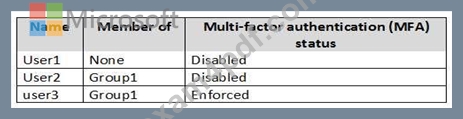
Azure AD Privileged Identity Management (PIM) is enabled for the tenant.
In PIM, the Password Administrator role has the following settings:
Maximum activation duration (hours): 2
Send email notifying admins of activation: Disable
Require incident/request ticket number during activation: Disable
Require Azure Multi-Factor Authentication for activation: Enable
Require approval to activate this role: Enable
Selected approver: Group1
You assign users the Password Administrator role as shown in the following table.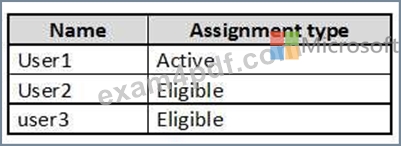
For each of the following statements, select Yes if the statement is true. Otherwise, select No.
NOTE: Each correct selection is worth one point.
Hot Area: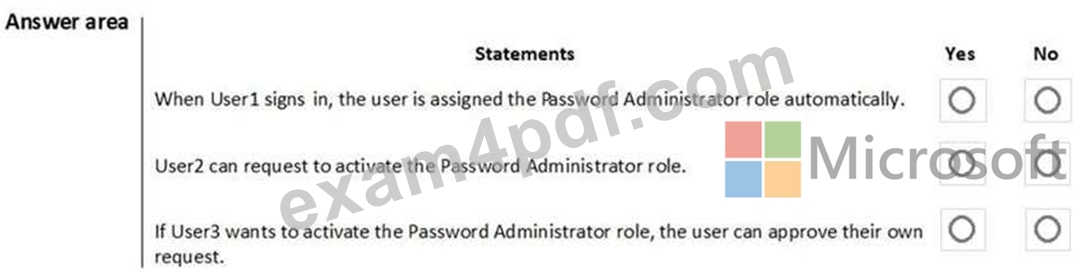
Answer:
Explanation: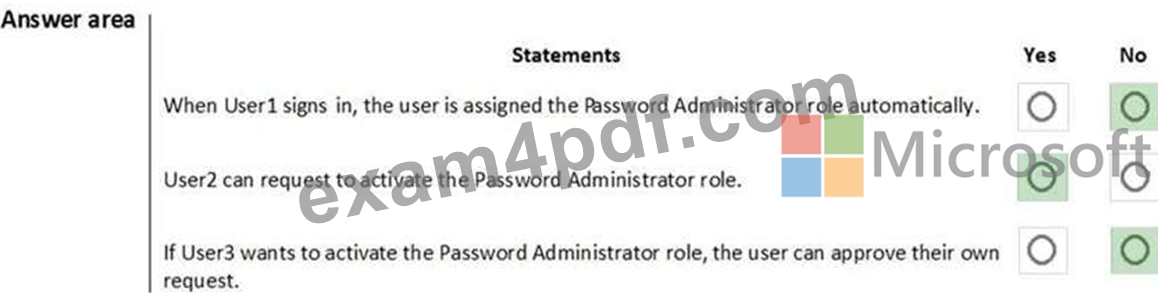
Explanation:
Box 1: Yes
Active assignments don't require the member to perform any action to use the role. Members assigned as active have the privileges assigned to the role at all times.
Box 2: No
MFA is disabled for User2 and the setting Require Azure Multi-Factor Authentication for activation is enabled.
Note: Eligible assignments require the member of the role to perform an action to use the role. Actions might include performing a multi-factor authentication (MFA) check, providing a business justification, or requesting approval from designated approvers.
Box 3: Yes
User3 is Group1, which is a Selected Approver Group
Reference:
https://docs.microsoft.com/bs-latn-ba/azure/active-directory/privileged-identity-management/pim-resource- roles-assign-roles
NEW QUESTION # 211
Use the following login credentials as needed:
To enter your username, place your cursor in the Sign in box and click on the username below.
To enter your password, place your cursor in the Enter password box and click on the password below.
Azure Username: [email protected]
Azure Password: Ag1Bh9!#Bd
The following information is for technical support purposes only:
Lab Instance: 10598168
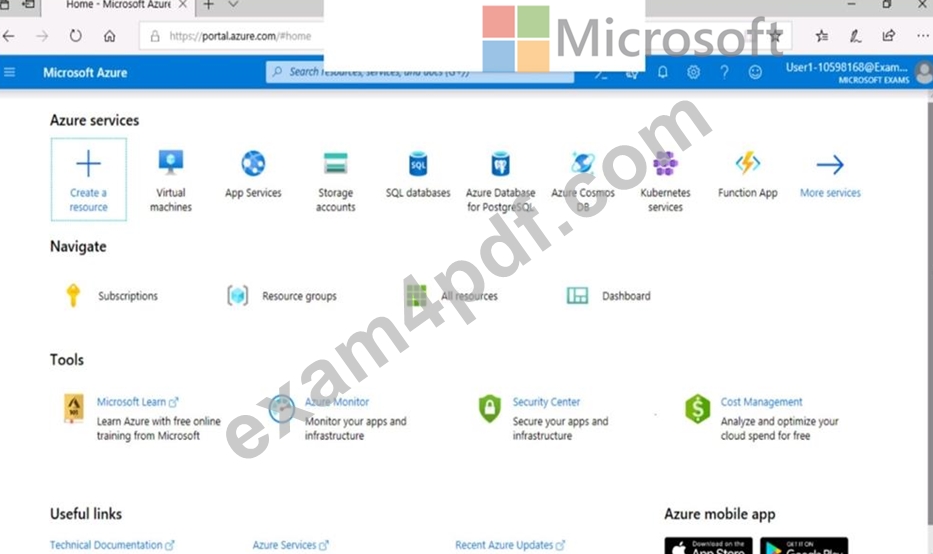
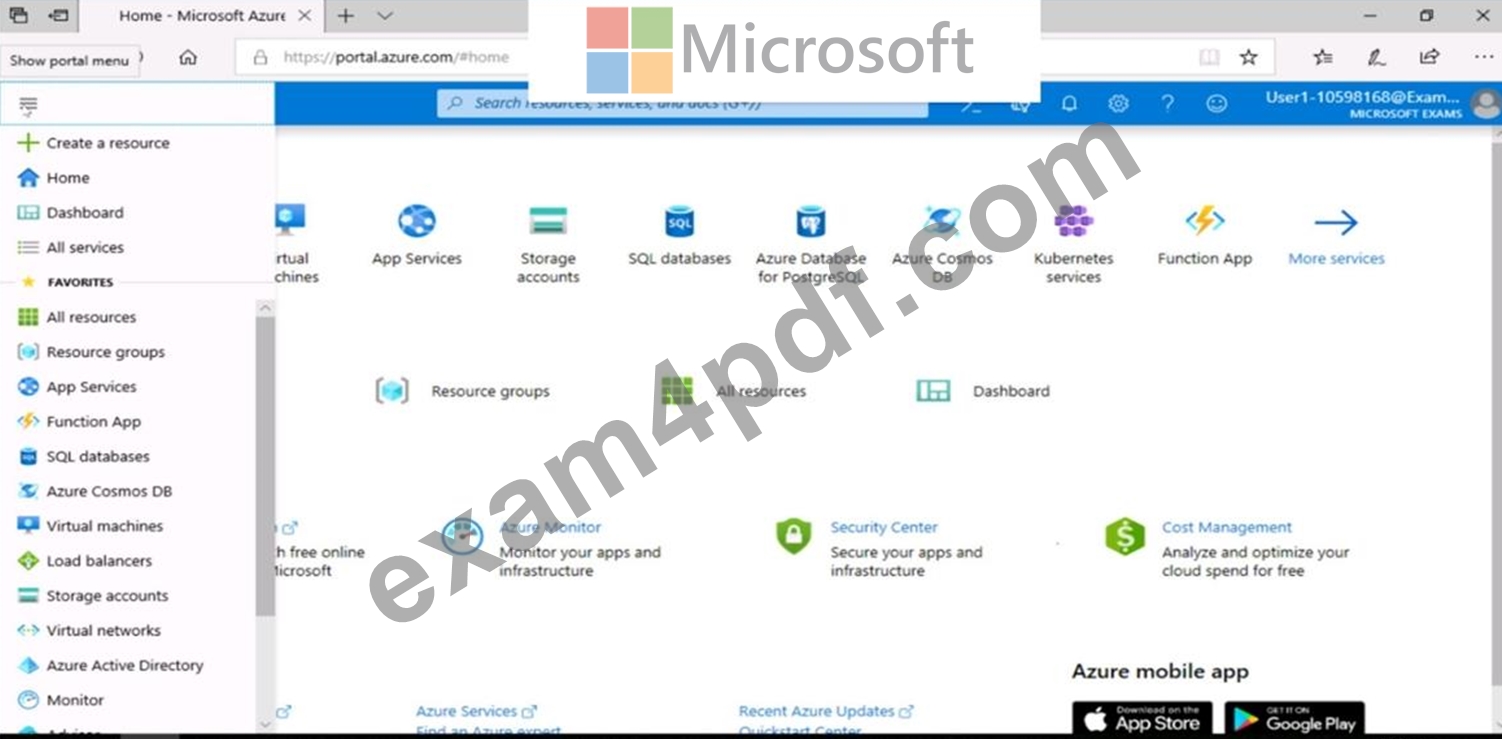
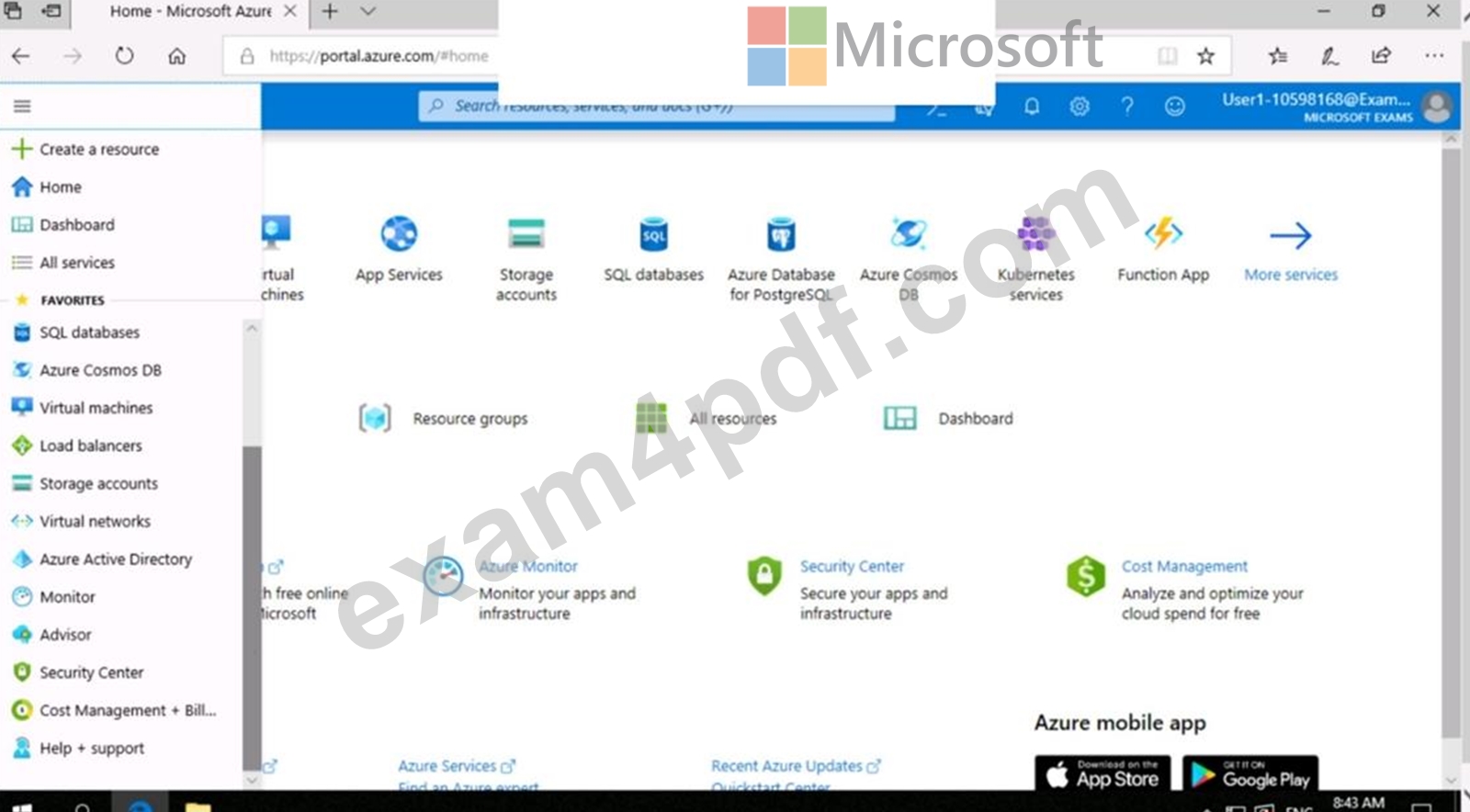
You need to prevent administrative users from accidentally deleting a virtual network named VNET1. The administrative users must be allowed to modify the settings of VNET1.
To complete this task, sign in to the Azure portal.
Answer:
Explanation:
See the explanation below.
Explanation
Locking prevents other users in your organization from accidentally deleting or modifying critical resources, such as Azure subscription, resource group, or resource.
Note: In Azure, the term resource refers to an entity managed by Azure. For example, virtual machines, virtual networks, and storage accounts are all referred to as Azure resources.
1. In the Settings blade for virtual network VNET, select Locks.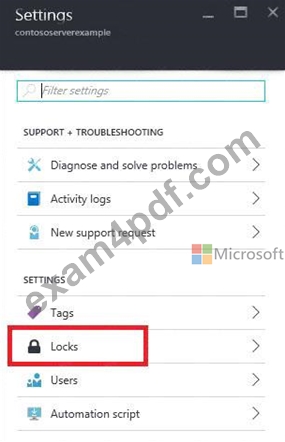
2. To add a lock, select Add.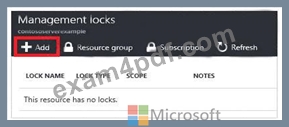
3. For Lock type select Delete lock, and click OK
Reference:
https://docs.microsoft.com/en-us/azure/azure-resource-manager/resource-group-lock-resources
NEW QUESTION # 212
You have an Azure subscription named Sub1 that contains an Azure Storage account named Contosostorage1 and an Azure key vault named Contosokeyvault1.
You plan to create an Azure Automation runbook that will rotate the keys of Contosostorage1 and store them in Contosokeyvault1.
You need to implement prerequisites to ensure that you can implement the runbook.
Which three actions should you perform in sequence? To answer, move the appropriate actions from the list of actions to the answer area and arrange them in the correct order.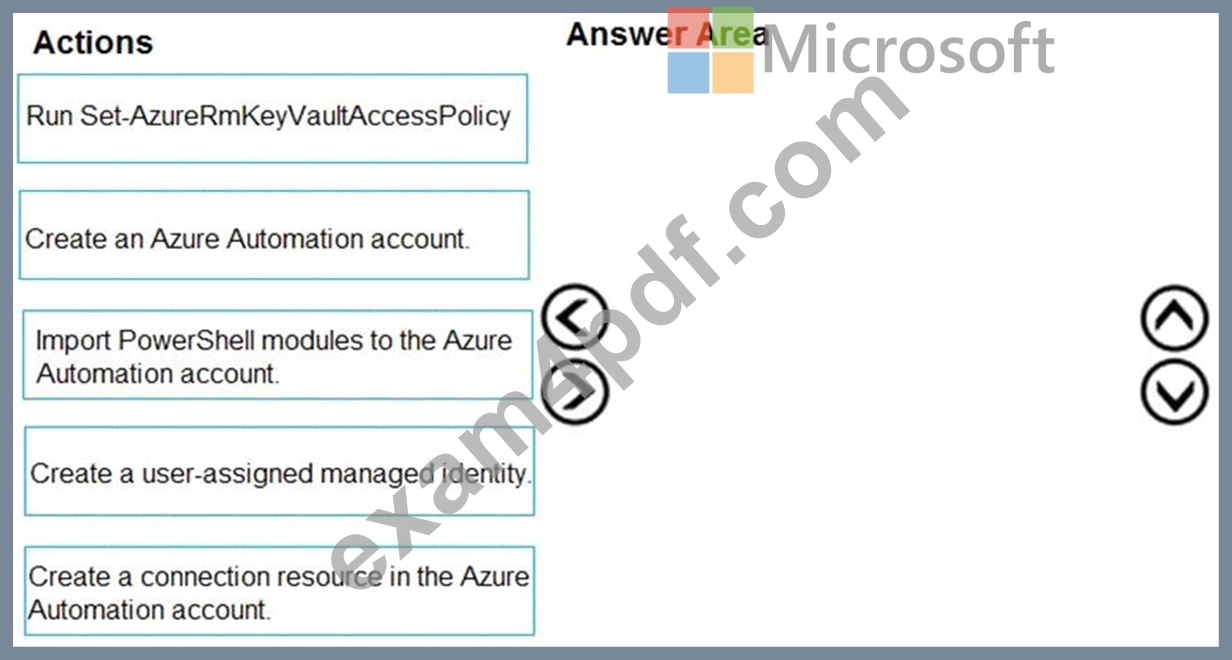
Answer:
Explanation: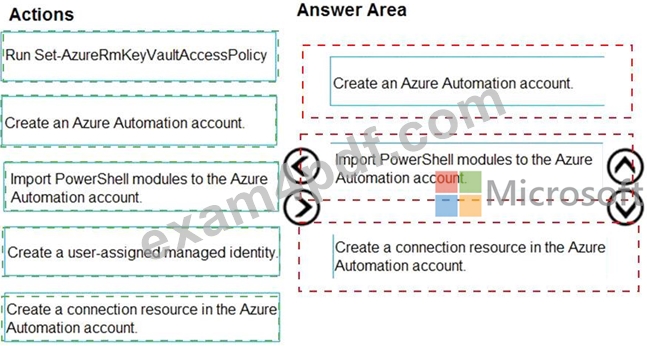
Explanation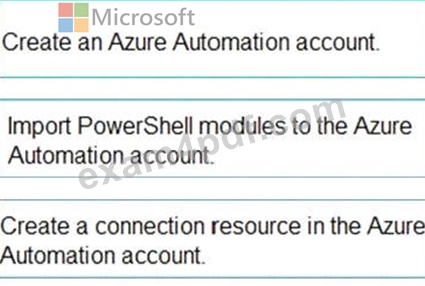
Step 1: Create an Azure Automation account
Runbooks live within the Azure Automation account and can execute PowerShell scripts.
Step 2: Import PowerShell modules to the Azure Automation account
Under 'Assets' from the Azure Automation account Resources section select 'to add in Modules to the runbook. To execute key vault cmdlets in the runbook, we need to add AzureRM.profile and AzureRM.key vault.
Step 3: Create a connection resource in the Azure Automation account
You can use the sample code below, taken from the AzureAutomationTutorialScript example runbook, to authenticate using the Run As account to manage Resource Manager resources with your runbooks. The AzureRunAsConnection is a connection asset automatically created when we created 'run as accounts' above.
This can be found under Assets -> Connections. After the authentication code, run the same code above to get all the keys from the vault.
$connectionName = "AzureRunAsConnection"
try
{
# Get the connection "AzureRunAsConnection "
$servicePrincipalConnection=Get-AutomationConnection -Name $connectionName
"Logging in to Azure..."
Add-AzureRmAccount `
-ServicePrincipal `
-TenantId $servicePrincipalConnection.TenantId `
-ApplicationId $servicePrincipalConnection.ApplicationId `
-CertificateThumbprint $servicePrincipalConnection.CertificateThumbprint
}
References:
https://www.rahulpnath.com/blog/accessing-azure-key-vault-from-azure-runbook/
NEW QUESTION # 213
You have a management group named MG1 that contains an Azure subscription and a resource group named RG1. RG1 contains a virtual machine named VM1. You have the custom Azure roles shown in the following table.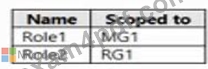
The permissions for Role1 are shown in the following role definition file.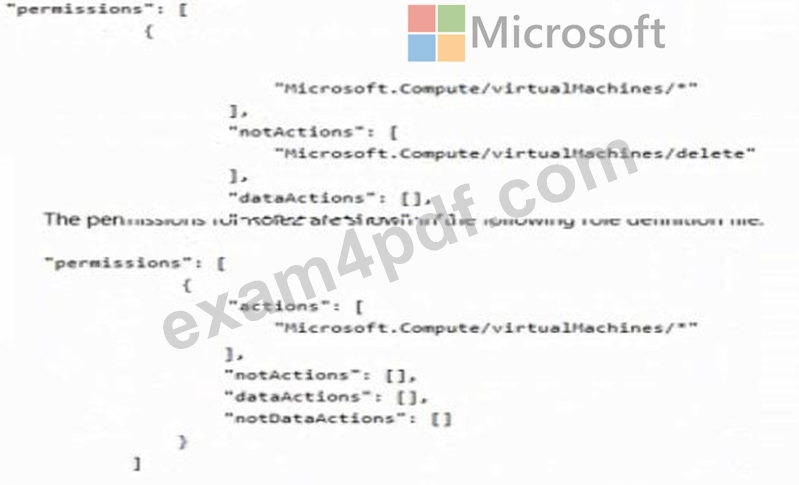
You assign the roles to the users shown in the following table.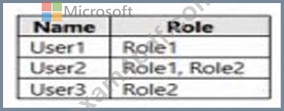
For each of the following statements, select Yes if the statement is true. Otherwise, select No NOTE: Each correct selection is worth one point.
Answer:
Explanation:
NEW QUESTION # 214
You have an Azure subscription that contains three storage accounts, an Azure SQL managed instance named SQL and three Azure SQL databases. The storage accounts are configured as shown in the following table.
SQ11 has the following settings:
* Auditing: On
* Audit tog destination: storage1
The Azure SQL databases are configured as shown in the following table.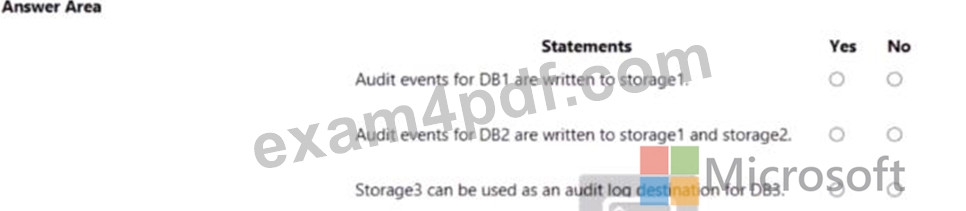
Answer:
Explanation: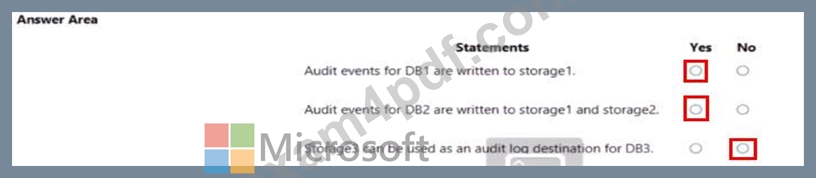
NEW QUESTION # 215
You have an Azure subscription that contains the alerts shown in the following exhibit.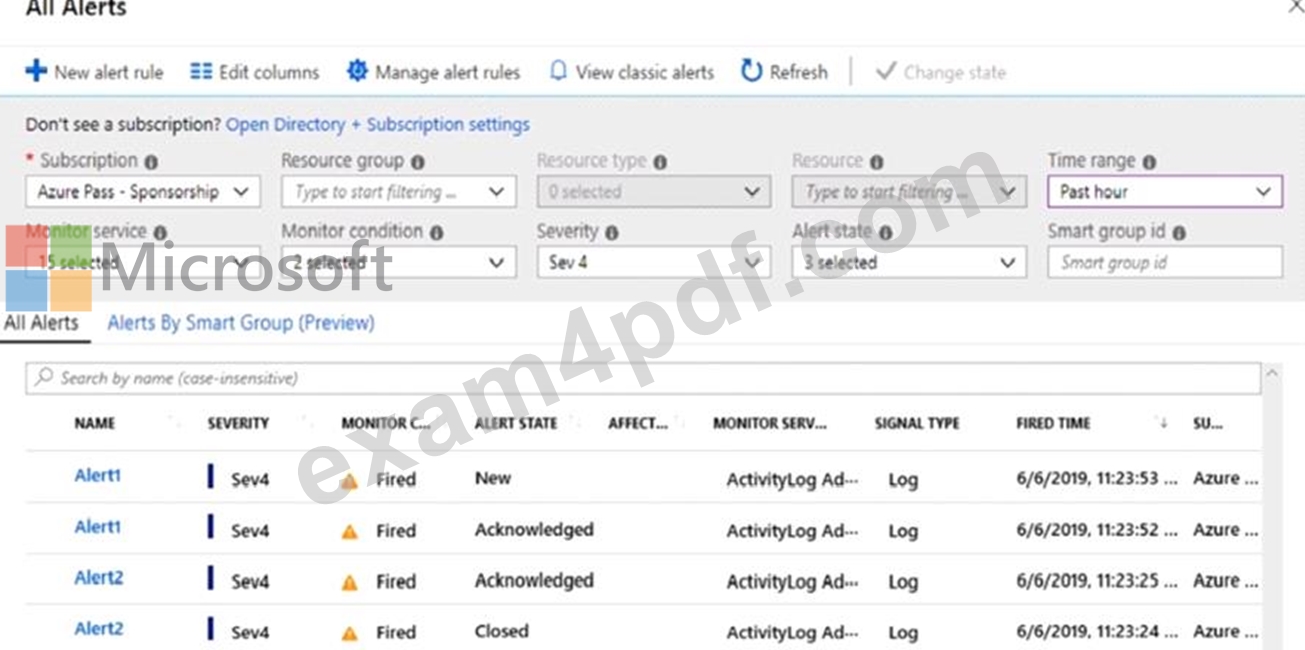
Use the drop-down menus to select the answer choice that completes each statement based on the information presented in the graphic.
NOTE: Each correct selection is worth one point.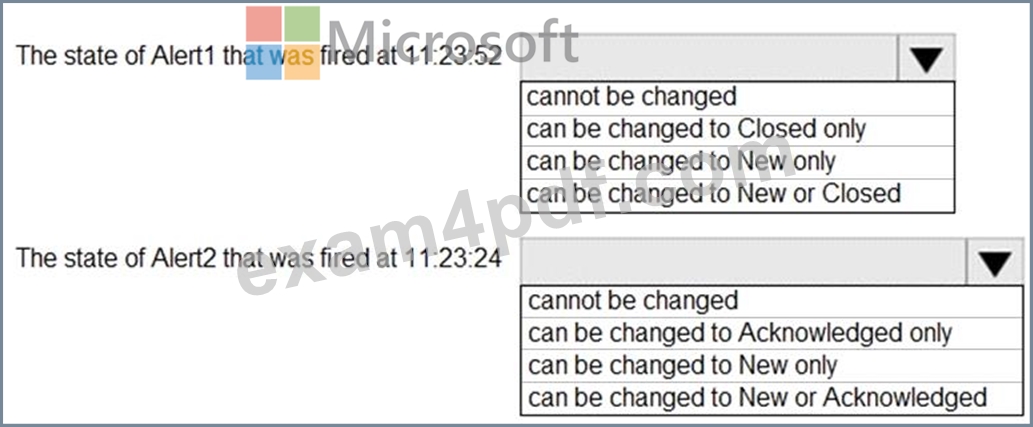
Answer:
Explanation: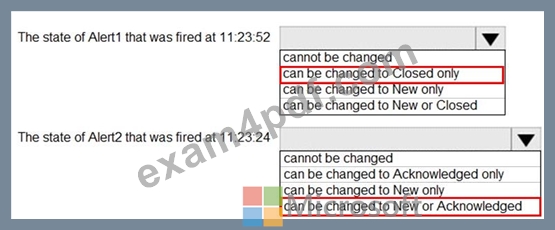
Reference:
https://docs.microsoft.com/en-us/azure/azure-monitor/platform/alerts-overview
NEW QUESTION # 216
......
BEST Verified Microsoft AZ-500 Exam Questions (2023) : https://www.exam4pdf.com/AZ-500-dumps-torrent.html
The Best Practice Test Preparation for the AZ-500 Certification Exam: https://drive.google.com/open?id=1MdoALYsgakAy2OTkBh_DUyQdCqhVLzOy
