

AZ-204 Exam Dumps - Try Best AZ-204 Exam Questions from Training Expert Exam4PDF
Practice Examples and Dumps & Tips for 2024 Latest AZ-204 Valid Tests Dumps
NEW QUESTION # 85
A company is developing a Java web app. The web app code is hosted in a GitHub repository located at
https://github.com/Contoso/webapp.
The web app must be evaluated before it is moved to production. You must deploy the initial code release to a deployment slot named staging.
You need to create the web app and deploy the code.
How should you complete the commands? To answer, select the appropriate options in the answer area.
NOTE: Each correct selection is worth one point.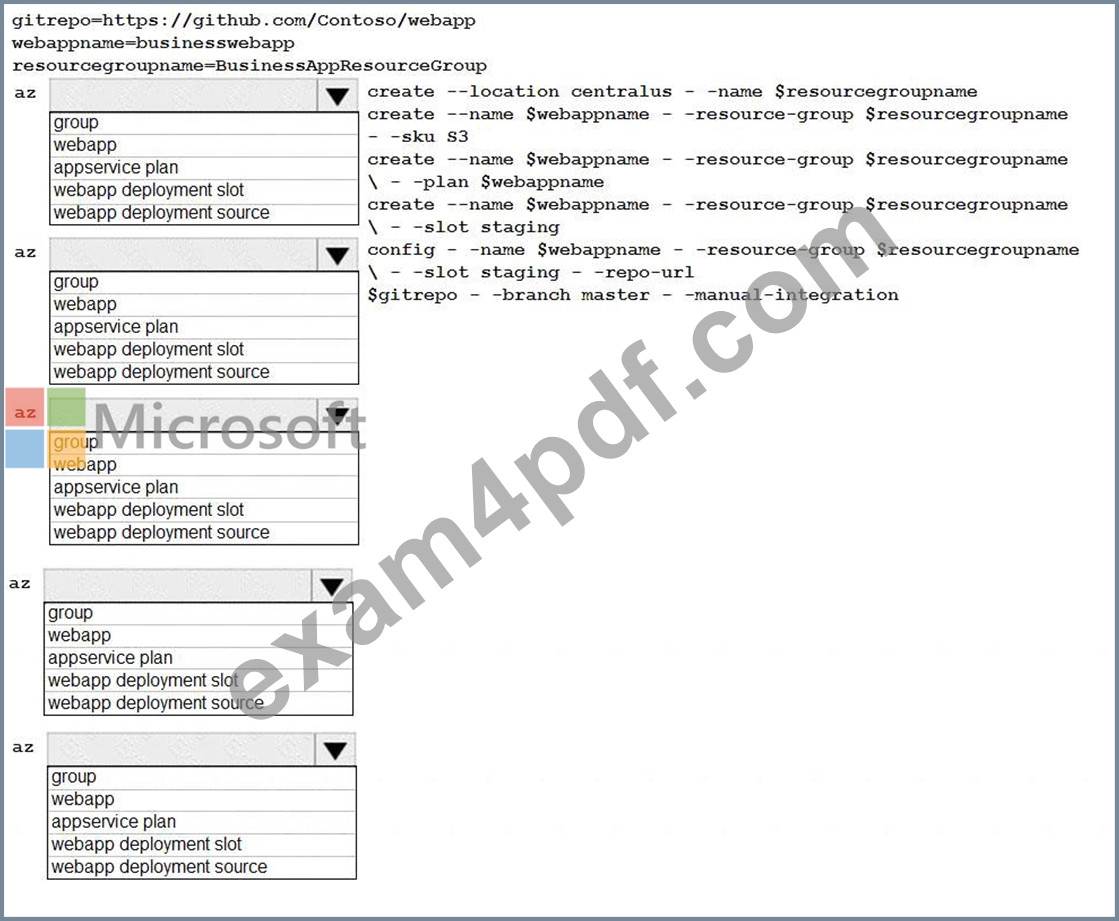
Answer:
Explanation: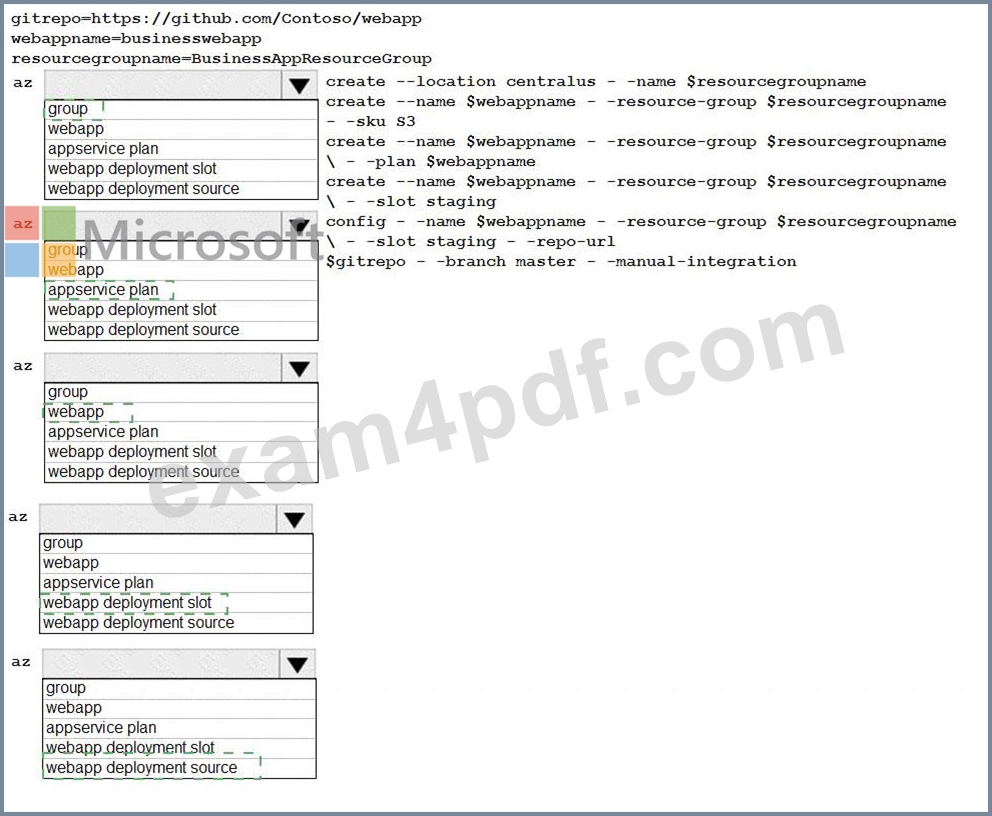
Explanation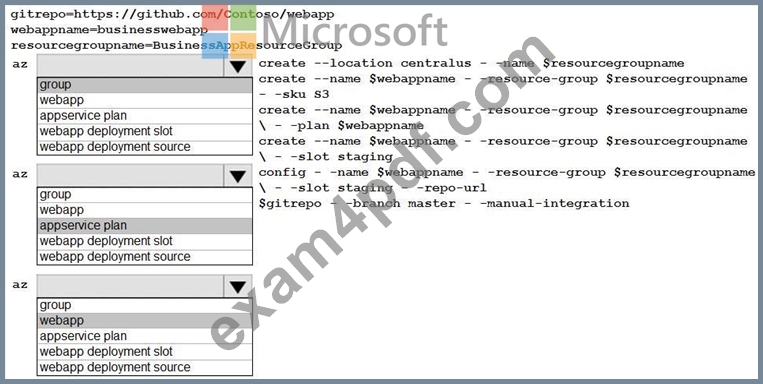
Box 1: group
# Create a resource group.
az group create --location westeurope --name myResourceGroup
Box 2: appservice plan
# Create an App Service plan in STANDARD tier (minimum required by deployment slots).
az appservice plan create --name $webappname --resource-group myResourceGroup --sku S1 Box 3: webapp
# Create a web app.
az webapp create --name $webappname --resource-group myResourceGroup \
--plan $webappname
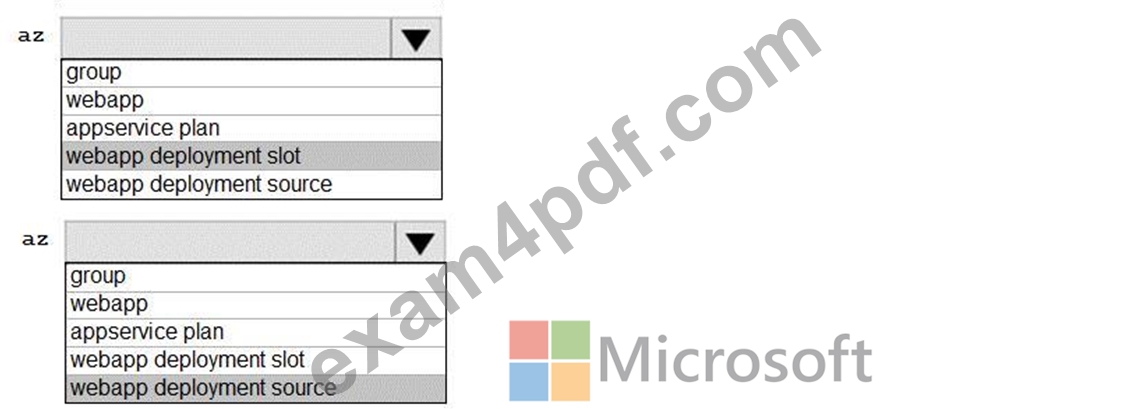
Box 4: webapp deployment slot
#Create a deployment slot with the name "staging".
az webapp deployment slot create --name $webappname --resource-group myResourceGroup \
--slot staging
Box 5: webapp deployment source
# Deploy sample code to "staging" slot from GitHub.
az webapp deployment source config --name $webappname --resource-group myResourceGroup \
--slot staging --repo-url $gitrepo --branch master --manual-integration References:
https://docs.microsoft.com/en-us/azure/app-service/scripts/cli-deploy-staging-environment
NEW QUESTION # 86
You must ensure that the external party cannot access the data in the SSN column of the Person table.
Will each protection method meet the requirement? To answer, drag the appropriate responses to the correct protection methods. Each response may be used once, more than once, or not at all. You may need to drag the split bar between panes or scroll to view content.
NOTE: Each correct selection is worth one point.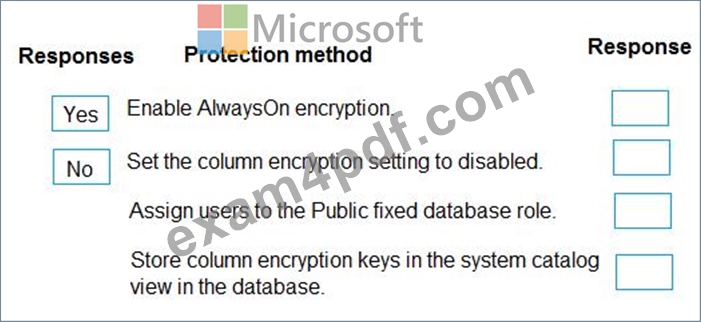
Answer:
Explanation: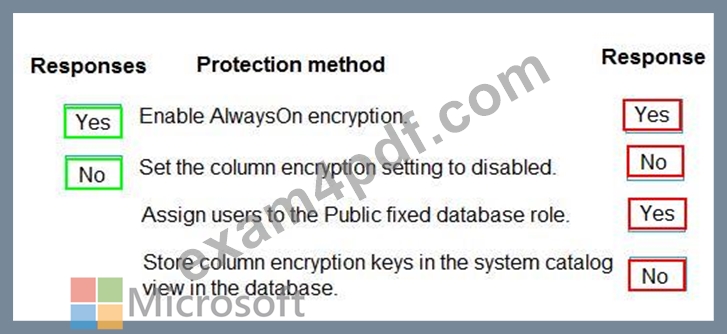
Reference:
https://docs.microsoft.com/en-us/sql/relational-databases/security/encryption/always-encrypted-database-engine
NEW QUESTION # 87
An organization plans to deploy Azure storage services.
You need to configure shared access signature (SAS) for granting access to Azure Storage.
Which SAS types should you use? To answer, drag the appropriate SAS types to the correct requirements. Each SAS type may be used once, more than once, or not at all. You may need to drag the split bar between panes or scroll to view content.
NOTE: Each correct selection is worth one point.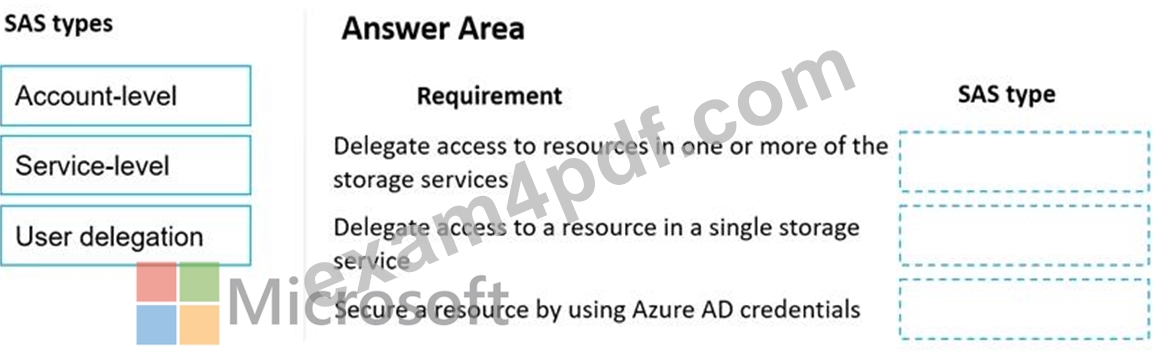
Answer:
Explanation: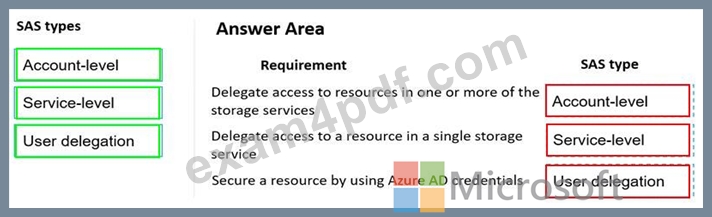
Reference:
https://docs.microsoft.com/en-us/azure/storage/common/storage-sas-overview
NEW QUESTION # 88
You are developing an Azure-hosted e-commerce web application. The application will use Azure Cosmos DB to store sales orders. You are using the latest SDK to manage the sales orders in the database.
You create a new Azure Cosmos DB instance. You include a valid endpoint and valid authorization key to an appSettings.json file in the code project.
You are evaluating the following application code: (Line number are included for reference only.)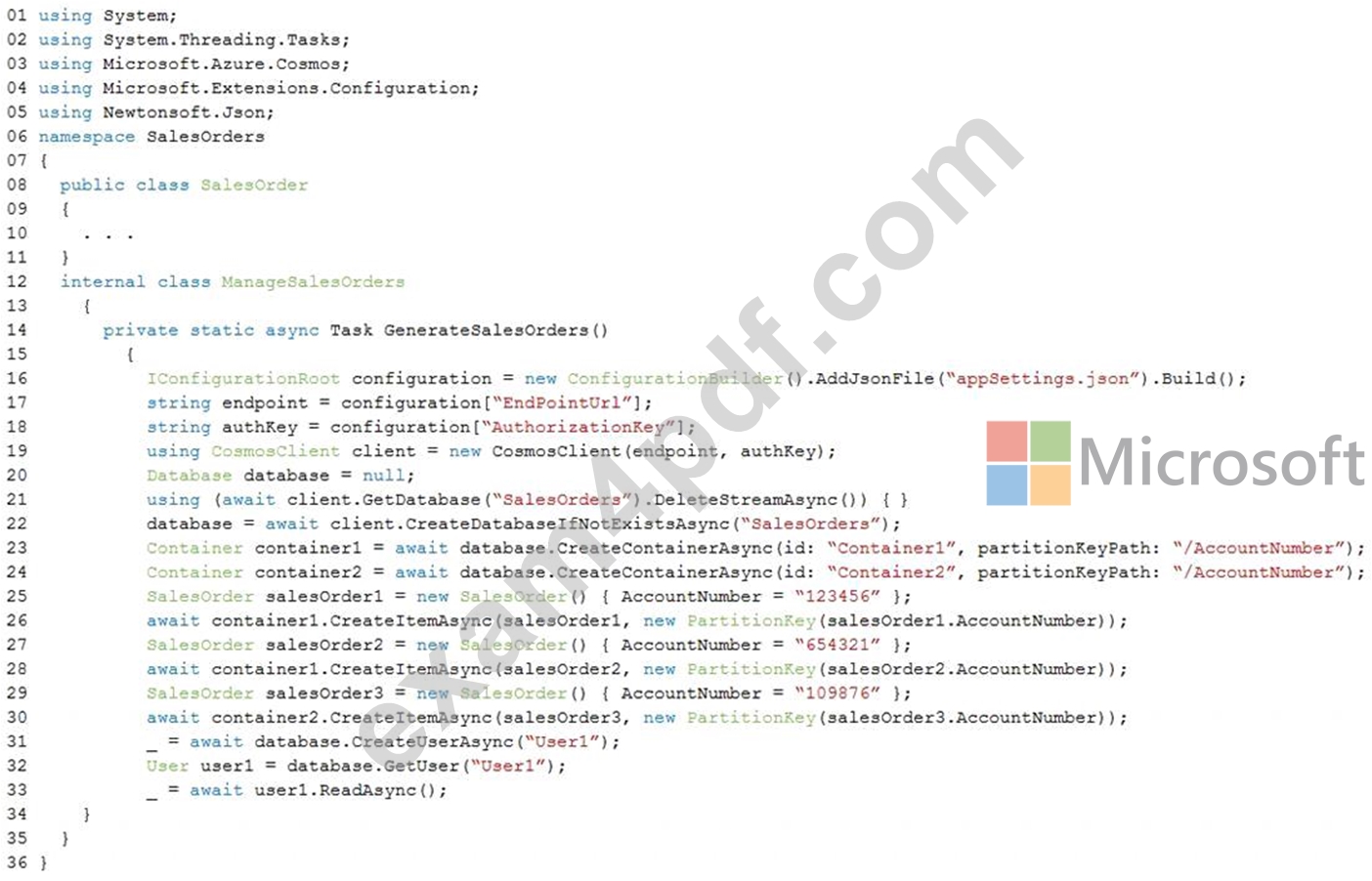
For each of the following statements, select Yes if the statement is true. Otherwise, select No.
NOTE: Each correct selection is worth one point.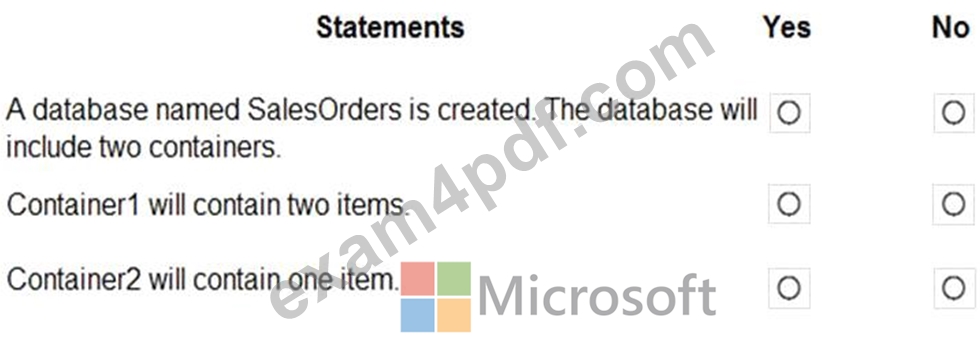
Answer:
Explanation: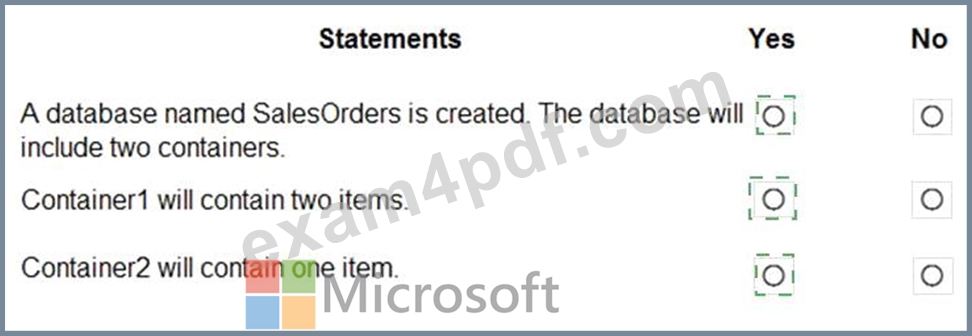
Explanation
Graphical user interface, text, application Description automatically generated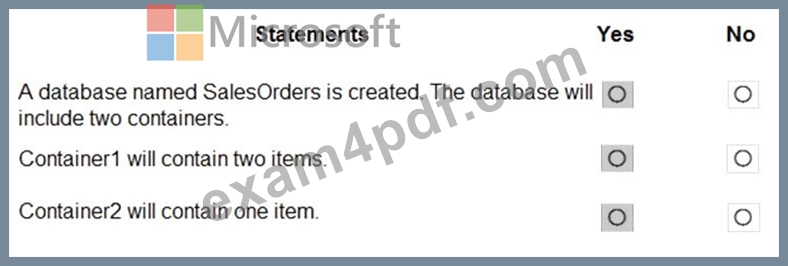
Box 1: Yes
The createDatabaseIfNotExistsAsync method checks if a database exists, and if it doesn't, create it.
The Database.CreateContainerAsync method creates a container as an asynchronous operation in the Azure Cosmos service.
Box 2: Yes
The CosmosContainer.CreateItemAsync method creates an item as an asynchronous operation in the Azure Cosmos service.
Box 3: Yes
Reference:
https://docs.microsoft.com/en-us/dotnet/api/microsoft.azure.cosmos.cosmosclient.createdatabaseifnotexistsasync
https://docs.microsoft.com/en-us/dotnet/api/microsoft.azure.cosmos.database.createcontainerasync
https://docs.microsoft.com/en-us/dotnet/api/azure.cosmos.cosmoscontainer.createitemasync
NEW QUESTION # 89
Case Study 1
Current environment
Windows Server 2016 virtual machine
The virtual machine (VM) runs BizTalk Server 2016. The VM runs the following workflows:
* Ocean Transport - This workflow gathers and validates container information including container contents and arrival notices at various shipping ports.
* Inland Transport - This workflow gathers and validates trucking information including fuel usage, number of stops, and routes.
The VM supports the following REST API calls:
* Container API - This API provides container information including weight, contents, and other attributes.
* Location API - This API provides location information regarding shipping ports of call and tracking stops.
* Shipping REST API - This API provides shipping information for use and display on the shipping website.
Shipping Data
The application uses MongoDB JSON document storage database for all container and transport information.
Shipping Web Site
The site displays shipping container tracking information and container contents. The site is located at http://shipping.wideworldimporters.com/ Proposed solution The on-premises shipping application must be moved to Azure. The VM has been migrated to a new Standard_D16s_v3 Azure VM by using Azure Site Recovery and must remain running in Azure to complete the BizTalk component migrations. You create a Standard_D16s_v3 Azure VM to host BizTalk Server. The Azure architecture diagram for the proposed solution is shown below: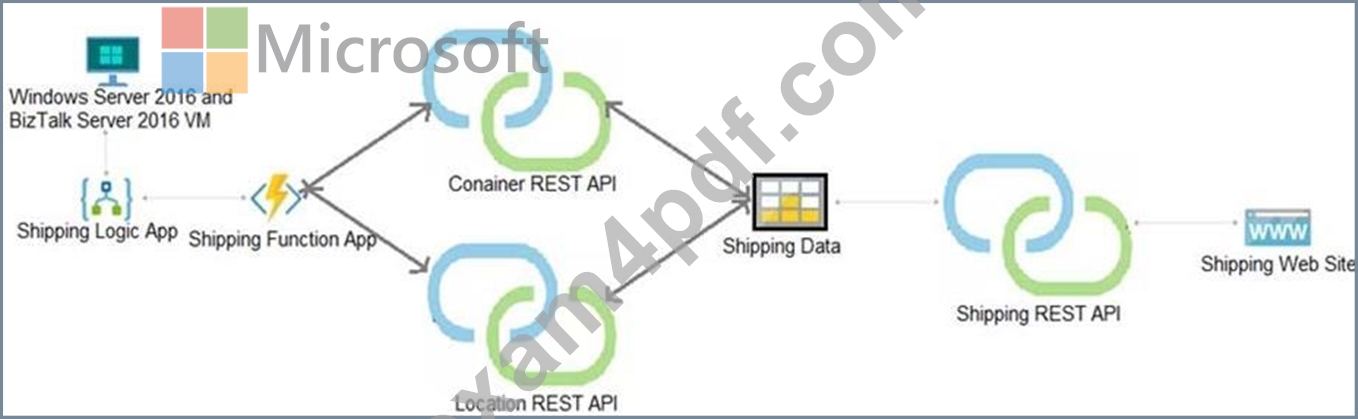
Requirements
Shipping Logic app
The Shipping Logic app must meet the following requirements:
* Support the ocean transport and inland transport workflows by using a Logic App.
* Support industry-standard protocol X12 message format for various messages including vessel content details and arrival notices.
* Secure resources to the corporate VNet and use dedicated storage resources with a fixed costing model.
* Maintain on-premises connectivity to support legacy applications and final BizTalk migrations.
Shipping Function app
Implement secure function endpoints by using app-level security and include Azure Active Directory (Azure AD).
REST APIs
The REST API's that support the solution must meet the following requirements:
* Secure resources to the corporate VNet.
* Allow deployment to a testing location within Azure while not incurring additional costs.
* Automatically scale to double capacity during peak shipping times while not causing application downtime.
* Minimize costs when selecting an Azure payment model.
Shipping data
Data migration from on-premises to Azure must minimize costs and downtime.
Shipping website
Use Azure Content Delivery Network (CDN) and ensure maximum performance for dynamic content while minimizing latency and costs.
Issues
Windows Server 2016 VM
The VM shows high network latency, jitter, and high CPU utilization. The VM is critical and has not been backed up in the past. The VM must enable a quick restore from a 7-day snapshot to include in-place restore of disks in case of failure.
Shipping website and REST APIs
The following error message displays while you are testing the website:
Failed to load http://test-shippingapi.wideworldimporters.com/: No 'Access-Control-Allow-Origin' header is present on the requested resource. Origin 'http://test.wideworldimporters.com/' is therefore not allowed access.
You need to secure the Shipping Logic App.
What should you use?
- A. Azure App Service Environment (ASE)
- B. VNet service endpoint
- C. Azure AD B2B integration
- D. Integration Service Environment (ISE)
Answer: D
Explanation:
Scenario: The Shipping Logic App requires secure resources to the corporate VNet and use dedicated storage resources with a fixed costing model.
You can access to Azure Virtual Network resources from Azure Logic Apps by using integration service environments (ISEs).
Sometimes, your logic apps and integration accounts need access to secured resources, such as virtual machines (VMs) and other systems or services, that are inside an Azure virtual network.
To set up this access, you can create an integration service environment (ISE) where you can run your logic apps and create your integration accounts.
Reference:
https://docs.microsoft.com/en-us/azure/logic-apps/connect-virtual-network-vnet-isolated-environment-overview
NEW QUESTION # 90
Note: This question is part of a series of questions that present the same scenario. Each question in the series contains a unique solution that might meet the stated goals. Some question sets might have more than one correct solution, while others might not have a correct solution.
After you answer a question in this section, you will NOT be able to return to it. As a result, these questions will not appear in the review screen.
You develop and deploy an Azure App Service API app to a Windows-hosted deployment slot named Development. You create additional deployment slots named Testing and Production. You enable auto swap on the Production deployment slot.
You need to ensure that scripts run and resources are available before a swap operation occurs.
Solution: Disable auto swap. Update the app with a method named statuscheck to run the scripts.
Re-enable auto swap and deploy the app to the Production slot.
Does the solution meet the goal?
- A. No
- B. Yes
Answer: A
Explanation:
Instead update the web.config file to include the applicationInitialization configuration element.
Specify custom initialization actions to run the scripts.
Note: Some apps might require custom warm-up actions before the swap. The applicationInitialization configuration element in web.config lets you specify custom initialization actions. The swap operation waits for this custom warm-up to finish before swapping with the target slot. Here's a sample web.config fragment.
<system.webServer>
<applicationInitialization>
<add initializationPage="/" hostName="[app hostname]" />
<add initializationPage="/Home/About" hostName="[app hostname]" />
</applicationInitialization>
</system.webServer>
Reference:
https://docs.microsoft.com/en-us/azure/app-service/deploy-staging-slots#troubleshoot-swaps
NEW QUESTION # 91
Note: This question is part of a series of questions that present the same scenario. Each question in the series contains a unique solution that might meet the stated goals. Some question sets might have more than one correct solution, while others might not have a correct solution.
After you answer a question in this section, you will NOT be able to return to it. As a result, these questions will not appear in the review screen.
You develop a software as a service (SaaS) offering to manage photographs. Users upload photos to a web service which then stores the photos in Azure Storage Blob storage. The storage account type is General- purpose V2.
When photos are uploaded, they must be processed to produce and save a mobile-friendly version of the image. The process to produce a mobile-friendly version of the image must start in less than one minute.
You need to design the process that starts the photo processing.
Solution: Trigger the photo processing from Blob storage events.
Does the solution meet the goal?
- A. No
- B. Yes
Answer: A
Explanation:
You need to catch the triggered event, so move the photo processing to an Azure Function triggered from the blob upload Note: Azure Storage events allow applications to react to events. Common Blob storage event scenarios include image or video processing, search indexing, or any file-oriented workflow.
Events are pushed using Azure Event Grid to subscribers such as Azure Functions, Azure Logic Apps, or even to your own http listener.
Note: Only storage accounts of kind StorageV2 (general purpose v2) and BlobStorage support event integration. Storage (general purpose v1) does not support integration with Event Grid.
Reference:
https://docs.microsoft.com/en-us/azure/storage/blobs/storage-blob-event-overview Develop for Azure storage Testlet 1 Case study This is a case study. Case studies are not timed separately. You can use as much exam time as you would like to complete each case. However, there may be additional case studies and sections on this exam. You must manage your time to ensure that you are able to complete all questions included on this exam in the time provided.
To answer the questions included in a case study, you will need to reference information that is provided in the case study. Case studies might contain exhibits and other resources that provide more information about the scenario that is described in the case study. Each question is independent of the other questions in this case study.
At the end of this case study, a review screen will appear. This screen allows you to review your answers and to make changes before you move to the next section of the exam. After you begin a new section, you cannot return to this section.
To start the case study
To display the first question in this case study, click the Next button. Use the buttons in the left pane to explore the content of the case study before you answer the questions. Clicking these buttons displays information such as business requirements, existing environment, and problem statements. If the case study has an All Information tab, note that the information displayed is identical to the information displayed on the subsequent tabs. When you are ready to answer a question, click the Question button to return to the question.
Requirements
ContentAnalysisService
The company's data science group built ContentAnalysisService which accepts user generated content as a string and returns a probable value for inappropriate content. Any values over a specific threshold must be reviewed by an employee of Contoso, Ltd.
You must create an Azure Function named CheckUserContent to perform the content checks.
Costs
You must minimize costs for all Azure services.
Manual review
To review content, the user must authenticate to the website portion of the ContentAnalysisService using their Azure AD credentials. The website is built using React and all pages and API endpoints require authentication.
In order to review content a user must be part of a ContentReviewer role. All completed reviews must include the reviewer's email address for auditing purposes.
High availability
All services must run in multiple regions. The failure of any service in a region must not impact overall application availability.
Monitoring
An alert must be raised if the ContentUploadService uses more than 80 percent of available CPU-cores.
Security
You have the following security requirements:
* Any web service accessible over the Internet must be protected from cross site scripting attacks.
* All websites and services must use SSL from a valid root certificate authority.
* Azure Storage access keys must only be stored in memory and must be available only to the service.
* All Internal services must only be accessible from Internal Virtual Networks (VNets)
* All parts of the system must support inbound and outbound traffic restrictions.
* All service calls must be authenticated by using Azure AD.
User agreements
When a user submits content, they must agree to a user agreement. The agreement allows employees of Contoso.Ltd to review content, store cookies on user devices and track user's IP addresses.
Information regarding agreements is used by multiple divisions within Contoso, Ltd.
User responses must not be lost and must be available to all parties regardless of individual service uptime.
The volume of agreements is expected to be in the millions per hour.
Validation testing
When a new version of the ContentAnalysisService is available the previous seven days of content must be processed with the new version to verify that the new version does not significantly deviate from the old version.
Issues
Users of the ContentUploadService report that they occasionally see HTTP 502 responses on specific pages.
Code
ContentUploadService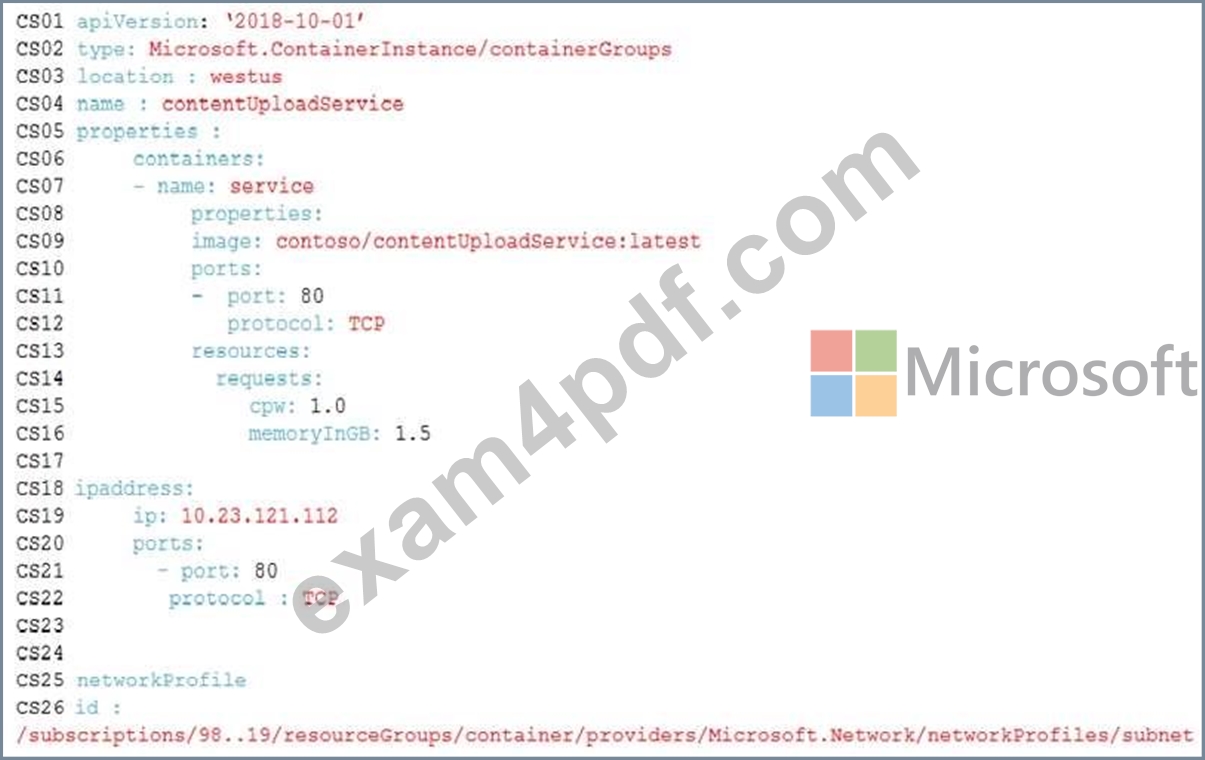
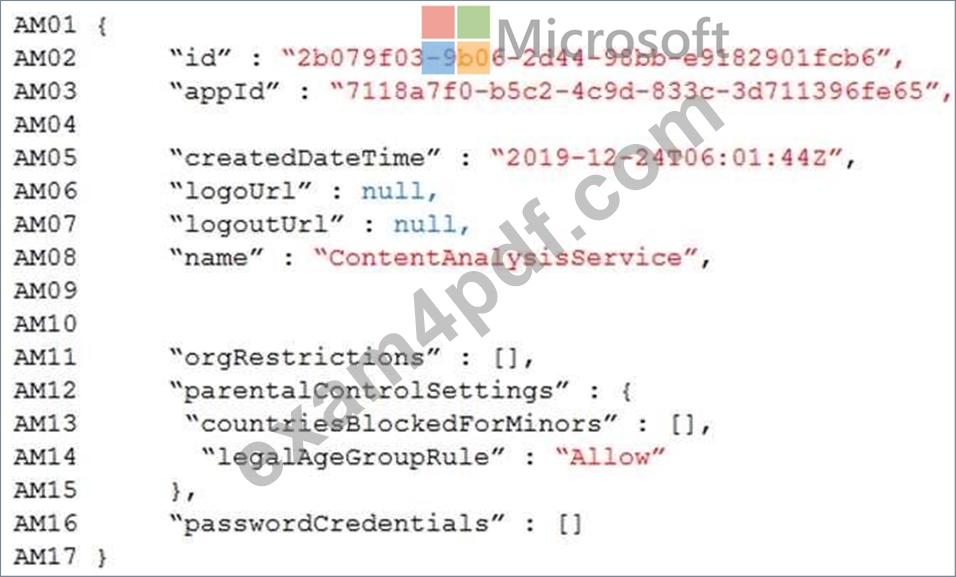
NEW QUESTION # 92
You are developing a .NET Core MVC application for customers to research hotels. The application will use Azure Search. The application will search the index by using various criteria to locate documents related to hotels. The index will include search fields for rate, a list of amenities, and distance to the nearest airport.
The application must support the following scenarios for specifying search criteria and organizing results:
* Search the index by using regular expressions.
* Organize results by counts for name-value pairs.
* List hotels within a specified distance to an airport and that fall within a specific price range.
You need to configure the SearchParameters class.
Which properties should you configure? To answer, select the appropriate options in the answer area.
NOTE Each correct selection is worth one point.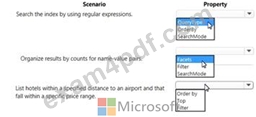
Answer:
Explanation: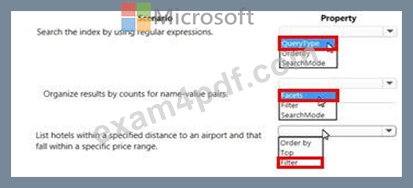
References:
https://docs.microsoft.com/en-us/dotnet/api/microsoft.azure.search.models.searchparameters
https://docs.microsoft.com/en-us/azure/search/query-lucene-syntax
https://docs.microsoft.com/en-us/dotnet/api/microsoft.azure.search.models.searchparameters.querytype
NEW QUESTION # 93
Note: This question is part of a series of questions that present the same scenario. Each question in the series contains a unique solution that might meet the stated goals. Some question sets might have more than one correct solution, while others might not have a correct solution.
After you answer a question in this question, you will NOT be able to return to it. As a result, these questions will not appear in the review screen.
You are developing a website that will run as an Azure Web App. Users will authenticate by using their Azure Active Directory (Azure AD) credentials.
You plan to assign users one of the following permission levels for the website: admin, normal, and reader. A user's Azure AD group membership must be used to determine the permission level. You need to configure authorization.
Solution:
* Create a new Azure AD application's manifest, set value of the groupMembershipClaims option to All.
* In the website, use the value of the groups claim from the JWI for the user to determine permissions.
Does the solution meet the goal?
- A. No
- B. Yes
Answer: B
Explanation:
To configure Manifest to include Group Claims in Auth Token
1. Go to Azure Active Directory to configure the Manifest. Click on Azure Active Directory, and go to App registrations to find your application:
2. Click on your application (or search for it if you have a lot of apps) and edit the Manifest by clicking on it.
3. Locate the "groupMembershipClaims" setting. Set its value to either "SecurityGroup" or "All". To help you decide which:
"SecurityGroup" - groups claim will contain the identifiers of all security groups of which the user is a member.
"All" - groups claim will contain the identifiers of all security groups and all distribution lists of which the user is a member Now your application will include group claims in your manifest and you can use this fact in your code.
Reference:
https://blogs.msdn.microsoft.com/waws/2017/03/13/azure-app-service-authentication-aad-groups/
NEW QUESTION # 94
You are working for Contoso, Ltd.
You define an API Policy object by using the following XML markup: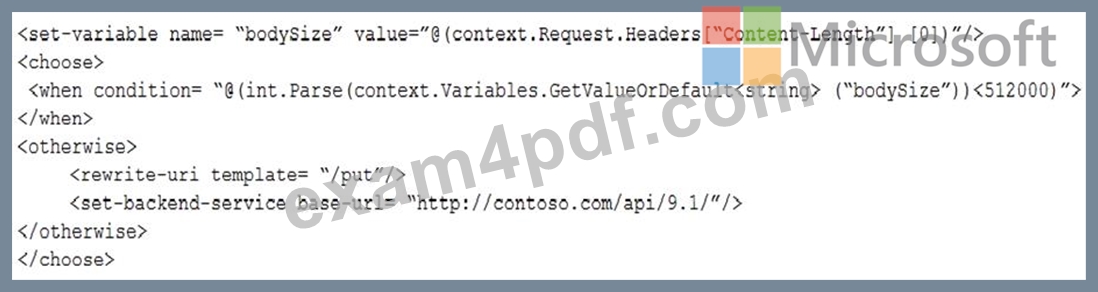
For each of the following statements, select Yes if the statement is true. Otherwise, select No.
NOTE: Each correct selection is worth one point.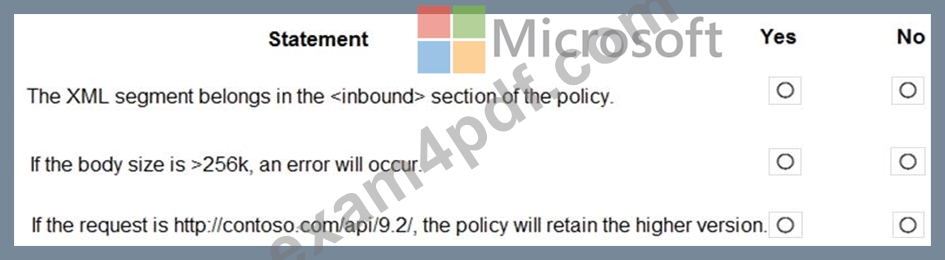
Answer:
Explanation: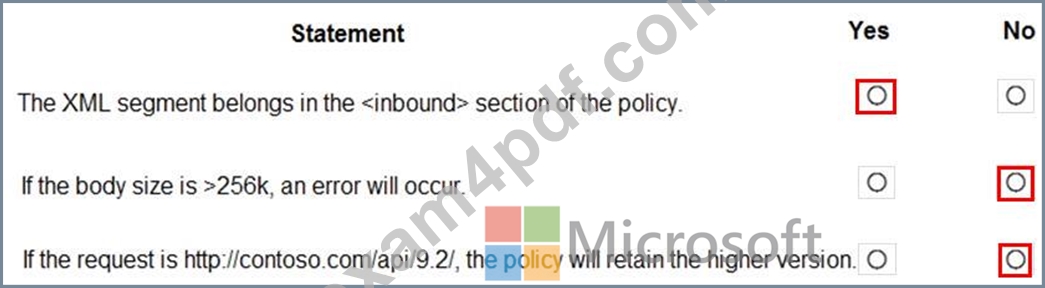
Reference:
https://docs.microsoft.com/en-us/azure/api-management/api-management-transformation-policies
NEW QUESTION # 95
You develop and deploy a Java RESTful API to Azure App Service.
You open a browser and navigate to the URL for the API. You receive the following error message:
You need to resolve the error.
What should you do?
- A. Add a CDN
- B. Enable CORS
- C. Map a custom domain
- D. Bind an SSL certificate
- E. Enable authentication
Answer: B
Explanation:
Explanation
We need to enable Cross-Origin Resource Sharing (CORS).
References:
https://medium.com/@xinganwang/a-practical-guide-to-cors-51e8fd329a1f
NEW QUESTION # 96
You are developing an Azure-hosted e-commerce web application. The application will use Azure Cosmos DB to store sales orders. You are using the latest SDK to manage the sales orders in the database.
You create a new Azure Cosmos DB instance. You include a valid endpoint and valid authorization key to an appSettings.json file in the code project.
You are evaluating the following application code: (Line number are included for reference only.)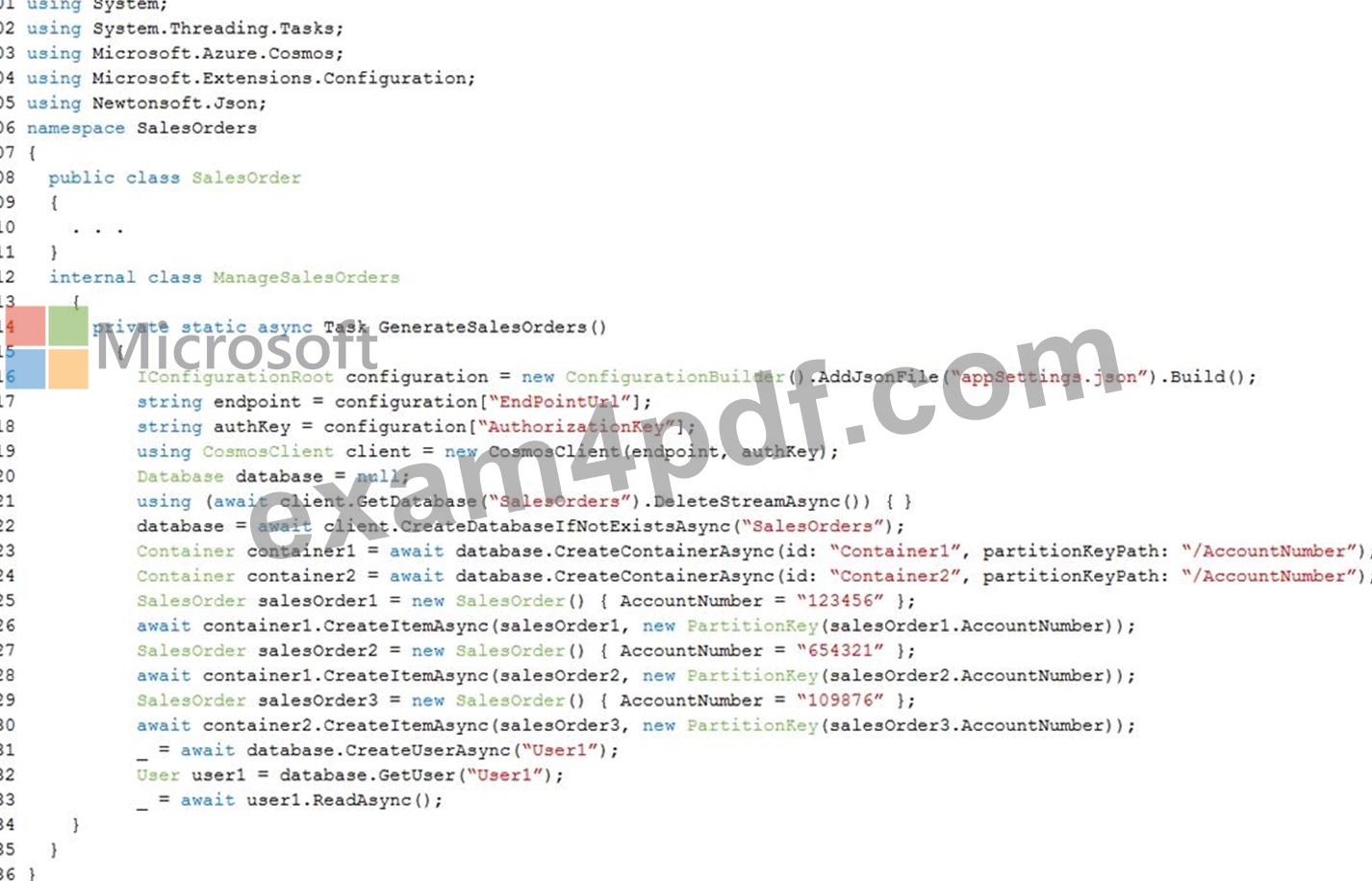
For each of the following statements, select Yes if the statement is true. Otherwise, select No.
NOTE: Each correct selection is worth one point.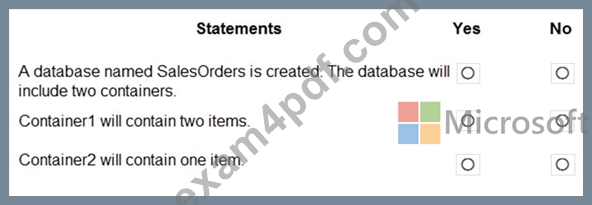
Answer:
Explanation: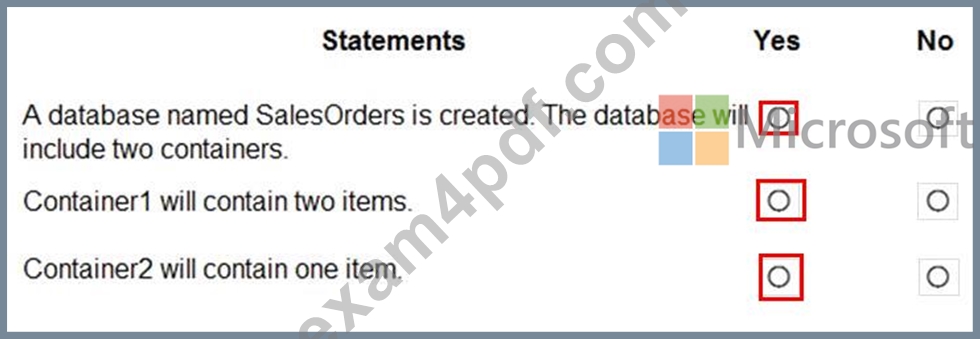
Reference:
https://docs.microsoft.com/en-us/dotnet/api/microsoft.azure.cosmos.cosmosclient.createdatabaseifnotexistsasync
https://docs.microsoft.com/en-us/dotnet/api/microsoft.azure.cosmos.database.createcontainerasync
https://docs.microsoft.com/en-us/dotnet/api/azure.cosmos.cosmoscontainer.createitemasync
NEW QUESTION # 97
Case study 1 - Litware Inc
Background
You are a developer for Litware Inc., a SaaS company that provides a solution for managing employee expenses. The solution consists of an ASP.NET Core Web API project that is deployed as an Azure Web App.
Overall architecture
Employees upload receipts for the system to process. When processing is complete, the employee receives a summary report email that details the processing results. Employees then use a web application to manager their receipts and perform any additional tasks needed for reimbursement.
Receipt processing
Employees may upload receipts in two ways:
* Uploading using an Azure Files mounted folder
* Uploading using the web application
Data Storage
Receipt and employee information is stored in an Azure SQL database.
Documentation
Employees are provided with a getting started document when they first use the solution. The documentation includes details on supported operating systems for Azure File upload, and instructions on how to configure the mounted folder.
Solution details
Users table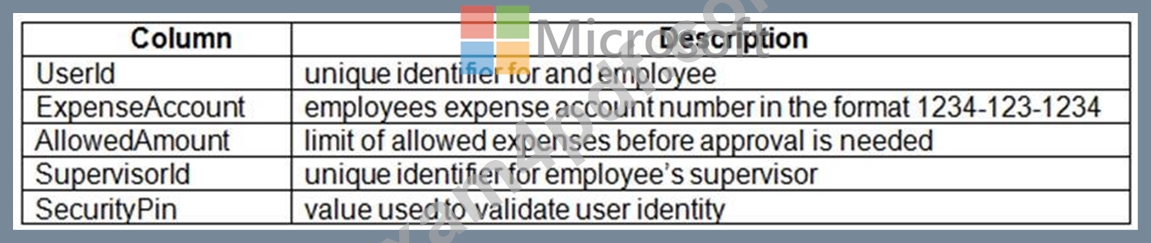
Web Application
You enable MSI for the Web App and configure the Web App to use the security principal name.
Processing
Processing is performed by an Azure Function that uses version 2 of the Azure Function runtime.
Once processing is completed, results are stored in Azure Blob Storage and an Azure SQL database. Then, an email summary is sent to the user with a link to the processing report. The link to the report must remain valid if the email is forwarded to another user.
Requirements
Receipt processing
Concurrent processing of a receipt must be prevented.
Logging
Azure Application Insights is used for telemetry and logging in both the processor and the web application. The processor also has TraceWriter logging enabled. Application Insights must always contain all log messages.
Disaster recovery
Regional outage must not impact application availability. All DR operations must not be dependent on application running and must ensure that data in the DR region is up to date.
Security
* Users' SecurityPin must be stored in such a way that access to the database does not allow the viewing of SecurityPins. The web application is the only system that should have access to SecurityPins.
* All certificates and secrets used to secure data must be stored in Azure Key Vault.
* You must adhere to the Least Privilege Principal.
* All access to Azure Storage and Azure SQL database must use the application's Managed Service Identity (MSI)
* Receipt data must always be encrypted at rest.
* All data must be protected in transit.
* User's expense account number must be visible only to logged in users. All other views of the expense account number should include only the last segment with the remaining parts obscured.
* In the case of a security breach, access to all summary reports must be revoked without impacting other parts of the system.
Issues
Upload format issue
Employees occasionally report an issue with uploading a receipt using the web application. They report that when they upload a receipt using the Azure File Share, the receipt does not appear in their profile. When this occurs, they delete the file in the file share and use the web application, which returns a 500 Internal Server error page.
Capacity issue
During busy periods, employees report long delays between the time they upload the receipt and when it appears in the web application.
Log capacity issue
Developers report that the number of log messages in the trace output for the processor is too high, resulting in lost log messages.
Processing.cs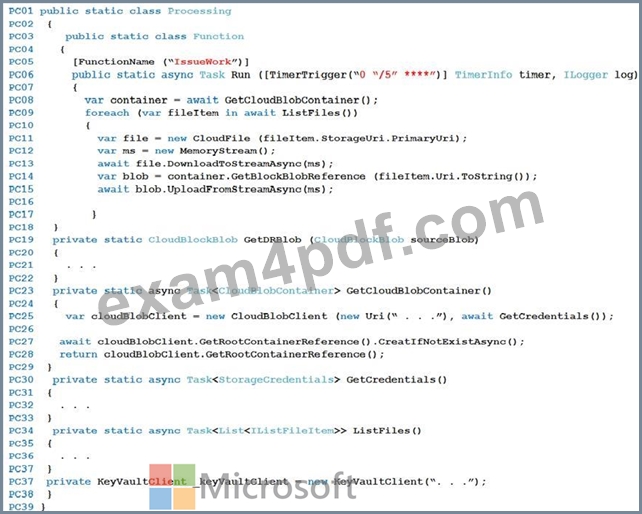
Database.cs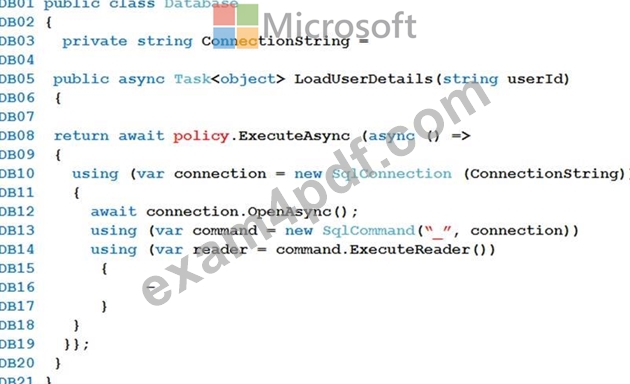
ReceiptUploader.cs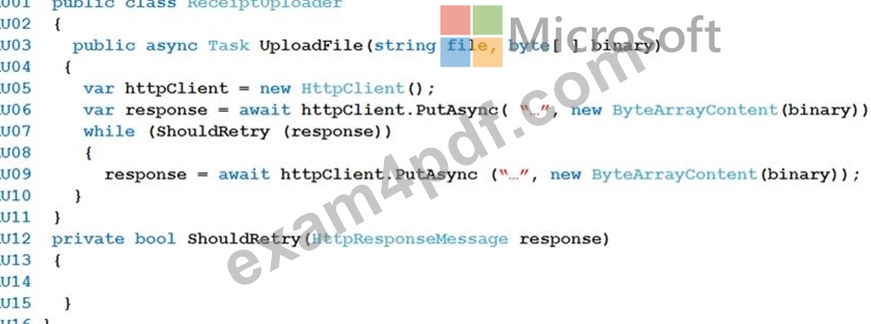
ConfigureSSE.ps1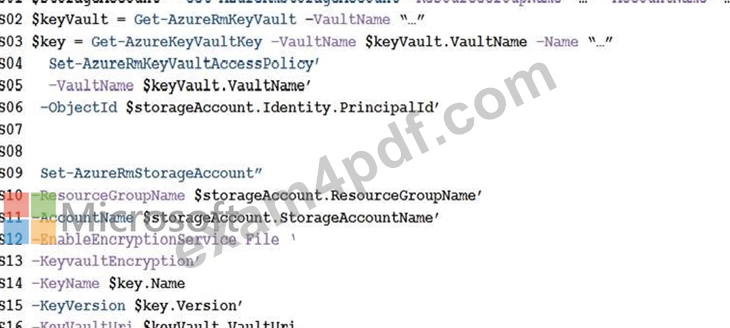
Hotspot Question
You need to ensure that security requirements are met.
What value should be used for the ConnectionString field on line DB03 in the Database class? To answer, select the appropriate options in the answer area.
NOTE: Each correct selection is worth one point.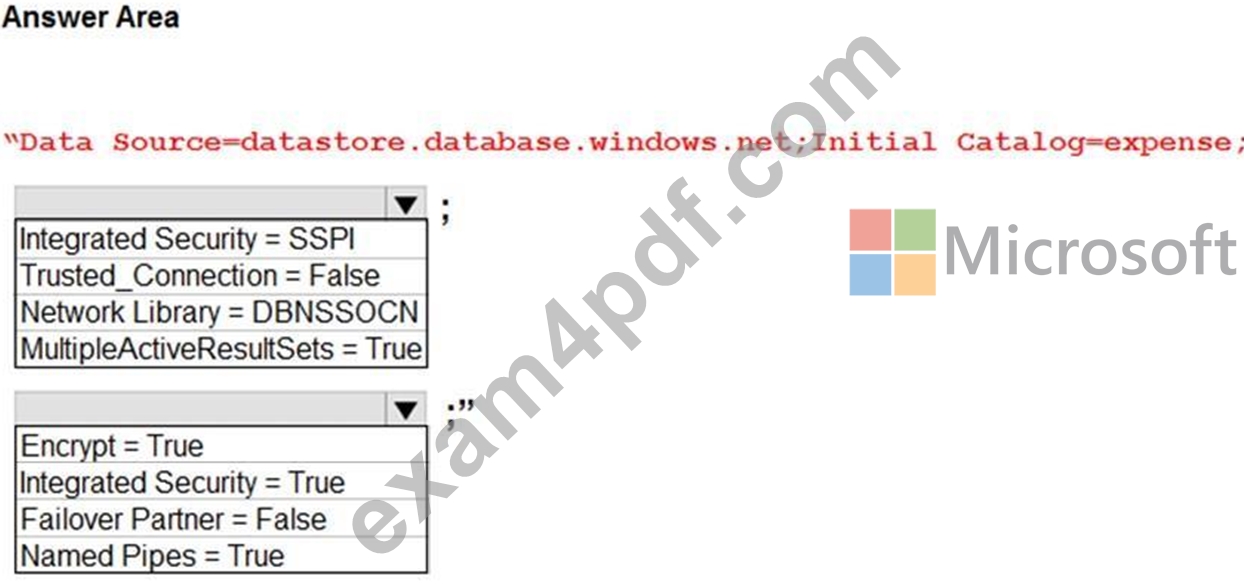
Answer:
Explanation: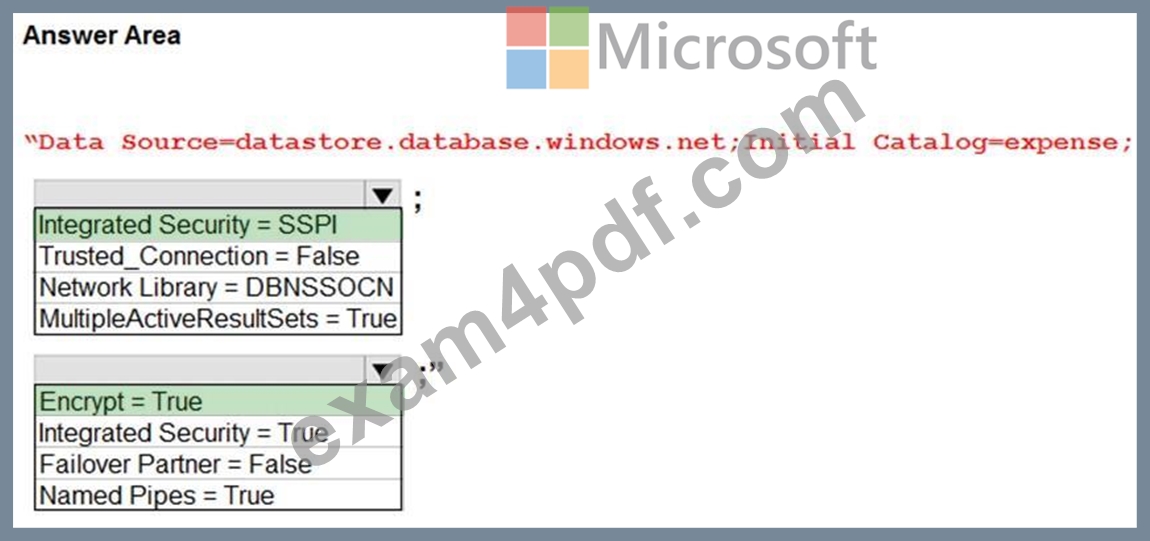
Explanation:
Box 1: Integrated Security=SSPI
Integrated security: For all data source types, connect using the current user account.
For SqlClient you can use Integrated Security=true; or Integrated Security=SSPI; Scenario: All access to Azure Storage and Azure SQL database must use the application's Managed Service Identity (MSI) Box 2: Encrypt = True Scenario: All data must be protected in transit.
References:
https://docs.microsoft.com/en-us/dotnet/framework/data/adonet/connection-string-syntax
NEW QUESTION # 98
You are developing an Azure Web App. You configure TLS mutual authentication for the web app.
You need to validate the client certificate in the web app. To answer, select the appropriate options in the answer area.
NOTE: Each correct selection is worth one point.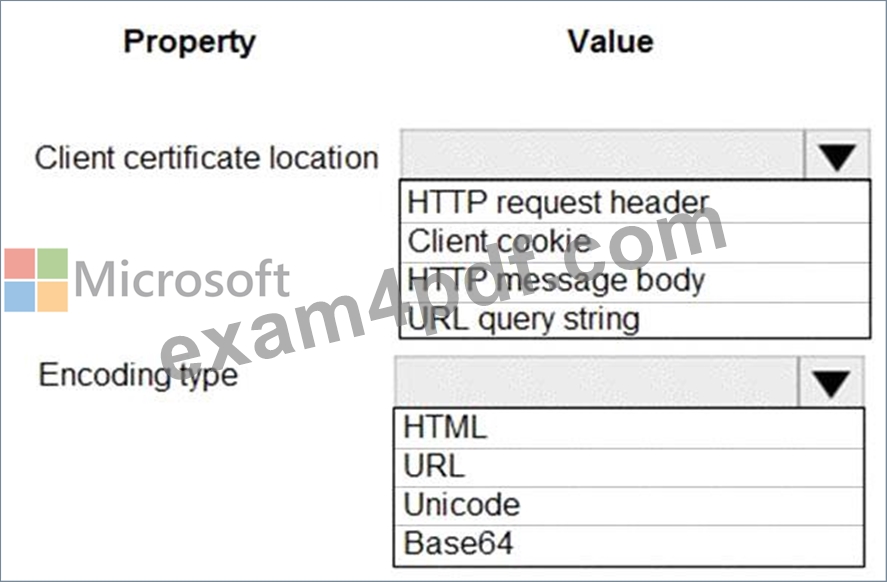
Answer:
Explanation: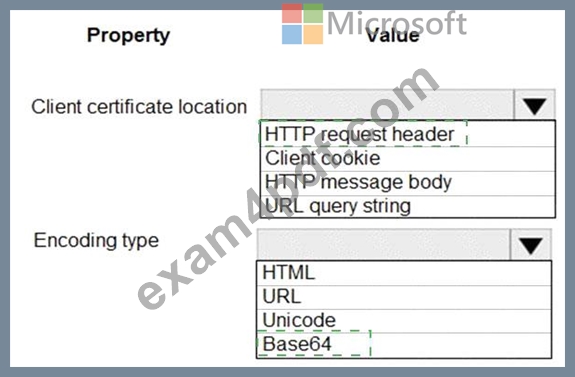
Explanation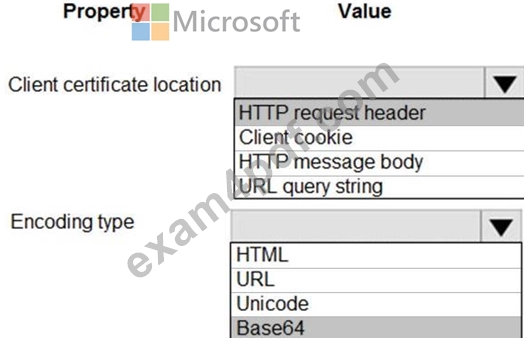
Accessing the client certificate from App Service.
If you are using ASP.NET and configure your app to use client certificate authentication, the certificate will be available through the HttpRequest.ClientCertificate property. For other application stacks, the client cert will be available in your app through a base64 encoded value in the "X-ARR-ClientCert" request header. Your application can create a certificate from this value and then use it for authentication and authorization purposes in your application.
References:
https://docs.microsoft.com/en-us/azure/app-service/app-service-web-configure-tls-mutual-auth
NEW QUESTION # 99
You need to configure Azure Service Bus to Event Grid integration.
Which Azure Service Bus settings should you use? To answer, select the appropriate options in the answer area.
NOTE: Each correct selection is worth one point.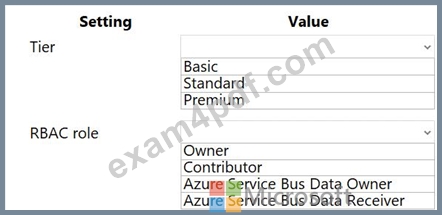
Answer:
Explanation: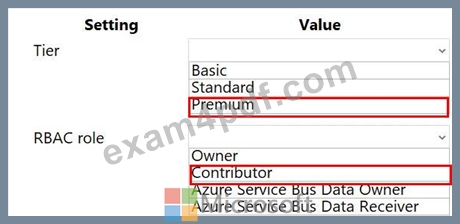
Reference:
https://docs.microsoft.com/en-us/azure/service-bus-messaging/service-bus-to-event-grid-integration-concept
NEW QUESTION # 100
You are developing a microservices solution. You plan to deploy the solution to a multinode Azure Kubernetes Service (AKS) cluster.
You need to deploy a solution that includes the following features:
* reverse proxy capabilities
* configurable traffic routing
* TLS termination with a custom certificate
Which components should you use? To answer, drag the appropriate components to the correct requirements.
Each component may be used once, more than once, or not at all. You may need to drag the split bar between panes or scroll to view content.
NOTE: Each correct selection is worth one point.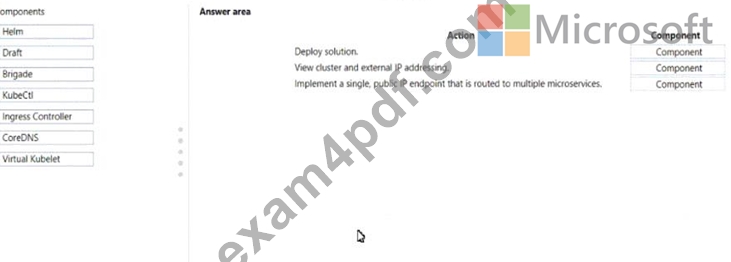
Answer:
Explanation: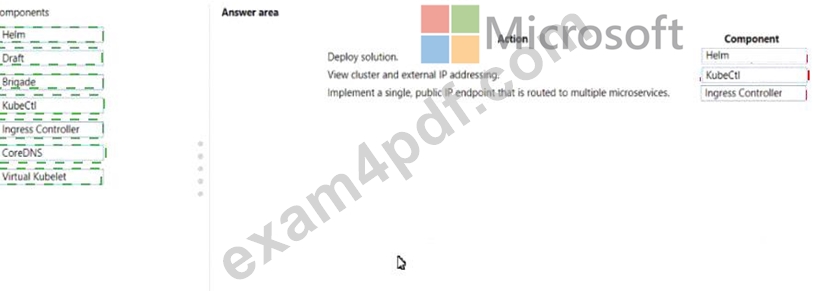
Explanation: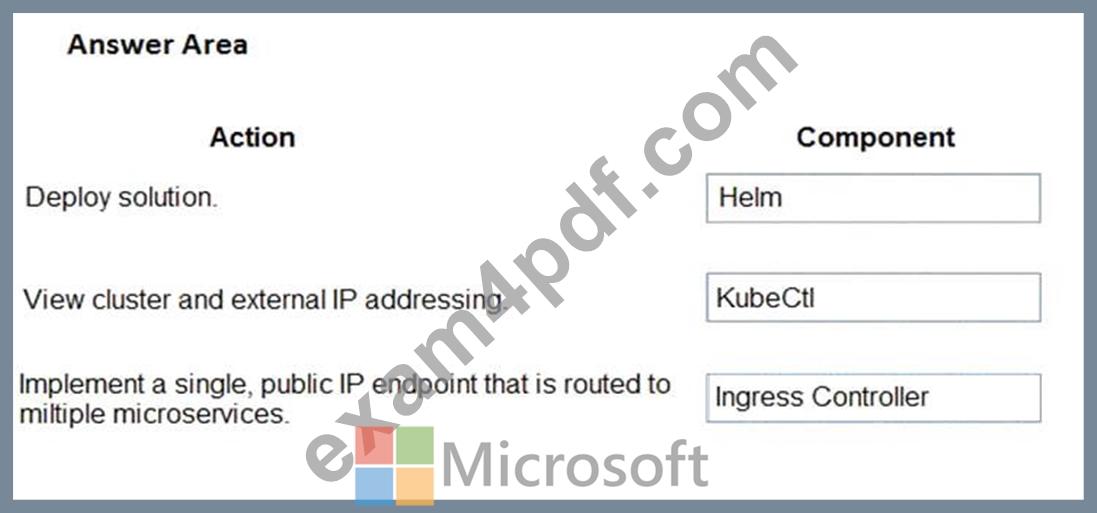
Box 1: Helm
To create the ingress controller, use Helm to install nginx-ingress.
Box 2: kubectl
To find the cluster IP address of a Kubernetes pod, use the kubectl get pod command on your local machine, with the option -o wide .
Box 3: Ingress Controller
An ingress controller is a piece of software that provides reverse proxy, configurable traffic routing, and TLS termination for Kubernetes services. Kubernetes ingress resources are used to configure the ingress rules and routes for individual Kubernetes services.
Reference:
https://docs.microsoft.com/bs-cyrl-ba/azure/aks/ingress-basic
https://www.digitalocean.com/community/tutorials/how-to-inspect-kubernetes-networking
NEW QUESTION # 101
You need to correct the internal staff issue with webpages.
Which three actions should you perform in sequence? To answer, move the appropriate actions from the list of actions to the answer area and arrange them in the correct order.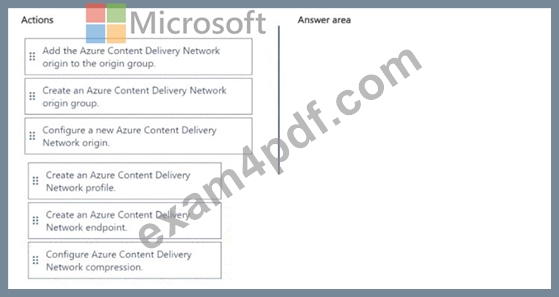
Answer:
Explanation: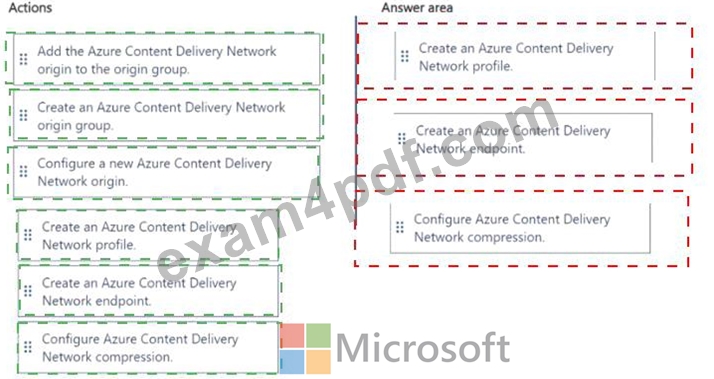
Explanation: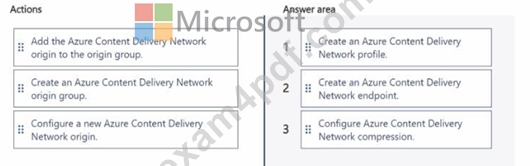
NEW QUESTION # 102
You are developing an ASP.NET Core app that includes feature flags which are managed by Azure App Configuration. You create an Azure App Configuration store named AppFeatureFlagStore that contains a feature flag named Export.
You need to update the app to meet the following requirements:
Use the Export feature in the app without requiring a restart of the app.
Validate users before users are allowed access to secure resources.
Permit users to access secure resources.
How should you complete the code segment? To answer, select the appropriate options in the answer area.
NOTE: Each correct selection is worth one point.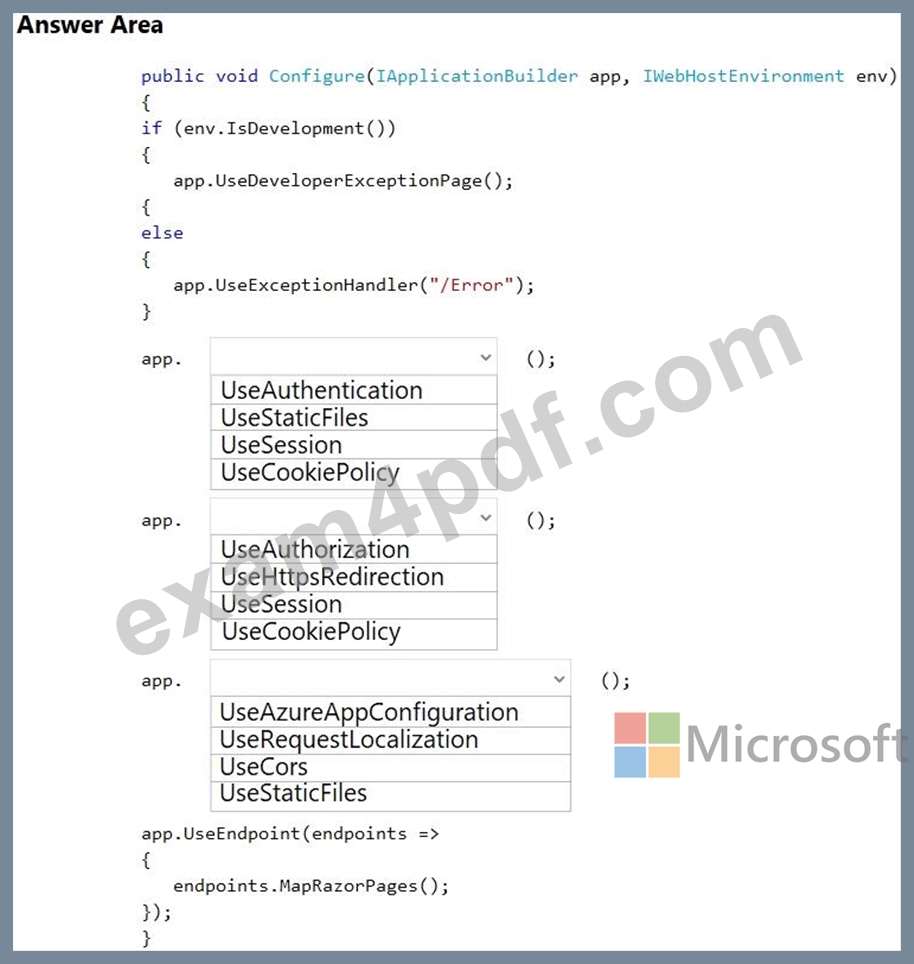
Answer:
Explanation: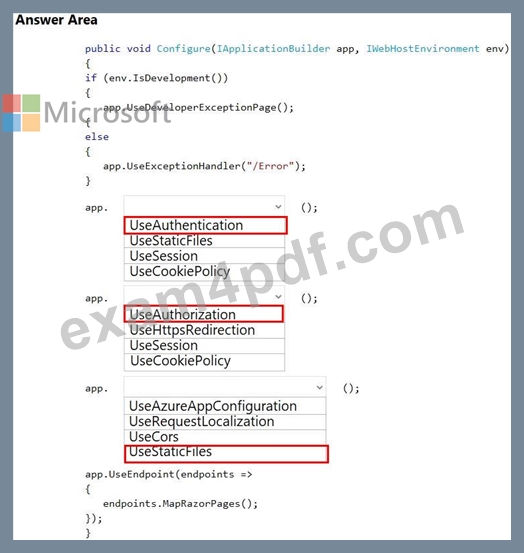
Reference:
https://docs.microsoft.com/en-us/dotnet/api/microsoft.aspnetcore.builder.iapplicationbuilder?view=aspnetcore-5.0
NEW QUESTION # 103
You are using Azure Front Door Service.
You are expecting inbound files to be compressed by using Brotli compression. You discover that inbound XML files are not compressed. The files are 9 megabytes (MB) in size.
You need to determine the root cause for the issue.
To answer, select the appropriate options in the answer area.
NOTE: Each correct selection is worth one point.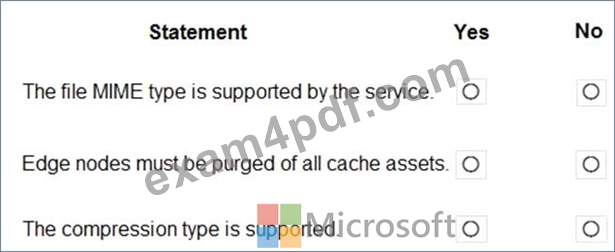
Answer:
Explanation: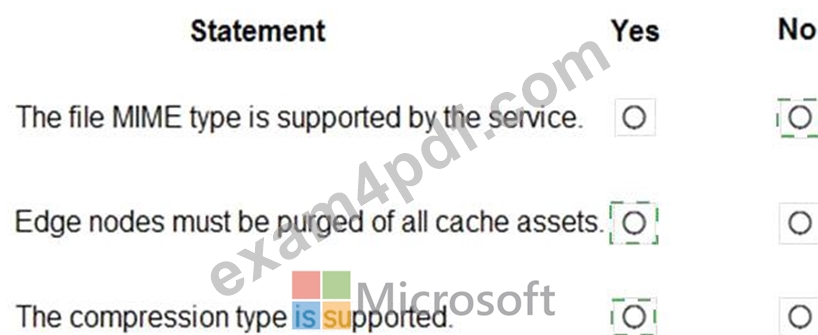
Explanation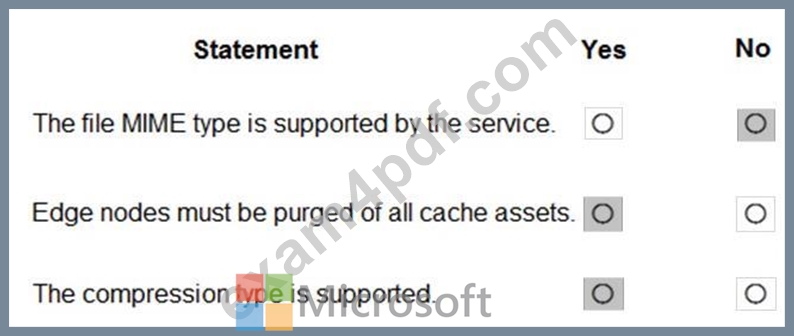
Box 1: No
Front Door can dynamically compress content on the edge, resulting in a smaller and faster response to your clients. All files are eligible for compression. However, a file must be of a MIME type that is eligible for compression list.
Box 2: No
Sometimes you may wish to purge cached content from all edge nodes and force them all to retrieve new updated assets. This might be due to updates to your web application, or to quickly update assets that contain incorrect information.
Box 3: Yes
These profiles support the following compression encodings: Gzip (GNU zip), Brotli Reference:
https://docs.microsoft.com/en-us/azure/frontdoor/front-door-caching
NEW QUESTION # 104
Drag and Drop Question
You develop a gateway solution for a public facing news API.
The news API back end is implemented as a RESTful service and hosted in an Azure App Service instance.
You need to configure back-end authentication for the API Management service instance.
Which target and gateway credential type should you use? To answer, drag the appropriate values to the correct parameters. Each value may be used once, more than once, or not at all.
You may need to drag the split bar between panes or scroll to view content.
NOTE: Each correct selection is worth one point.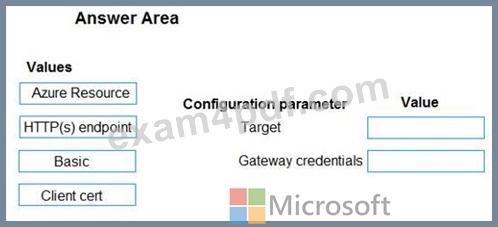
Answer:
Explanation: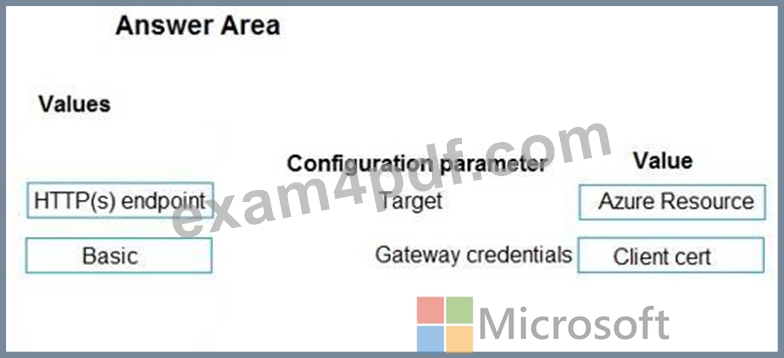
Explanation:
Box 1: Azure Resource
Box 2: Client cert
API Management allows to secure access to the back-end service of an API using client certificates.
References:
https://docs.microsoft.com/en-us/rest/api/apimanagement/apimanagementrest/azure-api- management-rest-api-backend-entity
NEW QUESTION # 105
You are developing an application to retrieve user profile information. The application will use the Microsoft Graph SDK.
The app must retrieve user profile information by using a Microsoft Graph API call.
You need to call the Microsoft Graph API from the application.
In which order should you perform the actions? To answer, move all actions from the list of actions to the answer area and arrange them in the correct order.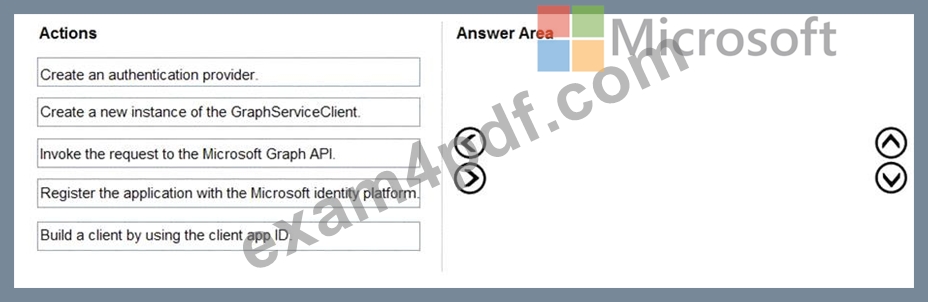
Answer:
Explanation: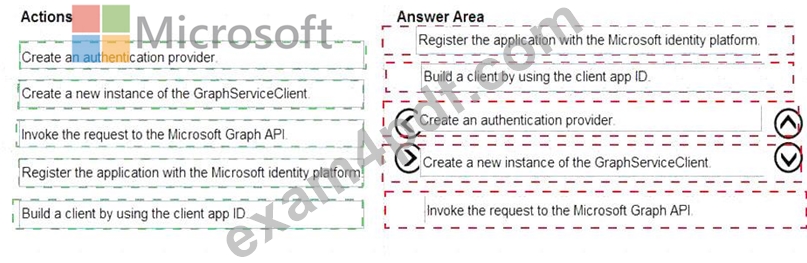
Explanation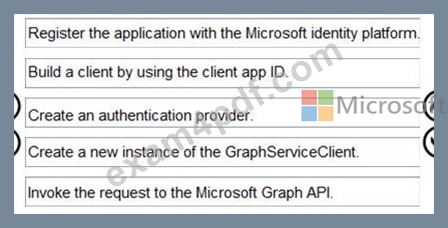
Table Description automatically generated
Step 1: Register the application with the Microsoft identity platform.
To authenticate with the Microsoft identity platform endpoint, you must first register your app at the Azure app registration portal Step 2: Build a client by using the client app ID Step 3: Create an authentication provider Create an authentication provider by passing in a client application and graph scopes.
Code example:
DeviceCodeProvider authProvider = new DeviceCodeProvider(publicClientApplication, graphScopes);
// Create a new instance of GraphServiceClient with the authentication provider.
GraphServiceClient graphClient = new GraphServiceClient(authProvider);
Step 4: Create a new instance of the GraphServiceClient
Step 5: Invoke the request to the Microsoft Graph API
Reference:
https://docs.microsoft.com/en-us/graph/auth-v2-service
https://docs.microsoft.com/en-us/graph/sdks/create-client
NEW QUESTION # 106
You are developing a web application by using the Azure SDK. The web application accesses data m a zone-redundant BlockBlobStorage storage account
The application must determine whether the data has changed since the application last reao the dat
a. Update operations must use the latest data changes when writing data to the storages..................
You need to implement the update operations.
Which values should you use? To answer, select the appropriate option m the answer area.
NOTE Each correct selection is worth one point.
Answer:
Explanation:
See the answer in below image.
NEW QUESTION # 107
A software as a service (SaaS) company provides document management services. The company has a service that consists of several Azure web apps. All Azure web apps run in an Azure App Service Plan named PrimaryASP.
You are developing a new web service by using a web app named ExcelParser. The web app contains a third- party library for processing Microsoft Excel files. The license for the third-party library stipulates that you can only run a single instance of the library.
You need to configure the service.
How should you complete the script? To answer, select the appropriate options in the answer area.
NOTE: Each correct selection is worth one point.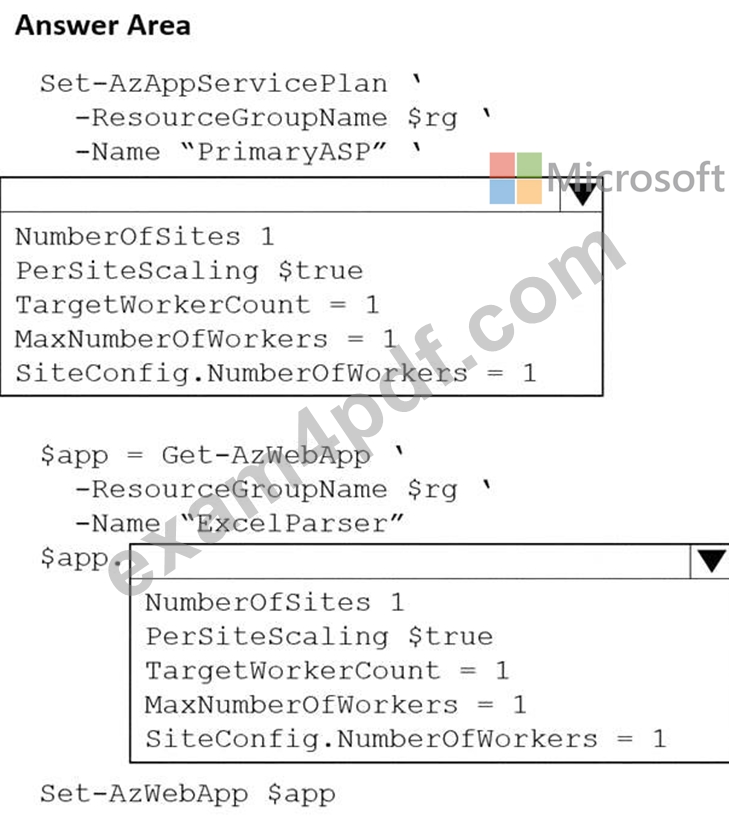
Answer:
Explanation: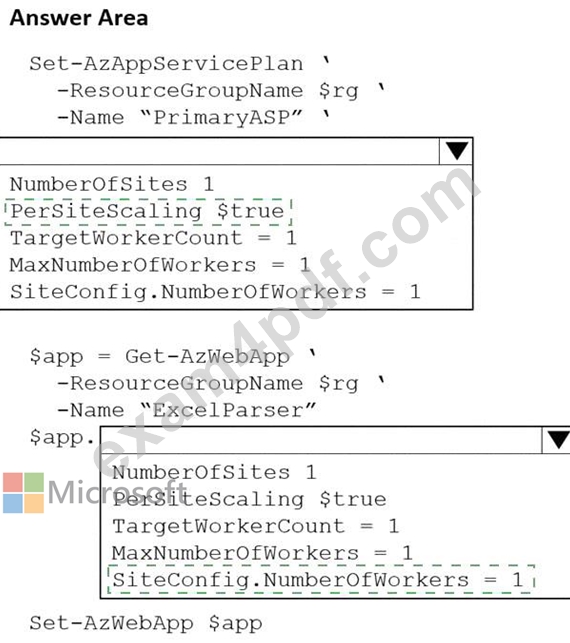
Explanation: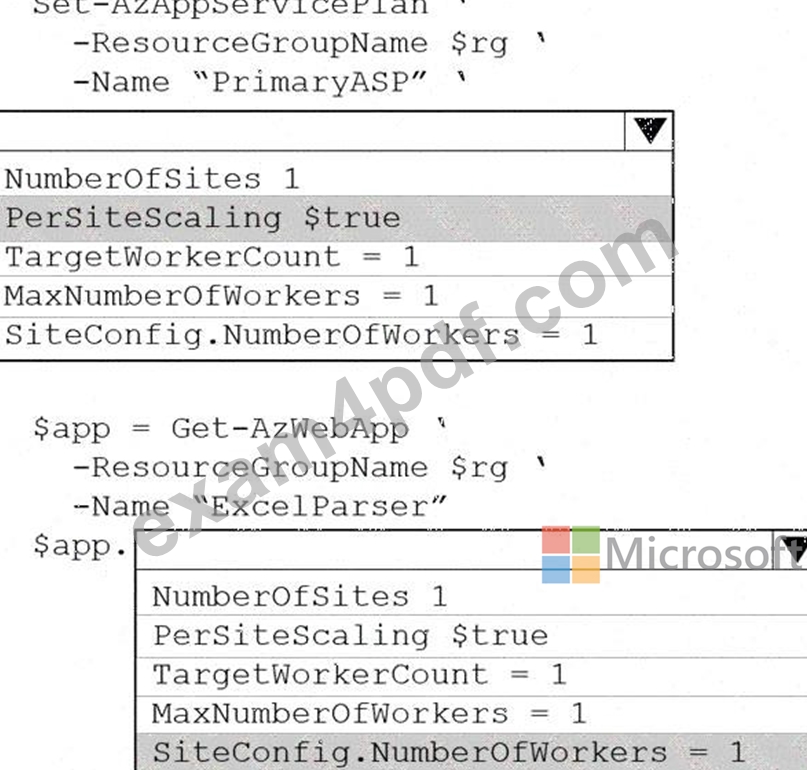
Reference:
https://docs.microsoft.com/en-us/azure/app-service/manage-scale-per-app
NEW QUESTION # 108
......
Latest 100% Passing Guarantee - Brilliant AZ-204 Exam Questions PDF: https://www.exam4pdf.com/AZ-204-dumps-torrent.html
AZ-204 Certification – Valid Exam Dumps Questions Study Guide: https://drive.google.com/open?id=12PmESdaQNKpGnCXpPA_-HMKapxRuvx2B
