

Easy To Download Linux Foundation CKA Exam Dumps Updated 63 Questions
New Updated CKA Exam Questions 2022
Understanding of functional and technical aspects of Troubleshooting
Detect, diagnose, and remedy a variety of Kubernetes failures at the network, node, control-plane, and application levels. You will use tools included in Kubernetes, such as kubectl, as well as a variety of Linux operating system tools like systemctl, journalctl, ss, and openssl to build a comprehensive Kubernetes troubleshooting toolkit.
The following will be discussed in CNCF CKA dumps:
- Troubleshoot Kubernetes connection failures
- Understand how to monitor applications
- Troubleshoot networking
- Evaluate cluster and node logging
- Troubleshoot Kubernetes component failures
- Troubleshoot cluster component failure
- Troubleshoot Kubernetes application failures
- Troubleshoot Kubernetes node failures
- Manage container stdout & stderr logs
- Troubleshoot application failure
The benefit of obtaining the Linux Foundation-CKA: Certified Kubernetes Administrator Exam Certification
A Kubernetes certification makes your resume look good and stand out from the competition. As companies rely more and more on k8s, your expertise will be an immediate asset. A top certification like the CKA or the CKAD gives you mighty potential for a better salary. Passing these exams is not an easy task, so companies seeking k8s engineers are willing to pay more because the certifications show that youâre not only experienced, but you truly understand the platform. Achieve personal growth. Passing these exams is rewarding on a personal level: you sacrificed free time and fun to study and prepare, so passing the exam is rewarding in itself. Next, you may even move onto another skillset to focus on.
Difficulty in Attempting Linux Foundation-CKA: Certified Kubernetes Administrator Exam
CKA is a tough exam. Mainly because it focuses on your ability to perform on a practical level rather than just asking a bunch of MCQ questions that would test your knowledge. If the user has successfully passed the CNCF CKA practice exam and has been through CNCF CKA exam dumps then the certification exam will not be too much difficult as the user has shown aptitude for understanding complicated processes.
NEW QUESTION 37
create a pod in a specific node (node1) by placing the pod definition file in a particular folder "/etc/kubernetes/manifests".
- A. Generate YAML before we SSH to the specific node, then copy the YAML into the exam notepad to use it after SSH into worker node.
SSH to the node: "ssh node1"
Gain admin privileges to the node: "sudo -i"
Move to the manifest-path "cd /etc/kubernetes/manifests"
Place the generated YAML into the folder "vi nginx.yaml"
Find the kubelet config file path "ps -aux | grep kubelet" . This
will output information on kubelet process. Locate the kubelet config
file location.
kubelet config file -- /var/lib/kubelet/config.yaml
Edit the config file "vi /var/lib/kubelet/config.yaml" to add
staticPodPath
staticPodPath: /etc/kubernetes/manifests
Restart the kubelet "systemctl restart kubelet" - B. Generate YAML before we SSH to the specific node, then copy the YAML into the exam notepad to use it after SSH into worker node.
SSH to the node: "ssh node1"
Gain admin privileges to the node: "sudo -i"
Move to the manifest-path "cd /etc/kubernetes/manifests"
kubelet config file -- /var/lib/kubelet/config.yaml
Edit the config file "vi /var/lib/kubelet/config.yaml" to add
staticPodPath
staticPodPath: /etc/kubernetes/manifests
Restart the kubelet "systemctl restart kubelet"
Answer: A
NEW QUESTION 38
Score: 7%
Task
First, create a snapshot of the existing etcd instance running at https://127.0.0.1:2379, saving the snapshot to
/srv/data/etcd-snapshot.db.
Next, restore an existing, previous snapshot located at /var/lib/backup/etcd-snapshot-previo us.db
Answer:
Explanation:
See the solution below.
Explanation
Solution:
#backup
ETCDCTL_API=3 etcdctl --endpoints="https://127.0.0.1:2379" --cacert=/opt/KUIN000601/ca.crt
--cert=/opt/KUIN000601/etcd-client.crt --key=/opt/KUIN000601/etcd-client.key snapshot save
/etc/data/etcd-snapshot.db
#restore
ETCDCTL_API=3 etcdctl --endpoints="https://127.0.0.1:2379" --cacert=/opt/KUIN000601/ca.crt
--cert=/opt/KUIN000601/etcd-client.crt --key=/opt/KUIN000601/etcd-client.key snapshot restore
/var/lib/backup/etcd-snapshot-previoys.db
NEW QUESTION 39
Get all the pods with label "env"
Answer:
Explanation:
kubectl get pods -L env
NEW QUESTION 40
Score:7%
Context
An existing Pod needs to be integrated into the Kubernetes built-in logging architecture (e. g. kubectl logs).
Adding a streaming sidecar container is a good and common way to accomplish this requirement.
Task
Add a sidecar container named sidecar, using the busybox Image, to the existing Pod big-corp-app. The new sidecar container has to run the following command:
/bin/sh -c tail -n+1 -f /va r/log/big-corp-app.log
Use a Volume, mounted at /var/log, to make the log file big-corp-app.log available to the sidecar container.
Answer:
Explanation:
See the solution below.
Explanation
Solution:
#
kubectl get pod big-corp-app -o yaml
#
apiVersion: v1
kind: Pod
metadata:
name: big-corp-app
spec:
containers:
- name: big-corp-app
image: busybox
args:
- /bin/sh
- -c
- >
i=0;
while true;
do
echo "$(date) INFO $i" >> /var/log/big-corp-app.log;
i=$((i+1));
sleep 1;
done
volumeMounts:
- name: logs
mountPath: /var/log
- name: count-log-1
image: busybox
args: [/bin/sh, -c, 'tail -n+1 -f /var/log/big-corp-app.log']
volumeMounts:
- name: logs
mountPath: /var/log
volumes:
- name: logs
emptyDir: {
}
#
kubectl logs big-corp-app -c count-log-1
NEW QUESTION 41
Check the rollout history and make sure everything is ok after the update
- A. kubectl rollout history deploy webapp
kubectl get deploy webapp --show-labels
kubectl get rs -l app=webapp
kubectl get po -l app=webapp - B. kubectl rollout history deploy webapp
kubectl get deploy webapp --show-labels
kubectl get rs -
kubectl get po -l app=webapp
Answer: A
NEW QUESTION 42
Create an nginx pod with containerPort 80 and with a PersistentVolumeClaim "task-pv-claim" and has a mouth path "/usr/share/nginx/html"
- A. vim nginx-pvc-pod.yaml
apiVersion: v1
kind: Pod
metadata:
name: task-pv-pod
spec:
volumes:
- name: task-pv-storage
persistentVolumeClaim:
claimName: task-pv-claim
containers:
- name: task-pv-container
image: nginx
ports:
- containerPort: 60
name: "http"
volumeMounts:
- mountPath: "/usr/share/nginx/html"
name: task-pv-storage
kubectl apply -f nginx-pvc-pod.yaml
// Verify
kubectl describe po "POD-Name" | grep -i volumes -A4
Volumes:
task-pv-storage:
Type: PersistentVolumeClaim (a reference to a
PersistentVolumeClaim in the same namespace)
ClaimName: task-pv-claim
ReadOnly: false - B. vim nginx-pvc-pod.yaml
apiVersion: v1
kind: Pod
metadata:
name: task-pv-pod
spec:
volumes:
- name: task-pv-storage
persistentVolumeClaim:
claimName: task-pv-claim
containers:
- name: task-pv-container
image: nginx
ports:
- containerPort: 80
name: "http"
volumeMounts:
- mountPath: "/usr/share/nginx/html"
name: task-pv-storage
kubectl apply -f nginx-pvc-pod.yaml
// Verify
kubectl describe po "POD-Name" | grep -i volumes -A5
Volumes:
task-pv-storage:
Type: PersistentVolumeClaim (a reference to a
PersistentVolumeClaim in the same namespace)
ClaimName: task-pv-claim
ReadOnly: false
Answer: B
NEW QUESTION 43
Get list of all pods in all namespaces and write it to file "/opt/pods-list.yaml"
Answer:
Explanation:
kubectl get po -all-namespaces > /opt/pods-list.yaml
NEW QUESTION 44
List all the pods that are serviced by the service "webservice" and copy the output in /opt/$USER/webservice.targets Note: You need to list the endpoints
Answer:
Explanation:
kubectl descrive svc webservice | grep -i "Endpoints" > /opt/$USER/webservice.targets kubectl get endpoints webservice > /opt/$USER/webservice.targets
NEW QUESTION 45
Create a NetworkPolicy which denies all ingress traffic
- A. apiVersion: networking.k8s.io/v1
kind: NetworkPolicy
metadata:
name: default-deny
spec:
podSelector: ()
policyTypes:
- Ingress - B. apiVersion: networking.k8s.io/v1
kind: NetworkPolicy
metadata:
name: default-deny
spec:
podSelector: {}
policyTypes:
- Ingress
Answer: B
NEW QUESTION 46
Get list of PVs and order by size and write to file "/opt/pvstorage.txt"
Answer:
Explanation:
kubectl get pv --sort-by=.spec.capacity.storage > /opt/pv storage.txt
NEW QUESTION 47
Create a Pod nginx and specify a CPU request and a CPU limit of 0.5 and 1 respectively.
- A. // create a yml file
kubectl run nginx-pod --image=nginx --restart=Never --dry-run -
o yaml > nginx-pod.yml
// add the resources section and create
vim nginx-pod.yaml
apiVersion: v1
kind: Pod
metadata:
labels:
run: nginx
name: nginx
spec:
containers:
- image: nginx
name: nginx
resources:
requests:
cpu: "0.5"
limits:
cpu: "1"
restartPolicy: Always
kubectl apply -f nginx-pod.yaml
// verify
kubectl top pod - B. // create a yml file
kubectl run nginx-pod --image=nginx --restart=Never --dry-run -
o yaml > nginx-pod.yml
// add the resources section and create
vim nginx-pod.yaml
apiVersion: v1
kind: Pod
metadata:
labels:
run: nginx
name: nginx
spec:
containers:
- image: nginx
name: nginx
resources:
requests:
cpu: "0.4"
limits:
cpu: "1"
restartPolicy: Always
kubectl apply -f nginx-pod.yaml
// verify
kubectl top pod
Answer: A
NEW QUESTION 48
An administrator accidentally closed the commit window/screen before the commit was finished. Which two options could the administrator use to verify the progress or success of that commit task? (Choose two)
- A. Task Manager
- B. System Logs
- C. Traffic Logs
- D. Configuration Logs
Answer: A,D
NEW QUESTION 49
List all the pods sorted by name
Answer:
Explanation:
kubect1 get pods --sort-by=.metadata.name
NEW QUESTION 50
Scale the deployment webserver to
Answer:
Explanation:
See the solution below.
Explanation
solution
NEW QUESTION 51
List all service account and create a service account called "admin"
- A. kubectl get sa
kubectl get sa --all-namespaces
kubectl create sa admin
//Verify
kubectl get sa admin -o yaml - B. kubectl get sa
kubectl get sa --all-namespaces
//Verify
kubectl get sa admin -o yaml
Answer: A
NEW QUESTION 52
Create a pod that echo "hello world" and then exists. Have the pod deleted automatically when it's completed
Answer:
Explanation:
See the solution below.
Explanation
kubectl run busybox --image=busybox -it --rm --restart=Never --
/bin/sh -c 'echo hello world'
kubectl get po # You shouldn't see pod with the name "busybox"
NEW QUESTION 53
Score: 4%
Task
Schedule a pod as follows:
* Name: nginx-kusc00401
* Image: nginx
* Node selector: disk=ssd
Answer:
Explanation:
See the solution below.
Explanation
Solution:
#yaml
apiVersion: v1
kind: Pod
metadata:
name: nginx-kusc00401
spec:
containers:
- name: nginx
image: nginx
imagePullPolicy: IfNotPresent
nodeSelector:
disk: spinning
#
kubectl create -f node-select.yaml
NEW QUESTION 54
For this item, you will have to ssh and complete all tasks on these
nodes. Ensure that you return to the base node (hostname: ) when you have completed this item.
Context
As an administrator of a small development team, you have been asked to set up a Kubernetes cluster to test the viability of a new application.
Task
You must use kubeadm to perform this task. Any kubeadm invocations will require the use of the
--ignore-preflight-errors=all option.
Configure the node ik8s-master-O as a master node. .
Join the node ik8s-node-o to the cluster.
Answer:
Explanation:
See the solution below.
Explanation
solution
You must use the kubeadm configuration file located at /etc/kubeadm.conf when initializingyour cluster.
You may use any CNI plugin to complete this task, but if you don't have your favourite CNI plugin's manifest URL at hand, Calico is one popular option:
https://docs.projectcalico.org/v3.14/manifests/calico.yaml
Docker is already installed on both nodes and apt has been configured so that you can install the required tools.
NEW QUESTION 55
Get the number of schedulable nodes and write to a file
/opt/schedulable-nodes.txt
- A. kubectl get nodes -o jsonpath="{range
.items[*]}{.metadata.name}
{.spec.taints[?(@.effect=='NoSchedule')].effect}{\"\n\"}{end}"
| awk 'NF==11 {print $0}' > /opt/schedulable-nodes.txt
// Verify
cat /opt/schedulable-nodes.txt - B. kubectl get nodes -o jsonpath="{range
.items[*]}{.metadata.name}
{.spec.taints[?(@.effect=='NoSchedule')].effect}{\"\n\"}{end}"
| awk 'NF==1 {print $0}' > /opt/schedulable-nodes.txt
// Verify
cat /opt/schedulable-nodes.txt
Answer: B
NEW QUESTION 56
Check to see how many worker nodes are ready (not including nodes tainted NoSchedule) and write the number to /opt/KUCC00104/kucc00104.txt.
Answer:
Explanation:
See the solution below.
Explanation
solution
F:\Work\Data Entry Work\Data Entry\20200827\CKA\15 B.JPG
F:\Work\Data Entry Work\Data Entry\20200827\CKA\15 C.JPG
NEW QUESTION 57
Create a Kubernetes secret as follows:
Name: super-secret
password: bob
Create a pod named pod-secrets-via-file, using the redis Image, which mounts a secret named super-secret at
/secrets.
Create a second pod named pod-secrets-via-env, using the redis Image, which exports password as CONFIDENTIAL
Answer:
Explanation:
See the solution below.
Explanation
solution
F:\Work\Data Entry Work\Data Entry\20200827\CKA\12 B.JPG
F:\Work\Data Entry Work\Data Entry\20200827\CKA\12 C.JPG
F:\Work\Data Entry Work\Data Entry\20200827\CKA\12 D.JPG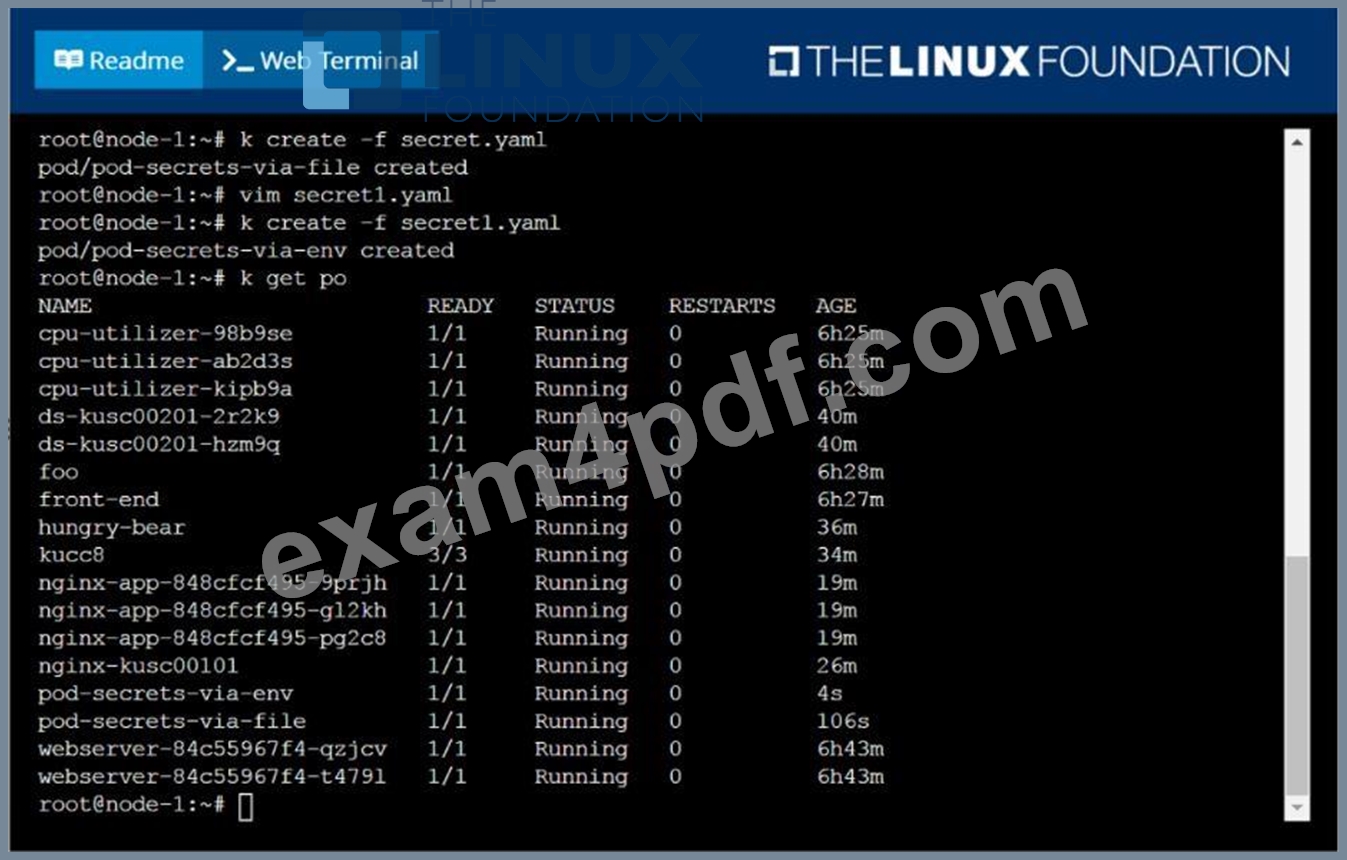
NEW QUESTION 58
Create a file:
/opt/KUCC00302/kucc00302.txtthatlists all pods that implement servicebazin namespacedevelopment.
The format of the file should be onepod name per line.
Answer:
Explanation:
See the solution below.
Explanation
solution


NEW QUESTION 59
Create a deployment as follows:
* Name:nginx-random
* Exposed via a servicenginx-random
* Ensure that the service & podare accessible via theirrespective DNS records
* The container(s) within anypod(s) running as a part of thisdeployment should use thenginxImage Next, use the utilitynslookupto lookup the DNS records of the service &pod and write the output to
/opt/KUNW00601/service.dnsand/opt/KUNW00601/pod.dnsrespectively.
Answer:
Explanation:
See the solution below.
Explanation
Solution:

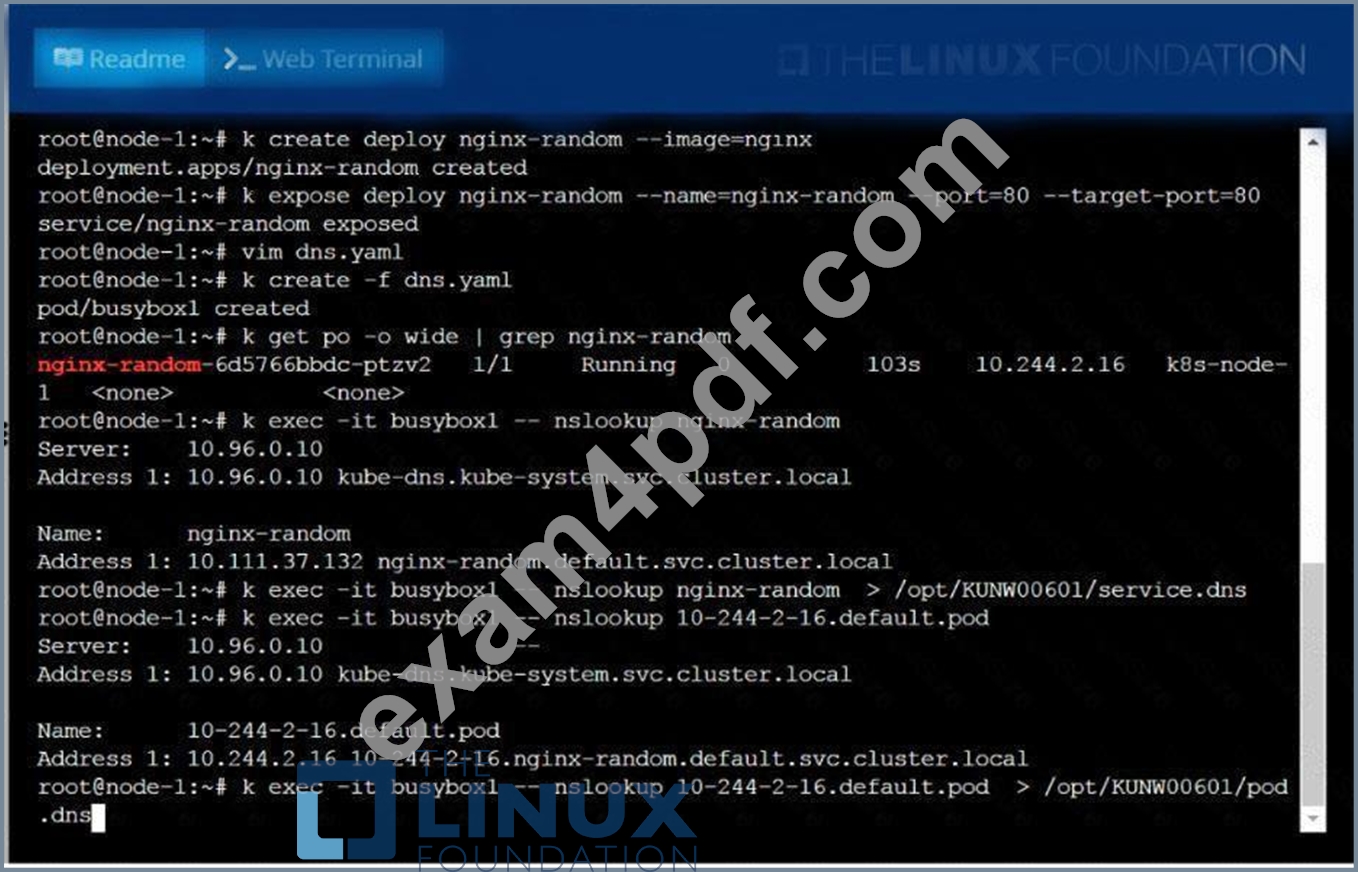
NEW QUESTION 60
Schedule a pod as follows:
* Name: nginx-kusc00101
* Image: nginx
* Node selector: disk=ssd
Answer:
Explanation:
See the solution below.
Explanation
solution


NEW QUESTION 61
......
Updated Free Linux Foundation CKA Test Engine Questions with 63 Q&As: https://www.exam4pdf.com/CKA-dumps-torrent.html
The Best Kubernetes Administrator CKA Professional Exam Questions: https://drive.google.com/open?id=1LyjZpn04WcilIX_DR0bDjQxEOX33gE--
