

Updated Jan-2023 Exam L4M2 Dumps - Pass Your Certification Exam
Latest Real CIPS L4M2 Exam Dumps Questions
NEW QUESTION 72
Dana is an automobile manufacturer. It has a new electrification strategy that aims at making eco-friendly electric pick-up trucks. To implement this strategy, the procurement department must source new categories of parts that make motors, sensors, solenoids and stators. He starts to analyse the market by identifying specific supply market segments for those parts and finding suppliers who have the best capabilities in those segment. He intends to segment the market based on specific features of the products. Which variable is used by Dana procurement manager to shape and manage supply market?
- A. Buyer segments
- B. Product segments
- C. Channel segments
- D. Geographical segments
Answer: B
Explanation:
In sales and marketing, market segmentation is the process of trying to understand clusters of cus-tomers in terms of their buying behavior and their buying characteristics. There are some traditional segmentation approaches: geography, demography, types of industry and the benefits. Then there are newer segmentation approaches: behavioral, situational, and psychographic.
Procurement professionals can learn market segmentation from sales and marketing. Segmenting the market can help them to shape and manage the supply market effectively. According to Michael Porter, a market can be segment with array of products and buyers.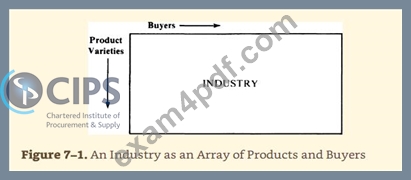
Source: Porter, Michael E.. Competitive Advantage: Creating and Sustaining Superior Performance (p. 234). Free Press. Kindle Edition.
In the scenario, the products that Dana needs to source is distinct in their features. The best way is to segment the market by product varieties.
Reference:
LO 2, AC 2.1
NEW QUESTION 73
Robert is a senior buyer at MMC Construction Ltd. His company is doing multiple development projects in the country, which increases procurement workload significantly. Meanwhile, most of the tasks are handled manually, which causes bottlenecks in the workflows. The procurement team is overwhelmed by the workload and complains from other departments. From previous experience, Robert knows that electronic system may help his procurement team. He writes a business case to submit to the senior management, in which he insists on the possible productivity improvement by adopting e-system in procurement. Is Robert's action reasonable?
- A. No, adopting e-system may make procurement department jobless
- B. Yes, his reason may appeal the senior management
- C. Yes, productivity improvement is a mandatory element in every business case
- D. No, there's no need to make a business case for new purchase
Answer: B
Explanation:
Composing a compelling business case requires the proposer to write in the language of the approvers. Generally, approvers are business executives or important shareholders whose major interest is the profitability of the firm. Business case proposer may embed the following contents:
- Return on investment: according to Investopedia, Return on Investment (ROI) is a performance measure used to evaluate the efficiency of an investment or compare the efficiency of a number of different investments. ROI tries to directly measure the amount of return on a particular investment, relative to the investment's cost. A business case would seem more attractive if the proposal is expected to have high ROI.
- Time to market: Time-to-market (TTM) refers to the time from which a company initially con-ceives a product or service idea to the point when the actual product or service is accessible to buyers in the market (Afonso et al., 2008). The speed at which companies can introduce products into the market is critical for sustaining competitive advantage, and the reduction of product development cycle time has become a strategic objective for many technology-driven firms.
- Customer satisfaction: Keeping existing customer to stay in the business can affect greatly on the profit margin of a firm. A new proposal that finds the way to innovate while keeping the current customers satisfied may gain the interest of senior management.
- Improving productivity: Productivity is the measure of how efficient and effective a firm is. Im-proving the productivity means that with the same or lesser input, better output is generated. In-creasing productivity also improves the profitability of a company.
- Risk management: Any business activity contains inherent risks. For example, for a mining company to be truly responsible, it must keep all of its workers safe, healthy and motivated, meet the expectations of the local community and government for the region in which it is operating, ensure it impacts on the environment positively if at all, as well as achieve the financial objectives set by its investors for both the short and long term. Managing risks well improves the production throughput and maintains customer satisfaction.
In the scenario, Robert is trying to convince the senior management to adopt e-procurement system by insisting on potential productivity improvement. This is the right approach. A business plan should engage and please senior management and directors. An appealing business case tells them how important things to the business (such as productivity, return on investment, customer satisfaction or costs) are affected by the plan.
Reference:
LO 1, AC 1.1
NEW QUESTION 74
When preparing through-life specification, which of the following requirements should procure-ment team define besides the physical asset? Select TWO that apply.
- A. Objectives
- B. Market analysis
- C. Logistics and installation
- D. Available substitute
- E. Customer service
Answer: C,E
Explanation:
Through-life Management involves the life-cycle management of the products, services and activities required to deliver a fully integrated capability to the customer, while reducing the cost of ownership for the customer.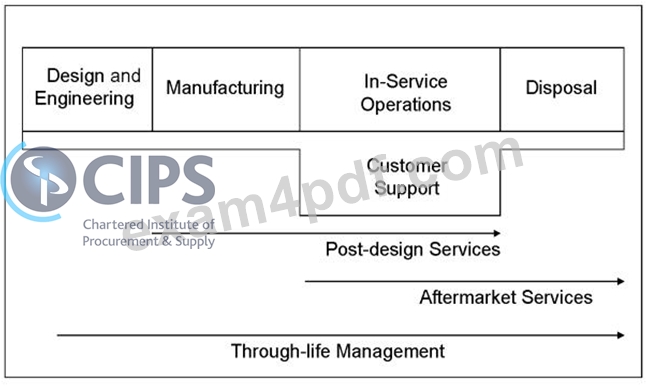
Source: Andrew Graves
With through-life management, buyer not only cares about the physical asset but also other factors like customer services and maintenance.
Reference:
LO 3, AC 3.2
NEW QUESTION 75
When procuring a machinery, at which stage buyer must check whether it is working to the stand-ards set out in the design specification?
- A. Maintenance and repair activities
- B. Customer support
- C. Manufacture
- D. Installation
Answer: D
Explanation:
Through-life Management involves the life-cycle management of the products, services and activities required to deliver a fully integrated capability to the customer, while reducing the cost of ownership for the customer.
Source: Andrew Graves
The installation stage occurs in In-Service Operations. At this stage, the machinery is shipped and installed on the buyer's premises and check to ensure that it is working to the standards set out in the design specification.
Reference:
LO 3, AC 3.2
NEW QUESTION 76
Which of the following is the technology that disrupts traditional retail?
- A. Blockchain
- B. Robotics
- C. Self-Driving Cars
- D. E-commerce
Answer: D
Explanation:
One of the biggest disruptors in retail has been e-commerce. According to a report by IDC, in the month of December 2018, which is also the holiday season in the west, the e-commerce sector globally, has grown by 20 percent.
LO 2, AC 2.2
NEW QUESTION 77
XYZ Ltd is a large supermarket chain which operates mainly in the UK and Europe. Their custom-ers are increasingly concerned about sustainability. Therefore, procurement manager is required to source the products from suppliers who have good environmental performance. Which of the fol-lowing can be an assurance that the supplier has procedures and policies to enhance its environmental performance?
- A. ISO 9001:2015 certificate
- B. ISO 14001:2015 certificate
- C. ISO 13485:2016 certificate
- D. ISO 22716:2007 certificate
Answer: B
Explanation:
ISO 9001:2015 specifies requirements for a quality management system.
ISO 14001:2015 specifies the requirements for an environmental management system that an or-ganization can use to enhance its environmental performance. ISO 14001:2015 is intended for use by an organization seeking to manage its environmental responsibilities in a systematic manner that contributes to the environmental pillar of sustainability.
ISO 22716:2007 gives guidelines for the production, control, storage and shipment of cosmetic products. These guidelines cover the quality aspects of the product, but as a whole do not cover safety aspects for the personnel engaged in the plant, nor do they cover aspects of protection of the environment.
ISO 13485:2016 specifies requirements for a quality management system where an organization needs to demonstrate its ability to provide medical devices and related services that consistently meet customer and applicable regulatory requirements.
Reference:
LO 3, AC 3.1
NEW QUESTION 78
Which of the following problems may be identified as closed problems? Select TWO that apply:
- A. Logistics costs incur a large portion in wholesale prices
- B. Shortage of key medicines in healthcare industry
- C. A cyber attack takes down whole company's IT system
- D. The suppliers don't comply with the company's policy on underage labour.
- E. There are not enough data for procurement analytics
Answer: B,C
Explanation:
Closed problem is something happens that should not have happened. To solve this type of prob-lem, procurement professional should find a way to correct the situation or try to adapt to it. On the other hand, open ended problem is a obstacle to your short-term objective. You will need to overcome this obstacle.
Shortage of key medicines is a situation in which procurement must find a substitution or try to save the current stock.
In case of cyber attack, procurement should find a way to recover the IT system as soon as possible.
Otherwise, 'There are not enough data for procurement analytics' is an open-ended problem be-cause it prevents company to conduct procurement analytics (an objective).
'Logistics costs incur a large portion in wholesale prices': In this situation, logistics costs are hur-dles that prevent companies to reach lower wholesale.
'The suppliers don't comply with the company's policy on underage labour': In this situation, pro-curement should seek ways to help supplier comply with the company's labour policy.
LO 1, AC 1.1
NEW QUESTION 79
A buying organisation may not have technical capability to produce a highly complex specification. Which of the following are sources of information that can be used to create the specification? Select TWO that apply
- A. Name cards
- B. Suppliers' know-how
- C. Industry standards
- D. Constitution
- E. Standard terms and conditions
Answer: B,C
Explanation:
If an organisation doesn't have capability to produce a technical specification, they can draft one based on standards or consulting the suppliers.
Reference:
LO 3, AC 3.1
NEW QUESTION 80
Product development consists of various stages, including planning and analysis, design develop-ment, pre-production, production and maintenance. At which stages the opportunities for cost re-duction will be the greatest?
1. Planning stage
2. Pre-design stage
3. Detail design stage
4. Production stage
5. Logistics support stage
- A. 2 and 5 only
- B. 2 and 3 only
- C. 1 and 4 only
- D. 1 and 2 only
Answer: D
Explanation:
Writing a specification and then procuring and using the product or service has a number of stages. The further on in the process you are, the less potential there is for cost reductions. Therefore, opportunities for cost reduction will be greatest in the two first stages: planning stage and pre-design stage.
LO 3, AC 3.1
NEW QUESTION 81
Which kind of these following costs belong to fixed costs? Select TWO that apply.
- A. The packaging and distribution costs
- B. The annual income tax charged by local authorities
- C. The depreciation of capital inputs
- D. The costs of leasing or purchasing capital equipment
- E. Energy consumption in manufacturing
Answer: C,D
Explanation:
Based on variability, the costs has been classified into three categories, they are fixed, variable and semi variable. Fixed costs, as its name suggests, is fixed in total i.e. irrespective of the number of output produced. Variable costs vary with the number of output produced. Semi-variable is the type of costs, which have the characteristics of both fixed costs and variable costs (Source: Key Differences).
Among above costs, leasing and depreciation are relatively static and do not change if volume of business activities increase or reduce.
Packaging, utilities and annual business rate (tax) are variable costs.
Reference:
LO 1, AC 1.2
NEW QUESTION 82
A company has a lists of items that make up 15% of total spend. These items also do not largely impact on quality of final product. The supply continuity is secured. Which of the following will be the most appropriate managing approach to purchase these items?
- A. Drive down cost based on market competition
- B. Enhance supply continuity
- C. Simplify procurement process
- D. Build partnership with suppliers
Answer: C
Explanation: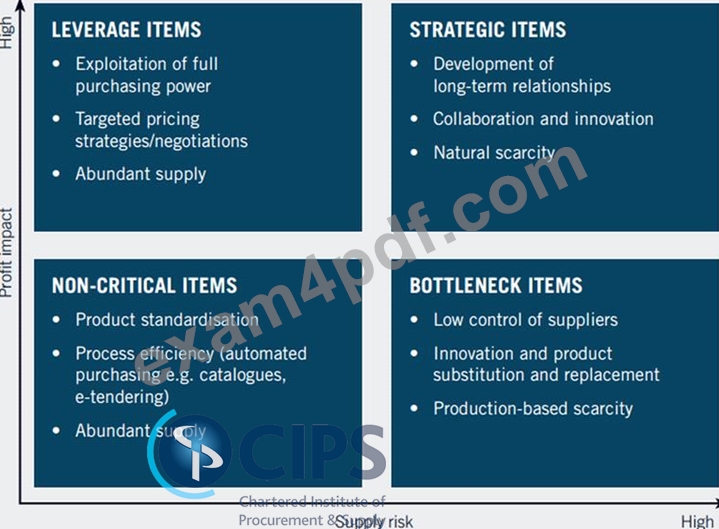
Those items make up small portion of spend and the supply risk is low. So it is tactical item according to Kraljic portfolio matrix. Procurement should bundle these items into larger contracts, simplify procurement process.
LO 2, AC 2.1
NEW QUESTION 83
Which of the following might be the consequences of under-specification? Select TWO that apply:
- A. Additional cost to rework
- B. Few suppliers can supply the full range of features
- C. Unfit products or services
- D. Poor competition between suppliers
- E. Higher cost due to inessential features
Answer: A,C
Explanation:
Main risks involved in an under-specified requirement
* The product or service is not fit for use since it does not match the actual needs
* Higher cost due to corrections or reworks (proposal evaluations, scope or work monitoring, change in insulation materials or systems, reduced productivity, etc.).
* Higher operating cost on many fronts: process control, energy consumption, maintenance, etc.
* Other problems like corrosion under insulation, mold development, safety-related concerns, etc.
LO 3, AC 3.3
NEW QUESTION 84
According to Porter's value chain, which of the following activities is categorised as support activity?
- A. Develop digital SRM technology to manage suppliers better
- B. Distribution of products from factory to retailer
- C. Product warranties and special services
- D. Storage of raw materials
- E. Supervising the production line
Answer: A
Explanation:
Primary activities consist of inbound logistics, operations, outbound logistics, sales & marketing, service.
Second activities consist of firm infrastructure, human resource management, technology development and procurement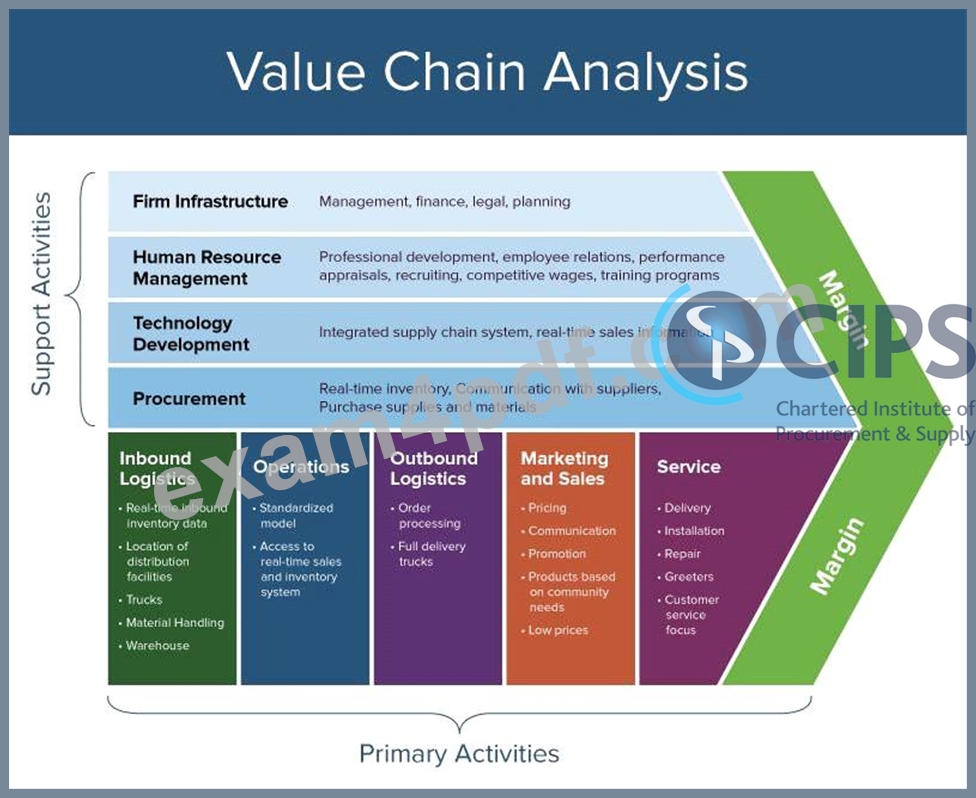
Support activities (also known as secondary activities) include Firm infrastructure, Human resource management, Technology development and Procurement. Developing digital SRM technology to manage suppliers better is Technology development.
LO 1, AC 1.2
NEW QUESTION 85
GE has developed TurboProp engine that is made from over 850 metal parts. These parts are sourced from many suppliers. Value of spend on these parts make up 73% of total spend. Any delay in receiving a part will cause a bottleneck around the production of the engine. Which of the following should be the best course of action of GE's CPO?
- A. Reduce delivery cost
- B. Drive down prices by using market competition
- C. Increase production
- D. Part standardisation
Answer: D
Explanation:
In this scenario, the final product has vast range of parts. The second problem is lacking any part can cause disruption to the production process. So GE has 2 things to do: to reduce the part varie-ties, and secure the supply. Part standardisation is the best option here. It can simplify the range of parts or materials used, and simultaneously, it expands the supply base of GE. If a supplier fails to deliver the part, the company always has other options to replace.
Costs are also a concern, but bottleneck in production imposes a serious risk to the organisation. Driving down costs using market competition cannot be a foremost priority.
Increasing production may help to reduce bottleneck. However, it will also increase the inventory of finished products and unnecessary upkeep costs.
LO 3, AC 3.4
NEW QUESTION 86
In Kano model, which of the following types of requirement should be excluded from the product or service?
- A. Attractive requirements
- B. Reverse requirements
- C. Must-be requirements
- D. Performance requirements
Answer: B
Explanation:
Kano model of excitement and basic quality (Kano et al, 1984; Berger et al, 1993; Matzler et al, 1996) brings a different perspective for the analysis of improvement opportunities in products and services because it takes in consideration the asymmetrical and non-linear relationship between performance and satisfaction. The Kano model classifies customers requirements in three categories (figure 3):
a) Basic Requirements (or Must-be requirement). The basic requirements fulfill the basic func-tions of a product. If they are not present or their performance is insufficient, customers will be extremely dissatisfied. On the other hand, if they are present or have sufficient performance, they don't bring satisfaction. Customers see them as prerequisites. For instance, for luxury automobiles, "air bags" are considered basic. A customer won't feel satisfied if the automobile has "air bag", however he/she will not buy it if "air bag" is not present.
b) Performance Requirements (or One-dimensional requirements). As for these requirements, satisfaction is proportional to the performance level - the higher the performance, the higher the customer's satisfaction will be and vice-versa. Gas consumption in automobiles is an example of these requirements. Usually customers explicitly demand performance requirements.
c) Excitement Requirements (or Attractive requirements). These requirements are key to cus-tomer satisfaction. If they are present or have sufficient performance, they will bring superior satisfaction. On the other hand, if they are not present or their performance is insufficient, customers will not get dissatisfied. For instance, a surprise gift at the end of a dinner in a restaurant will certainly bring satisfaction, but it will not cause dissatisfaction if not offered. These requirements are not demanded nor expected by customers.
Two other types of requirements may be identified in the Kano model: neutral and reverse ones. Neutral requirements do not bring either satisfaction or dissatisfaction. Reverse require-ments bring more satisfaction if absent than if present.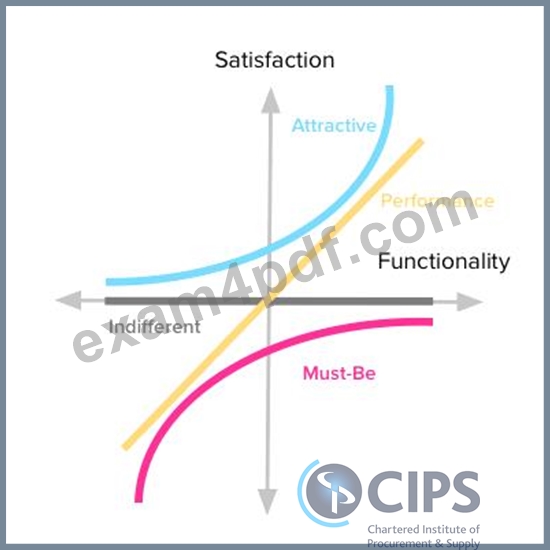
Reference:
- Integrating Kano model and QFD for Designing New Products
- CIPS study guide page 171-172
NEW QUESTION 87
When procuring an IT equipment, at which stage the buyer's expectations are translated into a technical specification?
- A. Customer support
- B. Installation
- C. In-service support
- D. Design
Answer: D
Explanation:
IT equipment is typically linked with through-life contracts. This type of contract not only deal with the specification and the price of a machinery, but also other stages such as design, manufacture, installation, in-service support, decommission and disposal. Among these stages, the design stage is when buyer's requirements are translated into technically correct specification.
Reference:
LO 3, AC 3.2
NEW QUESTION 88
Honda of America Manufacturing is a well established automobile manufacturer. It purchases tens of thousands of materials and parts from suppliers, however, only few of them are strategic. To these suppliers, Honda's procurement manager requires them to send details of labour, materials, overhead cost and profit. However, the suppliers are reluctant to submit such confidential infor-mation. Is the procurement manager's action appropriate?
- A. No, because procurement manager should conduct life-cycle analysis
- B. Yes, because strategies can be introduced for reducing cost and improving the supplier relationships.
- C. Yes, because the procurement manager can get a good insight from the market
- D. No, because no suppliers are willing to show sensitive information on their costs and profit.
Answer: B
Explanation:
With strategic suppliers, the aim should be to work co-operatively with them to find ways of reducing costs to achieve a target cost. It is necessary to work with the suppliers in carrying out open book costing by having first persuaded them of the need to do it. Open book can be used to establish a Target Cost, a Compensation Event value and can eventually be used to ensure the payment of actual costs to an organization. A number of forms of contract cater for this functionality of which only the NEC goes to into any great depth of methodology.
If the suppliers worry about leak of confidential information, procurement team can suggest them to sign a non-disclosure agreement. The buying organisation should also comply with data protection regulations. The Employer / individual responsible for a project's costs should ultimately take a pragmatic and sensible approach with regard to commercially or personally sensitive data provided by the contractor. The primary goal of all open book cost management is to provide Employer comfort and security in the accuracy of commercial data; this effectively means striking a balance between undertaking full audits and blind faith.
Reference:
LO 1, AC 1.2
NEW QUESTION 89
Which of the following is the structured approach for defining customer requirements and translating them into technical specification?
- A. Thomas-Kilmann model
- B. Mendelow's matrix
- C. Quality function deployment
- D. Kano model
Answer: C
Explanation:
Quality function deployment (QFD) is a method to transform qualitative user demands into quantitative parameters, to deploy the functions forming quality, and to deploy methods for achieving the design quality into subsystems and component parts, and ultimately to specific elements of the manufacturing process.
Kano model of excitement and basic quality (Kano et al, 1984; Berger et al, 1993; Matzler et al, 1996) brings a different perspective for the analysis of improvement opportunities in products and services because it takes in consideration the asymmetrical and non-linear relationship between performance and satisfaction. The Kano model classifies customers requirements in five categories: basic requirements, performance requirements, attractive requirements, indifferent requirements and reverse requirements.
Mendelow's Matrix is a tool that may be used by an organisation to consider the attitude of their stakeholders at the start of a project or when they are setting out strategic objectives.
The Thomas Kilmann model identifies two dimensions when choosing a course of action in a con-flict situation, these are assertiveness and cooperativeness. Assertiveness is the degree to which you try to satisfy your own needs. Cooperativeness is the degree to which you try to satisfy the other person's concerns.
Reference:
LO 1, AC 1.2
NEW QUESTION 90
Why should procurement professionals develop business case before seeking approval to purchase capital equipment?
- A. Devising business case may prompt the procurement to consider different options
- B. A business case can be used as a replacement of purchase order
- C. Using business case will prevent new entrants from entering the supply market
- D. Business case is a tool that eliminates all risks associated with the project
Answer: A
Explanation:
A business case is developed during the early stages of a project and outlines the why, what, how, and who necessary to decide if it is worthwhile continuing a project. One of the first things you need to know when starting a new project are the benefits of the proposed business change and how to communicate those benefits to the business.
Preparing the business case involves an assessment of:
- Business problem or opportunity
- Benefits
- Risk
- Costs including investment appraisal
- Technical solutions
- Timescale
- Impact on operations
- Organizational capability to deliver the project outcomes
These project issues are an important part of the business case. They express the problems with the current situation and demonstrate the benefits of the new business vision. Making business case with multiple options and choices also prompts the procurement and senior management to consider alternatives. As a result, the organisation may opt out the best option.
The business case brings together the benefits, disadvantages, costs, and risks of the current situa-tion and future vision so that executive management can decide if the project should go ahead.
Reference:
- CIPS study guide page 19-21
- How to Write a Business Case - Template & Examples | Adobe Workfront
LO 1, AC 1.1
NEW QUESTION 91
Which of the following is a risk to buying organization when using conformance specification?
- A. Buyer may face liquidity risks
- B. Time to produce specification is shortened
- C. Buyer is responsible for product failure
- D. Buyer cannot control the inputs
Answer: C
Explanation:
When using conformance specification, the buying organisation is responsible for the performance of the purchase. If the product fails due to poorly designed specification, the buyer is wholly responsible for it. It cannot blame the supplier for the failure because they still provided 'fit for purpose' product.
'Time to produce specification is shortened': Conformance specification requires details on dimen-sion, materials, design, etc. With such requirements, time to produce a complete conformance specification is often longer than producing performance specification.
'Buyer cannot control the inputs': Conformance specification is a list of inputs from buyer, so buyer has control over the inputs that will make the product. It also means that buyer is responsible for any product failure.
'Buyer may face liquidity risks': Liquidity means that how quick a business turns its assets into cash. This is a financial term, it does not link directly with specification failure.
Reference:
LO 3, AC 3.1
NEW QUESTION 92
What does the acronym RAQSCI stand for?
- A. Regulatory, Availability, Quality, Service, Cost, Innovation
- B. Relationship, Availability, Quantity, Sustainability, Cost, Innovation
- C. Relationship, Ability, Quality, Service, Cost, Innovation
- D. Regulatory, Availability, Quantity, Sustainability, Inventory
- E. Regulatory, Ability, Quality, Service, Cost, Inventory
Answer: A
Explanation:
RAQSCI stands for Regulatory, Availability, Quality, Service, Cost, Innovation.
LO 1, AC 1.1
NEW QUESTION 93
Which of the following are typically included in a conformance specification? Select TWO that apply.
- A. Brand name
- B. Product functions
- C. List of outcome
- D. Packaging requirements
- E. Product dimensions
Answer: D,E
Explanation:
A conformance specification is a specification that defines the technical and physical characteristics and/or measurements of a product, such as physical aspects (e.g. dimensions, colour, and surface finish), design details, material properties, energy requirements, processes, maintenance requirements and operational requirements.
On the other hand, performance specification typically includes list of output or outcome or func-tional requirements. Brand name can be a part of performance specification because brand is a re-minder of quality that customers remember. For example, when talking about Roll Royce, people will think about an elegant car.
Reference:
LO 3, AC 3.1
NEW QUESTION 94
XYZ Ltd is producing an engine which consists of many components. The procurement manager wants to find cost reduction opportunities and minimise part varieties. Which of the following may help her to achieve these objectives?
1. Value analysis
2. Segment analysis
3. Variety reduction
4. Standardisation
- A. 3 and 4 only
- B. 1 and 4 only
- C. 2 and 3 only
- D. 1 and 3 only
Answer: B
Explanation:
Value analysis is often defined as a systematic process for improving the value of a product, service or project. It is typically used in the following ways:
- To determine the value of each component used
- To find cost reduction opportunities by optimising the components used Segment analysis helps procurement and supply to shape and manage the supply markets.
There is no concept known as Variety reduction.
Standardisation is the process which is used to reduce varieties of products or parts.
In this scenario, the company's objective is cost reduction, then value analysis or value engineering is more likely to be applied. Also the company aims at reducing variety, standardisation can be combined with value analysis to produce the best results.
LO 3, AC 3.4
NEW QUESTION 95
......
CIPS L4M2 Exam Syllabus Topics:
| Topic | Details |
|---|---|
| Topic 1 |
|
| Topic 2 |
|
| Topic 3 |
|
| Topic 4 |
|
| Topic 5 |
|
L4M2 Dumps To Pass CIPS Level 4 Diploma in Procurement and Supply Exam in One Day: https://www.exam4pdf.com/L4M2-dumps-torrent.html
100% Guaranteed Results L4M2 Unlimited 147 Questions: https://drive.google.com/open?id=1cHZk_5qUPzwdvSJa8LzlWwI96Jvb9WG0
